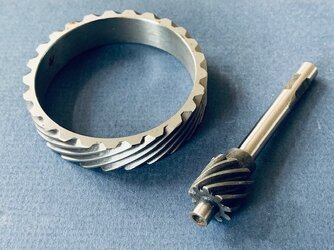
ND Speedo

With the ends of the cable being chewed up, I suspect that's your problem. The cable inner should have clean square ends on it. It seems to me that the only way the ends could get chewed up is the cable not engaging properly. Maybe the inner was always a bit too short.

Do a simple diagnostic test before you pull the wheel apart. Put the bike on its centre stand and use a chock or jack under the engine to lift the front wheel off the ground. Spin the front wheel. If the little cable drive pinion rotates then your worm drive is most likely OK. Just to be sure it'll handle the friction load of the cable without jumping teeth, find something like a small screwdriver that'll engage in the square hole in the cable drive pinion and put a bit of resistance on the gears with your hand.

The speedo has already tested OK. If you confirm that the bottom end is OK, then it can only be the cable.
I'll give that a try later today - work is interfering with my diagnostics here :)
 
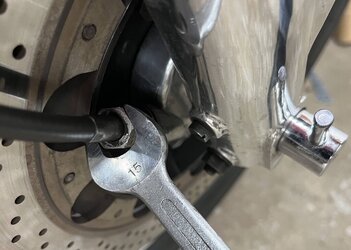
Have you ever noticed that the gearbox end cable has a hexagon that fits a 16mm spanner quite well? (its not 16mm its an imperial size) and a flat has to be square with the disc to avoid contact, its imperial, a hex of 17mm would foul.
CLEM

I will wager that I will suffer by posting this.
Suffer away, Clem!
15 All!
A 16mm would surely round off the alloy nut.
It's a 15mm spanner that fits the drive end of my OEM speedo cable.

Speedo Drive Cable End 15mm.jpg
 
Last edited:
its the cable as Cam says,pattern cables very often do not engage far enough its that simple, I have had 3 from the same supplier (2 of them custom made with a speedo gearbox and clock cluster on their bench at £80+ and all of it money wasted) and none of them engaged, a NOS cable from an ex dealer who was aware if my problem solved this. Genuine NOS, the plating was fairly tarnished, like that bothers me! plus he gave it to me, a true gent, thank you Mr Bell.

What is not generally known is that the gearbox end of the cable is imperial, steming back from SF days when they used Smiths (ie imperial) clocks, the clock is metric, the crimped on squares are not the same, but pattern parts may well be, have you ever noticed that the gearbox end cable has a hexagon that fits a 16mm spanner quite well? (its not 16mm its an imperial size) and a flat has to be square with the disc to avoid contact, its imperial, a hex of 17mm would foul.
CLEM

I will wager that I will suffer by posting this.
I am hoping this is just the cable - cheapest, easiest fix....more diagnostics to do.
 
840 mm for Marzocchi forks from a well known UK retailer......last one on the shelf evidently! :giggle:

To be fair there was nothing wrong with the cable but the square drive seemed a lot smaller than my worn gear drive apeture.
 
Last edited:
its the cable as Cam says,pattern cables very often do not engage far enough its that simple, I have had 3 from the same supplier (2 of them custom made with a speedo gearbox and clock cluster on their bench at £80+ and all of it money wasted) and none of them engaged, a NOS cable from an ex dealer who was aware if my problem solved this. Genuine NOS, the plating was fairly tarnished, like that bothers me! plus he gave it to me, a true gent, thank you Mr Bell.

What is not generally known is that the gearbox end of the cable is imperial, steming back from SF days when they used Smiths (ie imperial) clocks, the clock is metric, the crimped on squares are not the same, but pattern parts may well be, have you ever noticed that the gearbox end cable has a hexagon that fits a 16mm spanner quite well? (its not 16mm its an imperial size) and a flat has to be square with the disc to avoid contact, its imperial, a hex of 17mm would foul.
CLEM

I will wager that I will suffer by posting this.
Pretty sure they were 15mm Clem... just measured them on wifeys' 500 with OEM cables. A 16mm hex can indeed foul the front hub if a flat cannot be positioned accordingly. I recall the thread as being M12x1, but not entirely sure.

With 5 as numerator, an imperial fraction is about as spot on as you could wish with a metric size, ie, 5/32" = 4mm, 5/16" = 8mm and 5/8" = 16mm. No great coincidence that both an imperial and metric spanner fit the same hex, 14mm fits 9/16" nicely, 28mm = 1 1/8", etc, etc.

Instead of re-inventing the wheel, Smiths simply continued with metric threads when they bought a big stake of the british branch of Jaeger and started producing their instruments in the 1920s.

piet
 
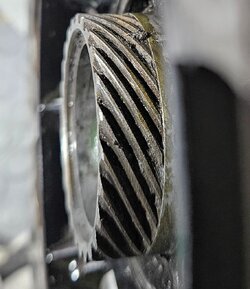
Ok - finally got to work on this again. I followed dellortoman's, test suggest which pretty much convinced me that the problem was in the wheel drivers. So pulled the wheel and removed the drivers. Thanks to Schurminater's warning and scary pictures and sfcpiet's advice I was able to get the bushing and driver out with penetrating oil, heat, a gentle hand and patience without damaging anything.

The driver is badly worn, and as The Sock suggest some razor sharp worn edges. Definitely needs replacing. The driver on the wheel is in much better shape and much less worn - in comparing to The Sock's pictures on new ones, doesn't seem too badly worn. I have a hard time figuring out how bad it is. Although I guess replacing both is the safest path (and a new cable as well, I guess). How big a deal is it to remove from wheel - doesn't look like you can grab it with a gear puller....

As always and advice appreciated.
20240415_182551.jpg20240415_165505.jpg20240415_165727.jpg
 
The drive gear looks perfectly servicable. As these gears are not fitted to close tolerances, it shouldn't pose a problem to replace only the driven gear. These are few and far between and quite expensive, unfortunately. I think repros are available in Italy, possibly through Riccardo Oro or Guiseppi Andrighetto.

The drive gear is shrink fit to the wheel hub, a very close fitting puller is required to get it off without damage.

The wear on the driven gear is most certainly caused by excessive friction somewhere in the drive to the speedo. This could be the cable or the drive gearbox itself, due to lack of lubrication (which would be the best case), or in the worm drive inside the speedo head. This can wear to the point that it can effectively jam and place excessive pressure on the drive gears through the cable. Surprisingly, the cable stands up to this abuse for quite some time before finally giving up. Stick a small screwdriver in the speedo and give it a few twirls. If it turns smoothly for about 20-30 turns in sucession, all should be well. If the worm drive is worn, the screwdriver will require increased force to be turned after 5-10 rotations (always turn in one direction, not back and forth), time for a speedo overhaul. If this is the case and not attended to, a replacement drive gear at the wheel hub will fail very quickly, irrespective of lube, cable condition, etc. Don't ask me how I know...

piet
 
Good news and bad news:
Bad news first.
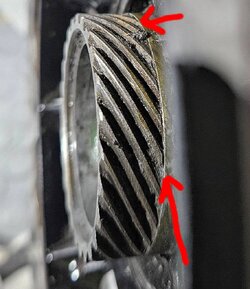
Unfortunately, the puller only works on the cast wheels, where the gear sits proud of the hub. This allows the puller to grip the back of the gear, to pull it off.
On the wire wheel, the gear and the hub are the same diameter (arrowed) preventing the puller from getting any purchase.

20240415_165727.jpg

And now the good news:
Looks like the ring gear has been replaced, already.
So, a new, or good second hand worm gear should see you right.
Try Alan Bell, Alan James on here, and the usual suspects, inc. fleabay.
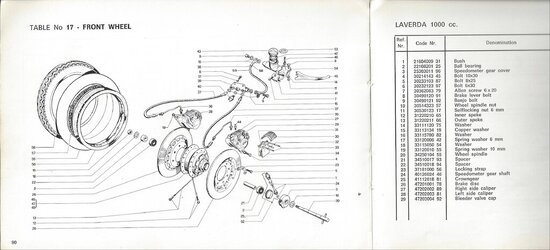
Make sure you have the thrust washers in place, top and bottom, (24 in illustration), when you re-assemble.

Laverda Handbook Page 90 Front Wheel Parts.jpg
 
Thanks for the reassurance on the ring gear. There was only a single thrust washer (top)
when I removed the worm gear.....that could be part of the root issue. Wolfgang is in Germany right now, and DAM who I've order from before is out of stock.

I'll reach out to the "Alans" you mentioned and start a search - I think Laverda-Paradies may have it - but definitely more expensive to here in the states. Any other sources would be welcome.

barry
 
Problem with that is the clamping force is squeezing on to the hub, from which, you want to pull it off.
Much easier to carefully grind the ring gear, at right angles to the axle, until a section is paper thin. Then tap it on the inside edge, where it sits proud of the hub, and the gear will split.
Job's a good un!
 
I
Problem with that is the clamping force is squeezing on to the hub, from which, you want to pull it off.
Much easier to carefully grind the ring gear, at right angles to the axle, until a section is paper thin. Then tap it on the inside edge, where it sits proud of the hub, and the gear will split.
Job's a good un!
I did just this with my SF/ Dremel cutting disk is ideal.
 
Problem with that is the clamping force is squeezing on to the hub, from which, you want to pull it off.
Much easier to carefully grind the ring gear, at right angles to the axle, until a section is paper thin. Then tap it on the inside edge, where it sits proud of the hub, and the gear will split.
Job's a good un!
Why would the OP want to destroy a perfectly usable ring gear?

As stated before, tolerances are not critical, no problems running a new gear on an old one.

An alternative would be to grind 2 or 3 recesses to accomodate a 2- or 3-arm puller. As the driven gear engages on the outer half of the ring gear, a couple of missing sections on the hub side won't be at all detrimental. Once it is off, the ring gear could be modified to accept the factory (or similar) puller.

piet
 
I think I used a firmly tightened hose clamp over cardboard to create enough lip to use a puller for removal of the ring gear.
Problem with that is the clamping force is squeezing on to the hub, from which, you want to pull it off.
Much easier to carefully grind the ring gear, at right angles to the axle, until a section is paper thin. Then tap it on the inside edge, where it sits proud of the hub, and the gear will split.
Job's a good un!
Why would the OP want to destroy a perfectly usable ring gear?

As stated before, tolerances are not critical, no problems running a new gear on an old one.

An alternative would be to grind 2 or 3 recesses to accomodate a 2- or 3-arm puller. As the driven gear engages on the outer half of the ring gear, a couple of missing sections on the hub side won't be at all detrimental. Once it is off, the ring gear could be modified to accept the factory (or similar) puller.

piet
There's absolutely no reason the OP would want to destroy a perfectly usable (as I advised in post #30, above) ring gear, Piet.
My response #37 was in context of posts #35 & 36, as would be clear if read in order, as it was to Robin in post #38.
 
Back
Top