

Hello all
Shed space during the winter is not sufficient. Fortunately I have a very understanding wife (and it is her Monster )
)
I intend to modify the SFC with more modern brakes, rubber etc and lower the weight, but keeping the overall appearance quite original.
Like the 916 it will be a road bike that I will take to the racetrack once in a while.
For the weight reduction I would like to know the present dry weight. Aiming point, when completed, would be a dry weight just below 200 kg, and now it gets a bit tricky:
Our bikes are not exactly lightweight. How I managed to jumpstart my former RGS (alone and with luggage, when starting a trip to Southern Europe) is still a mystery to me. A lot of it is technique and I was quite a bit younger as well!
The term dry weight is used very differently by various company’s: Some will give the weight without any fluids at all, and some will even not include the battery weight. In my mind (and the value I want to use as a reference point), dry weight is the bike ready to go, but with an empty fuel tank. The figure I have seen most often is 238 KG / 524,7 LBS. Trouble is that I don’t know what’s included in that number.
Therefore some fool (yours truly) attempted to put one wheel at a time on a bathing scale while putting the other wheel on a piece of wood to have the bike level.
DO NOT TRY THIS AT HOME!- especially if you are alone and recovering from a mild stroke with poor balance. The eagle eyed can see the scar on the passenger seat hump. Later on my wife helped and I got a number.
For the time being I will keep that figure to myself.
A lot of explanation leading up to my question: Have any of you guys any precise measurements of the weight of the 1000 SFC?
Best regards
Niels
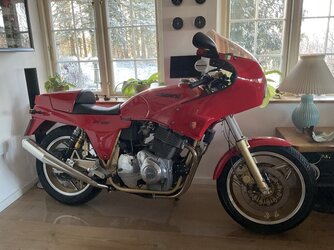
Shed space during the winter is not sufficient. Fortunately I have a very understanding wife (and it is her Monster
)I intend to modify the SFC with more modern brakes, rubber etc and lower the weight, but keeping the overall appearance quite original.
Like the 916 it will be a road bike that I will take to the racetrack once in a while.
For the weight reduction I would like to know the present dry weight. Aiming point, when completed, would be a dry weight just below 200 kg, and now it gets a bit tricky:
Our bikes are not exactly lightweight. How I managed to jumpstart my former RGS (alone and with luggage, when starting a trip to Southern Europe) is still a mystery to me. A lot of it is technique and I was quite a bit younger as well!
The term dry weight is used very differently by various company’s: Some will give the weight without any fluids at all, and some will even not include the battery weight. In my mind (and the value I want to use as a reference point), dry weight is the bike ready to go, but with an empty fuel tank. The figure I have seen most often is 238 KG / 524,7 LBS. Trouble is that I don’t know what’s included in that number.
Therefore some fool (yours truly) attempted to put one wheel at a time on a bathing scale while putting the other wheel on a piece of wood to have the bike level.
DO NOT TRY THIS AT HOME!- especially if you are alone and recovering from a mild stroke with poor balance. The eagle eyed can see the scar on the passenger seat hump. Later on my wife helped and I got a number.
For the time being I will keep that figure to myself.
A lot of explanation leading up to my question: Have any of you guys any precise measurements of the weight of the 1000 SFC?
Best regards
Niels
Last edited:


 Me too, lets put their washing machines outside, that should get the conversation started.….. are you interested in sharing a house together?


