New member and thanks...

The only holes coke should ever go is up the nose. Put that shit up your arse  Shocked and your ring will be 'so solven', you can't use it!

I generally drink the stuff, with ice and perhaps a slice of lemon.  Am I doing it wrong?
 
Hi Bob and welcome to this forum.
I swing bothways, having a twin and triple (Brit one) myself :D
You will get expert advises here, no doubt.
Why don't you take pictures and publish them here as you progress with stripping the mill.

Haakeik

 
Welcome to our little nuthouse, Bob!

There are actually quite a few triple owners here that know their way about the twins, unlike a certain twin owner that knows fuck all about triples... :D

Carefully disassemble your engine to evaluate the damage, pics tell a 1000 stories, and we're all, well most of us, willing to help as much as we can.

The engine is easy to work on (but the kitchen table will be ruined by the weight and all those scratches, the missus'll kill you), very little in the way of special tools is required to do a sound job.  Consumables are all available from the usual suspects, most vital bits can be sourced as well, some do have their price though.  I get derelict engines (twins AND triples :D) pulled from barns on my workbench every second week, most can be salvaged without the need for replacing many major bits and pieces.  Guess rust will be your biggest enemy!

Please let us know how you get on.

Cheers,
piet

 
sfcpiet said:
Welcome to our little nuthouse, Bob!

There are actually quite a few triple owners here that know their way about the twins, unlike a certain twin owner that knows fuck all about triples... :D

Carefully disassemble your engine to evaluate the damage, pics tell a 1000 stories, and we're all, well most of us, willing to help as much as we can.

The engine is easy to work on (but the kitchen table will be ruined by the weight and all those scratches, the missus'll kill you), very little in the way of special tools is required to do a sound job.  Consumables are all available from the usual suspects, most vital bits can be sourced as well, some do have their price though.  I get derelict engines (twins AND triples :D) pulled from barns on my workbench every second week, most can be salvaged without the need for replacing many major bits and pieces.  Guess rust will be your biggest enemy!

Please let us know how you get on.

Cheers,
piet

Piet,

I'm not overly convinced that he knows very much about twins either!

James
 
Welcome to the nuthouse Bob. I got my triple in much the same condition as yours.Go ahead and take the engine all the way out as the others have said.You know once the engine is usable the rest of the bike will need to be brought up to standard too. I went through the same discovery process looking to see why mine was seized up.Had to drill holes around the piston crown and break the top through so I could saw the skirt in three places to get the #2 piston free. That allowed me to realize the crank was rusted solid. The nicest part is how available and reasonably priced parts are. Wolfgang is almost a ones stop shop when it comes to what you require,and wonderful to deal with too!
As far as any technical or general meaning of life questions you might have,all the answers are right here on the forum.
 
I'm not overly convinced that he knows very much about twins either!

James

I feel sorry for you. All you do is Bait and Bully and offer no concrete info in this forum. Keep digging and you'll discover - There ain't NO Way Out and I'm sure most members here already know that.

Ron
 
After much work finally got the cylinder head off.
Used a Dremel to grind through two cam chain rivets to remove the chain. Easy enough.
The cam chain cog still did not want to turn.
The head did not want to lift off the cylinder. More penetrating oil and heat. Stuck.
I didn't want to pry on anything and ruin any of the beautiful cast fins.
Devised using a nut on the rear stud to gradually open the joint.
xt43.jpg


The head finally came up and found a corroded big stud and tight fits on the studs near the spark plugs.
The head was a tight fit when removing. Brilliant design on the front fins to just clear the fender!
73qj.jpg


Head off for inspection. Uh-oh!!
aldi.jpg


The valves are stuck in the guides. That's why the cam chain wheel wasn't turning.
I need to make a tool to remove the rocker spindles. I was able to use a valve spring compressor to get the
collar keeper off which allowed a drift to knock the valves out for cleanup.
Really ring pocketed seats. The bike was running when parked so the heads must be really sturdy.

More to report after clean-up.
The pistons/cylinder bores are soaking.

 
Any recommendations for removing the hard carbon deposits in the head?
Any chemical products advised?
I've used metal scrapers and rotary wire brush on British bikes.

The combustion chamber and valve seat layout on the Laverda looks quite different from
similar vintage Brit bikes. The valve seats kind of 'hang out'.
Was the Laverda head/valve design unique at the time? 
 
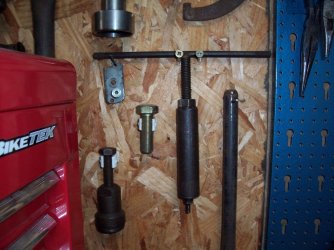
Hi Bob - Here's a shot of the extractor I made many years ago - not dissimilar to works one. you can use a long 6mm bolt or studding and a socket instead. Cast iron "skull" is common on many Laverdas. - regards - Phil
 

Attachments

  • spindle exct.jpg
    spindle exct.jpg
    148.5 KB · Views: 25
I made a tool like Phil mentions, a length of copper pipe that fits over the pin (cut square with a pipe cutting roller), a strong washer and some threaded bar. I use a 6mm stub for the pin, welded to a length of 8mm for the nut to work on, but 6mm all the way will do it.
Heat the head up a bit (a paint strip gun works great) for removing or refitting pins, cams etc.
Be very careful who you allow to touch up your valve seats, they are part of the cast skull and a heavy hand could have you fitting separate seats unnecessarily. Give them a lap with valve paste to assess their state first. And be extremely careful of who gets the job if you need to replace guides.
And get that bloody motor out of your frame NOW!! You are certainly not going to reassemble it like that so the sooner the easier :-)
 
Wow! That is one seized mill and you say it was running before stored -Stored where - Sish!

Heat the head up a bit (a paint strip gun works great)

Heat helps immensely.

I would soak the Head in a bucket of Diesel Fuel for a few days before attempting to dissemble it.
 
At around 400 degrees you are bloody close to the annealing temperature of alluminium, far too hot. Give the head a light warm with a blowtorch, 100 - 150 degrees is plenty warm enough the spindles and cam bearings are only a light interference fit and they draw out fine without excessive temperature.


      Keith
 
400?F methinks.
You talking about ?C?
400?F = 204.444?C.
Approximately.
 
Bob Z. said:
Any recommendations for removing the hard carbon deposits in the head?
Any chemical products advised?
I've used metal scrapers and rotary wire brush on British bikes.

The combustion chamber and valve seat layout on the Laverda looks quite different from
similar vintage Brit bikes. The valve seats kind of 'hang out'.
Was the Laverda head/valve design unique at the time?   

No, not at all.

Several small Honda twins of the 60's (the ones that caught Massimos' imagination) also used the skull construction.  Probably others as well (that I don't know of).

Glass bead blasting will clean it up nicely.  Not much you can do about severe rust pitting, but I've seen worse that came out quite reasonable.

piet

 
Back
Top