New tool / toy

Cheap and sweet - the old man didn't have much of a palate for wines. If it burned on the way down, that would do him.
My father was an old masters man ! As a teen I did a fair amount of damage with their fortified wine that they couldn’t call port.
 
I've been around sailing boats most of my life, but nothing like the stuff Todd is into. My boat is only 35 ft long and it has a big clunky old aluminium mast that's about as bendy as a telegraph pole. It's not even tapered. Certainly not big enough to crawl up inside it!

Here's my old-timer's rig tuning recipe: Set the mast in the boat so it's straight, vertical and the shrouds are not much more than finger tight. Go out for a sail on a windy day when full mainsail and genoa are almost too much sail. Drive the boat hard and tighten up the turnbuckles until the leward shrouds aren't flopping around loose, after each adjustment, re-check that the mast is roughly straight on both tacks by eyeballing the sail track up the mast. That's pretty much it.

Alternatively, borrow someone's rig tensioning device and do it the easy way. :)

I did break an aluminium boom once. And no, it didn't go "boom" when it broke.
 
I never cease to be amazed at the non-Laverda related knowledge & expertise occasionally revealed here. I mean - who knew tuning a mast was a thing??
Can only echo Quentin's 'fark me - spectacular boat' and Greg's 'Wow' comments! 🤯
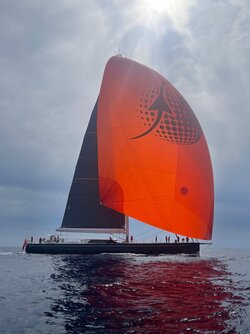
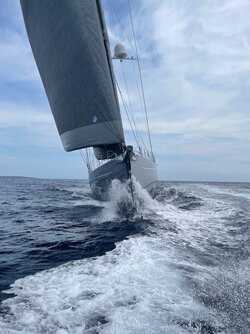
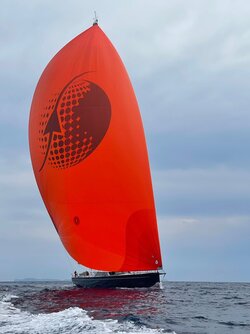
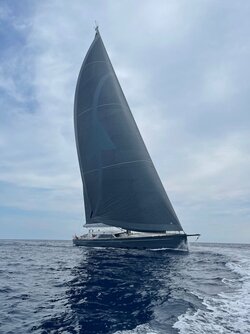
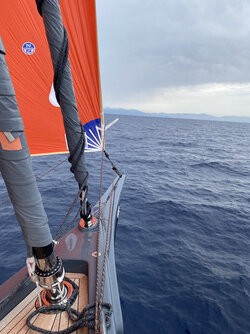
This is the project I have just finished, I spent the best day sailing on her Monday, we reached along at 17 kts in 12 kts of breeze , as usual for a new bus, there was a photo shoot with her, where they like to show a 46 meter boat can be sailed by 2 people, with the rest of us hidden down below during photo time. Where you can see us on deck , photo time is over. There is about 4000 meters of my running rigging onboard. She is off to Monaco for the yacht show that starts next wednesday. I love my job


Attachments

  • 3366b66b-c3b2-4cbe-ac3b-7edb2513d48f.jpg
    3366b66b-c3b2-4cbe-ac3b-7edb2513d48f.jpg
    107.6 KB · Views: 32
  • 63b14f53-38d0-4b75-b890-26a9922b2c68.jpg
    63b14f53-38d0-4b75-b890-26a9922b2c68.jpg
    159.8 KB · Views: 32
  • 41146927-4d66-4d59-b44d-0be5ca47fda0.jpg
    41146927-4d66-4d59-b44d-0be5ca47fda0.jpg
    87.8 KB · Views: 30
  • 53cf8bf9-5096-411e-acee-486f2e234fba.jpg
    53cf8bf9-5096-411e-acee-486f2e234fba.jpg
    108.6 KB · Views: 32
Some people have too much money 🤑 and I'm jealous.

I've never seen 4 roller furlers in front of a mast before. Let me guess ... Working from the bow back: Big genoa up front, then a #2 genoa, an inner staysail and a storm jib closest to the mast? Looking at all that gear, I can see where some of that 4km of running rigging went.
Hi Cam from front to back, we have a code zero, then blade ( outer jib) then inner jib and then stay'sl . Normally you wouldnt leave a code zero up when not in use, but as its such a big sail and the owner likes sailing with it, the idea was to keep this one on the halyard lock almost all the time, so its easy to deploy. They are a bit ungainly to handle if you have to keep hoisting and dropping them. The furlers are all below deck, so everything looks very smooth , you can see from this photo how unobtrusive the furler for the code sail and the blade are, its pretty cool having a bow sprit on boats this size too, which means we get a bigger kite, and there is less of a clusterfuck at the bow and the mast head
 

Attachments

  • IMG_9563.jpeg
    IMG_9563.jpeg
    182 KB · Views: 20
That's neat having the furler drum below deck. I'm guessing they're powered in some way (electric or hydraulic) unlike my human-powered genoa furler. So what's that drum at the bottom of the 2nd (blade) furler with the white rope around it?

What happens when you tack the code zero? Do you have to roll it in then unroll it again after you've passed through the wind?

Excuse my ignorance, I've never sailed on a millionnaire's boat. I'm from the era when sailing boats meant getting blisters on your hands from pulling on ropes, and a hand operated winch was considered a luxury.
Aargh, where's me eye patch. Pass me the hemp yarn and serving mallet.
 
Cam, the first Tassie trip we did had us arrive at some stunning white sand beach that had a stunning Beautiful huge sailing boat moored there. We found out later it was fully Carbon Fiber technical marvel owned by some Russian Billionaire. There should be an amazing pic of that boat somewhere posted on this site somewhere.
 
That's neat having the furler drum below deck. I'm guessing they're powered in some way (electric or hydraulic) unlike my human-powered genoa furler. So what's that drum at the bottom of the 2nd (blade) furler with the white rope around it?

What happens when you tack the code zero? Do you have to roll it in then unroll it again after you've passed through the wind?

Excuse my ignorance, I've never sailed on a millionnaire's boat. I'm from the era when sailing boats meant getting blisters on your hands from pulling on ropes, and a hand operated winch was considered a luxury.
Aargh, where's me eye patch. Pass me the hemp yarn and serving mallet.
I see you aargh, getting in the spirit of, aargh, International Talk Like A Pirate Day me heartie - that's tomorrow, aargh! Where's me parrot?

Aargh, bazzee-aargh
 
That's neat having the furler drum below deck. I'm guessing they're powered in some way (electric or hydraulic) unlike my human-powered genoa furler. So what's that drum at the bottom of the 2nd (blade) furler with the white rope around it?

What happens when you tack the code zero? Do you have to roll it in then unroll it again after you've passed through the wind?

Excuse my ignorance, I've never sailed on a millionnaire's boat. I'm from the era when sailing boats meant getting blisters on your hands from pulling on ropes, and a hand operated winch was considered a luxury.
Aargh, where's me eye patch. Pass me the hemp yarn and serving mallet.
Yup for the code zero we furl her in and out. You still get blisters off the sheets when trimming and when doing anything else with these big boats when racing. Broken bones aren’t unheard of either, a good friend of mine got hit by a lazy jib sheet taking up the load when the working sheet snapped( not my work!!!) He was thrown 12 meters in the air and hit the mast with his head, the blood stains on the mast told us that, he broke 6 ribs, broken collar bone and shoulder blade, fractured skull, punctured lung, burst spleen, tore his liver broken arm and shattered wrist, He survived and races to this day .The sheet loads loads are so high in comparison to little boats that you have no chance of trimming the kite or code sail by winch handle, let alone a jib sheet at 18 tons working load. . The code sheets on this one are 24mm OD, the clew load when coming in hot is 8 tons. There is still plenty of work for hands up forward where I work when racing. It takes 6 of us to set up the kite for deploying , 6 to drag it forward far enough to plug in the tack. We get as many as we can when dropping the kite and we have it packed up wind in about 9 minutes. Which is amazing when you are heeled over at 25 degrees smashing through waves ( in St Barth’s) Just the kite weight alone is about 250kg dry, when wet it’s a load more, and around 1600 square meters in size, it’s luff is 64 meters. Despite hydraulics and electrics being used, sailing big boats as fast as you can is a real kick. 🏴‍☠️🏴‍☠️🏴‍☠️🏴‍☠️🏴‍☠️🏴‍☠️🏴‍☠️🏴‍☠️🏴‍☠️🏴‍☠️🏴‍☠️🏴‍☠️A Pirates life for me.
 
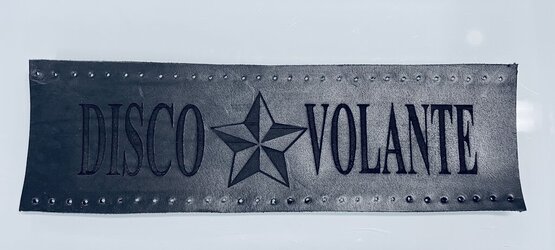
I’ve been using the laser for loads of things at work. First photo is the name and logo for a boat having hand leathered mooring lines done with us. This was the test section on the leather to make sure I had the right laser settings , speed , power and hz. We hand cut the leather and hand punch the holes for stitching . The leather then gets soaked in water for a few days and then hand stitched on the mooring line. The leather is cut under size , so when it’s wet it stretches and when it sets after stitching, it doesn’t move. The lengths of leather we cut are normally about 1.4 meters long , most mooring lines we do are 36 through 60 mm od.

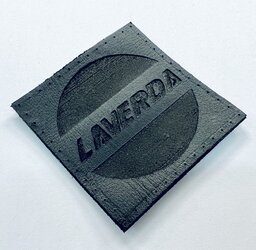
I had a wee play as well , and lasered up a Laverda patch. It came out quite nice. The patch is laser cut around the edges and the holes are cut with the laser as well . This was a bit of a test., it just doesn’t look as nice as hand cut or as nice as hand punched holes.
But I do like the laser for the logos on leather.
 

Attachments

  • 20ABF704-E201-4D6D-9234-916DF0B6AF81.jpeg
    20ABF704-E201-4D6D-9234-916DF0B6AF81.jpeg
    101.6 KB · Views: 22
  • 3A4EF29E-9BA6-4771-AC60-41AB217D8AD8.jpeg
    3A4EF29E-9BA6-4771-AC60-41AB217D8AD8.jpeg
    230.8 KB · Views: 22
Todd, what do the fumes that give off when lasering leather smell like? I’m thinking rib eye on the bbq.
I wish …. More like burnt hair. But I I run an extractor fan by it with a carbon filter which gets rid of most of the odour.
Titanium smells very pleasant when hit with the laser
 
Back
Top