Newbie jetting questions

When swapping the fork legs, they're often just that... with the spacers that were fitted prior.  In that case, the brake calipers will not be centred over the discs.

In stock form, with the axle inserted from the RH side, there is a gap of ca. 1-1.5mm between speedo drive gearbox and slider, the entire wheel/axle assembly is pulled rigidly to the LH slider by the axle nut.  Both sliders are then clamped to the axle.

With swapped sliders and the axle inserted from the LH side, the gap closes up when the nut is tightened, pulling the wheel to the right.  A spacer needs to be inserted between speedo drive and slider and the LH spacer shortened by a gnats whisker to restore correct spacing.

All that may not sound much, and might even have no effect at all with worn brake pads.  But, it may seriously jam the brake when new pads are installed.  No fun having a brake disc explode due to overheating!

It took the factory another couple of years to have dedicated fork sliders made,  trailing calipers with axle inserted from the RH side.

I've  found all sorts of mis-aligned front and rear ends, very hard to comprehend mostly. ::)

That instrument bracket used to be a Laverda part. :D

Mystery part is indeed steering stop, even the correct one for your fork yokes.

piet
 
doublegarage said:
Thanks for the close-up top clamp picture.  That explains it then, i don't have the handlebar clamp bases on mine.  I don't think they've been ground down so it must be a clamp from a different Marzocchi-equipped bike.  My clock mounting plate has been modified (or of course it's a clamp from a different bike..) to remove the top-clamp radius for the handlebars (see side-shot attached) and also re-radiused to clear the nut - which is tall and has a hole through it, I suppose for the tank-breather tube on a different bike. I'm not crazy about the top clamp having been drilled in 4 places to accept the 4 clock-mount screws either.  I need to contact this Wolfgang!

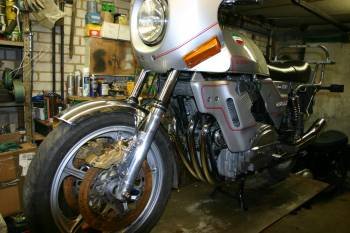
The front axle is definitely inserted from the left on this bike. how much should I worry that it's wrong? I'll take the wheel off and look at spacing as Piet recommends.  Does it matter that the calipers have swung around?  I can't think of a reason why it would, but...

Also just sorting through the
parts stash and cannot identify the mystery piece in the attached pic.  Anybody? (Edit: ohh suddenly it looks like lockstops..)

Thanks to all for the help - the jets will be here next week and I promise to get back to jetting issues asap.

It does look like a very nicely modified clock holder (done very professionally). It is that nice that it would be definitely worth keeping.

Don't worry about the caliper location unless you have a bowl of rivets and you need them counted. The calipers to the rear are simply a different way to mount them and if you are racing and need an extra .001 seconds per lap then they may be just fine. It is your choice.

Correct ....... part of the steering stop.

Jim
 
Richard, you don't have to run on Californian ethanol fuel. I'm up in Sonoma and have found a local airfield that sells non ethanol fuel ( obviously ) for aircraft. More expensive per gallon, but in overall $$ terms, a low cost given the number of miles run. ALEX
 
Piet, I will take the wheel off and study the axle setup this weekend - there may be pictures.
Alex, thanks yes I always look at the pumps when I visit Sears Point and wish there was a racetrack nearer to me. A couple of old cars I have would benefit from a tankful too.  I have no airfields very close either but might be worth an experiment one day.
Jim, yes it's nicely modified, definitely a keeper. I was told the tank was modified by Dennis Etcheverry (sp?) in Berkeley who is a lovely bloke and the person you take your Italian crankcases to when a conrod bursts through them - only to say, the quality of the metal-working on the bike seems generally pretty high.

-Richard
 
I had exactly this off centre reversed calliper thing, with a set of adapters supplied by Red, but around the other way, since his preference is for them to be behind the legs and mine is for in front, I had to shim the callipers off the legs to get them directly above the discs, very fiddly to bolt it all up, but required with new pads, when they wear down a bit I cant be arsed and bolt them up without the shims, a shame (though) that the pads are about 3mm above the discs leaving an unworn section of pad, which has to kept an eye on otherwise if they wear down greatly the pads will collide and offer no braking, never happened, they last ages and ages, once a year iI polish off the unworn bit, so far three times, pads still look nearly new.

Just for Red, a different pic, not the same old, same old.
CLEM
 

Attachments

  • front end.jpg
    front end.jpg
    18.3 KB · Views: 299
I haven't checked out the front wheel yet - Christmas distractions and all that..

The carbs are rebuilt now, new seal kits, K1 needles, AB265 emulsion, new float valves and levels set, 55 idle and 130 mains - hopefully that will provide a good baseline.

But for now the carbs are off while I do some much-needed re-wiring - some very crispy wires around the Regulator and a crumbling fusebox so that's all been ripped out and replaced with a new blade-style fusebox and Shindengen voltage regulator, relays for the headlamp and horn, that sort of thing.

Today I pulled off the right side engine cover to check how the alternator wires looked. They look fine, but some oil poured out when the cover came off - say a couple of eggcups worth.  How much should I be worried about that? The "Green Book" has arrived so I've got some studying to do, but haven't found the relevant section yet.

-Richard
 
some oil poured out when the cover came off - say a couple of eggcups worth.  How much should I be worried about that?
Nothing to worry about at all.  Just make sure the rubber seal around the alternator wiring is in good condition and reseated properly.  The gasket - if not damaged when the cover was removed - can be reused. However, many are torn where the alternator wiring passes through it.
 
Back to the original jetting topic..
New jet kit (55-130-K1-AB265-float valves) is in and float level set.  I adjusted the linkage on the bench with the 8mm diam. drill under the slides method.

After that the bike idled well enough so i connected the vacuum gauges. For some reason I don't understand, the bike idled worse with the gauges connected - banging and spitting.  But, it ticked-over well enough to see the gauges so adjusted the linkage and got a much smoother idle - then played with the mixture screws and had to open them (richer) from 1.5out for a better idle - maybe 2.5-3 turns out in the end. 

Then disconnected the gauges and reconnected the vacuum-port link pipe - now it ran smoother again - checked the mixture-screws and got a smoother idle by going leaner on all 3, finished up with maybe 1.5-2 turns out.  This seems weird - what makes it run worse with gauges connected?  I suppose the link-pipe provides some sort of pressure balancing function that I don't understand..?

So while it's improved, I don't have anything to compare it against so I uploaded a video and maybe you more experienced types could judge the idle quality from that?  It's a bit "fluffy" just off idle, and then seems to return slowly to ~1000rpm after revving up - what do you reckon?  The bike has a 80s era Witt ignition system which seems to be working well but I have questions about setup that I'll post later.

https://www.youtube.com/watch?v=huhi_xKZjVk

My feeling is that it's "test-rideable" now (but I haven't yet cos it's raining, I need newer tyres than these 1996 Dunlops and California's DMV is running slooowly for obvious reasons)

thanks as always,

-Richard


Hi Richard,
I'd say that there is an unwanted air leak with the gauges fitted, causing you to richen the mixture.

The rev dropping slowly indicates too lean on the mixture screw, I'd turn the mixture screws out  (anticlockwise) by say 1/4 of a turn and see what happens.

Andy
 
KERMIT1200 said:
Hi Richard,
I'd say that there is an unwanted air leak with the gauges fitted, causing you to richen the mixture.

The rev dropping slowly indicates too lean on the mixture screw, I'd turn the mixture screws out  (anticlockwise) by say 1/4 of a turn and see what happens.

Andy
Try 1/8 turn out first. Dellortos always seem to want to be just that tad richer on the idle mixture.
If you have some spare T pieces, link up your vac gauges and use a syringe to suck them down and check them for leaks and comparison.
 
While it was running with the gauges i sprayed starter fluid around the intakes (it's called "Thrust") but couldn't detect any change - could be a leak around the gauges themselves though.  i did fiddle with the damper valves but again no difference. They're only about 6 months old so the tubing is still pretty flexible etc

Anyway sounds like this is unusual so must be something wrong with my method and it's not a Dell'orto or Laverda thing - I'll try again.

Anybody any judgment on the idling or slow-return from blipping?

Thanks,

-Richard
 
Basically, highest idle speed doesn't give you the smoothest operation - as Tippie said, Dells on Lavs very commonly like a slightly richer idle mixture to get them to come off idle cleanly and drop back quickly. I just screw each mixture screw out 1/8th and see how it feels. Go 1/4 and if no better, go back to 1/8th.

Gauges issue has to be air leaking in somewhere.
 
I've found exactly the same thing with the Dellortos on my Ducati. Tune them for correct mixture at idle and the bike doesn't pull cleanly on the first bit of throttle opening as you come off idle (before it hits the accelerator pump ramp). Dialling the idle mixture up so it's richer than needed at idle, and it works a lot better on the transition to the first crack of throttle opening.

This behaviour is actually more evident on the Ducati than the Laverda (when my Jota had Dells). Possibly because of the bigger carbs on the Ducati (40mm on the Ducati vs 32 on the Jota).
 
Bloody accelerator pumps!! This is probably exactly the sort of flat spot (lean) that they should be eliminating - instead they come active well past those miniscule throttle settings that are in effect where all slow city riding on a constant throttle is done. I'm so glad I ditched mine decades ago - had flat alu plates where the stupid things used to reside. And now I can forget Dells and enjoy the FCRs.
 
Back
Top