O-rings dimensions

Eurocycleguy

Hero member
Location
Chicagoland-USA
I have searched for this info on the forum but my search terms are bad or it just ain't on the forum.
Does any one have a listing of all the O-ring dimensions used on Lavs.
Inside dia
Outside dia
Cross section dim
etc
I am working on my 750s. Laverda part numbers are useless in hardware store.
Anyone know if there is a universal specs or will I be dealing with Metric and SAE specs???
thanks
1700135213820.jpeg
 
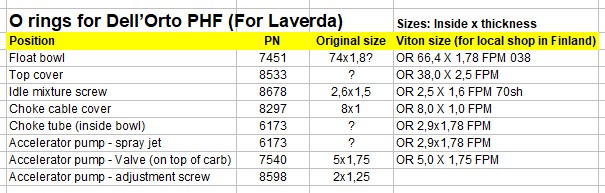
Although very useful this list only concerns O-rings for Dell'Orto carbs Paul.
I'll take a look in my documentation this evening.
However, the general rules for applying ORs allow us to guess their sizes.. roughly speaking :)
Good luck
 
I have searched for this info on the forum but my search terms are bad or it just ain't on the forum.
Does any one have a listing of all the O-ring dimensions used on Lavs.
Inside dia
Outside dia
Cross section dim
etc
I am working on my 750s. Laverda part numbers are useless in hardware store.
Anyone know if there is a universal specs or will I be dealing with Metric and SAE specs???
thanks
View attachment 86582
Metric or SAE .. doesn't matter I guess .. as long as the sizes are correct
 
Although very useful this list only concerns O-rings for Dell'Orto carbs Paul.
I'll take a look in my documentation this evening.
However, the general rules for applying ORs allow us to guess their sizes.. roughly speaking :)
Good luck
You didn't open the word document Stéphane. Not much in there but always helpful.
Otherwise, a lot of the O rings are in the various tech documents I seem to remember.
Paul
 
Thanks dude.
That is Oil seals, I am looking for O-Rings. At the moment I was working on the intake manifolds.
The o-rings for the manifold insulators are thinner section than "standard" that come in general o-ring kits but are readily available. Too thick and the manifolds will distort. Easy to measure the section from the groove in the insulator.
 
Thanks Paul.
I was hoping some fastidious person (we all know who they are) had compiled a list of ALL the O-rings used on Laverdas. On the carbs, speedo and tach cable ends, engines, carbs (thanks Paul).
The o-rings for the manifold insulators are thinner section than "standard" that come in general o-ring kits but are readily available. Too thick and the manifolds will distort. Easy to measure the section from the groove in the insulator.
 
The o-rings for the manifold insulators are thinner section than "standard" that come in general o-ring kits but are readily available. Too thick and the manifolds will distort. Easy to measure the section from the groove in the insulator.
Thanks Tippie.
I was thinking of just measuring the cutout in the manifold for the O Ring dimensions, but I thought they would measure out for a too large O Ring.
I have some new O rings now but they seem a little small, in that when the manifold is torqued no It didn't seem to seal well. the manifold just seemed to bottom out on the head.
 
I tried fitting a petrol-resistant O ring to a Laverda inlet manifold, it was a bit big in section and guess what happened? They don't compress well, O rings I mean. I would be using fuel-resistant Gasget goo. Less chance of cracking the ears off.
 
Thanks Tippie.
I was thinking of just measuring the cutout in the manifold for the O Ring dimensions, but I thought they would measure out for a too large O Ring.
I have some new O rings now but they seem a little small, in that when the manifold is torqued no It didn't seem to seal well. the manifold just seemed to bottom out on the head.
I think the principle with O rings is that the housing should bottom out, the elastomeric characteristics of the O ring make the seal. This gives a mechanically superior joint to a gasket. That’s why correct size is so critical. Too large and you could blow out the housing if the groove can’t accommodate the ring.
 
Or re-machine the manifold to accept a standard O ring profile, having a lathe here gave me and does allow for overcoming issues like this, that end up taking up a great deal of time, searching and locating oem type profiles. It does not take much material removal to allow for standard Orings generally available. Perhaps a local retired ex machine shop person is a good contact, plenty retired with full workshop facilities, suggest of merit or no, j. ** here is a url to one such source of CORRECT recess profile in regards to long term reliability of Orings.

 
Following up on the precept of thinking outside oem parts, a local ex sea captain ( Master 5 international ) repairs clocks, carriage to long case. Several in his collection pre date Australia discovery, believe one is 17th Century. He fabricates parts that are worn or damaged with basic workshop tools, brads, punches mostly Swiss quality. Watchmakers Lathe and tooling. Brings a whole new dimension of parts worn out after hundreds of years, obviously over the counter parts are not common, a grin here.

He is by nature versatile in thought of how to rectify the issues, or worst of all, the local person whom "repaired" the clock, now all he has to do is make it work, including a box of parts that was one a clock mechanism, hence the impetus to all whom would condescend that there are more solutions than the obvious or the insurmountable, a wry smile here. j
 
On the SF I know the o-rings sit in machined grooves in the insulators (are the earlier ones the same?), the manifold stubs and head are flat and often in shit condition. Most original insulators are breaking up now due to age, new ones I have sourced are thicker but still take the same o-rings.
 
This isn't hard, head to manifold OR 2137, all the OR specs are in the parts list!
O-ring specs came from the USA and are all in imperial measurements, others had to use those till perhaps eventually they developed their own metric specs.
 
Btw, you dont need the infernal O rings in the head gasket if you use one of Keith at Laverdascozia new gssket design😉
 
Back
Top