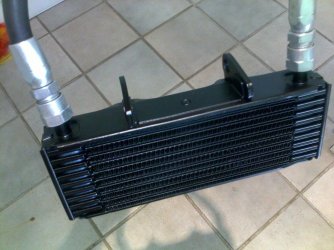
Oil Cooler

use brake caliper satin black spray cans to paint the oil cooler, comes up a treat

flush it out by setting up some form of pressured flow through it, I connect them to my parts washer and let the pump flow through one side for 30 mins
sometimes a lot longer when I forget and get side tracked doing something else, remember one being in there for at least 8 hrs


I used a satin black high heat engine block paint.
Need to thoroughly clean the exterior of the cooler first.
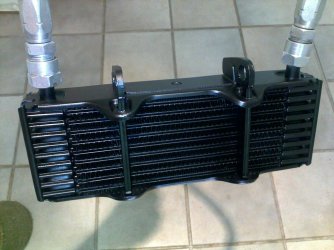
Here's how it came out.
 

Attachments

  • LaverdaJotaOilCooler1Small.jpg
    LaverdaJotaOilCooler1Small.jpg
    107.6 KB · Views: 51
  • LaverdaJotaOilCooler2Small.jpg
    LaverdaJotaOilCooler2Small.jpg
    108.3 KB · Views: 42
Hot soapy water pumped through after a solvent wash will get out the metal particles that have fallen out of suspension in the oil. A good dish soap is best and flush in both directions. Honda has us doing that before we replace an auto trans. It suprised me how much shit was in there after just a solvent flush. Works well on parts that have been bead blasted too.
 
I'm with Red I wash mine with detergent, rinse well and let dry, a couple of coats of satin black caliper paint and I then bake mine in  the BBQ to get the full heat resistant benifits. Better half will not let me use the kitchen oven.

JW
 
I have used the local garage token jet wash and then sprayed using satin black  rattle cans.... After all they never get that hot even racing !!

            Tim
 
I checked out my oil cooler after a big end cage broke up and used half a bottle of washing up liquid and the pressure washer, with the nozzle screwed down to a narrow jet.
Just reversed the direction every few minutes and probably was at it for half hour but it was cool to see the amount of aluminium crap come out.
I dried it by directing a hot air gun onto the matrix, 100 degrees C soon dries it out..

Rob
 
...a few years ago when ebay was in its infancy, there was a bloke who was breaking a mint low mileage jota that had a

blown engine, (at this time the whole bike was probably only worth 3.5k) i bought the oil cooler off him and when it arrived it was just about blocked, it looked nice

though..
 
My cooler needs replacing and I am looking to install a remote spin on filter this winter so anyway need to replace original lines. I found the 2CV cooler (602cc engines) is readily available, but will need outlet pipes to be cut back, suitable fittings found and painting to replicate original. Typically 60EUR for cooler, stocked by multiple vendors. Problem is outlets are 1/8 NPS, schedule 10 pipe 0,405” (10,3mm) od, 0,049” wall. Being aluminium it would work with compression fittings, but I can find no one who makes fittings for this pipe standard which was designed to use 1/8” NPT or NPS threads to join hard pipe. So far contemplating welding on an AN6 adapter to suit AN6 (3/8”) hose fittings, but welding these to such a thin wall and difficult to access join is a tricky prospect so interested in more info regarding the olive gas fittings that others have used to replace olives used on original coolers. Part or standard numbers, web links, vendor data would be great. From there I hope to find a suitable fitting. Ruled out using worm drive clips etc as getting AN6 hose over ends would anyway not be easy, but once lubed and in use would not be too secure without some form of hard abutment to prevent hose slipping off. Other ideas welcome.
 
Others will no doubt chime in, but don't fit an oil filter, keep the original setup
Hi Marty, whats your argument for leaving it stock? My main motivation is to avoid time taken in dropping exhausts to clean mesh strainer every 1500km. Dropping it is not a significant problem, but getting it all hooked up so nothing is touching the chassis takes time and none of it is convenient when away from home.
coming back to hose ends for cooler. New cooler arrived today and pipes are now 10mm od for which compression fittings are readily available, problem solved. The 2CV installation is not sensitive to if the pipe is 1/8 NPS (10,3mm) or 10mm and application is anyway suited to using tubing so I assume at least some manufacturers (there are many) now use 10mm tube despite drawings on web. Mine was manufactured by Ridex. I believe NRF also use 10mm.
 
Hi Marty, whats your argument for leaving it stock? My main motivation is to avoid time taken in dropping exhausts to clean mesh strainer every 1500km. Dropping it is not a significant problem, but getting it all hooked up so nothing is touching the chassis takes time and none of it is convenient when away from home.
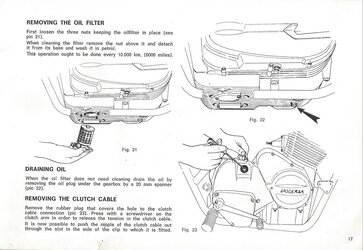
Unless you are away on a more than 10,000 km. trip, there's no need to drop it.
See the Laverda Factory Handbook, which came with the bike (attached).Handbook 17 Oil Strainer.jpg
 
Last edited:
Been done to death this type of topic on fitting additional "oil filter" you run the high risk of doing more damage than good.... do have to love the factory "tea strainer" filter... at least it prevents objects like a large beetle ( am not kidding ) and small children going around and around in the engine. You will have a much better outcome by fabricating a magnetic drain plug, that is an eye opener as to what metals are circulating around the engine, or once did. Your call as i have been a participant in specialised low pressure high volume external filter, with electrical circuit internal to warn of excessive back pressure build up, on a special triple Laverda...HTH j.
 
Thanks for the info, I was unaware of factory recommendation re strainer. Hmm, shall think again on this. Magnetic drain bolt went in on last change, shall be interested to see how that looks next time around.
 
Back
Top