Oil coolers, why are they black.

yes, that seems to be common enough, but i was clearly told that 'this type' of ceramic coating helps radiatiors (we're talking central heating here) work better, but i cannot tell you what type of coating it was. i believe it may have been developed in israel.
 
most commercial vehicles, big trucks and the not so big (4x4's for example) have an oil cooler for the engine oil, very often this is cooled by the engine coolant water,rather than ambiant air, because
a) it gives a faster oil heat up time (beneficial) and
b) when at operating temp. the water is always cooler than the oil and is 100% "available"

In this application they are usually called "heat exchangers" and have been both tubular and alternate plate type in the past

very often there is also a tramsmission cooler, and even on some Jap sports cars and other hoard worked stuff like limo's there is not only an oil cooler in the airflow, but with a pump circulating that oil for the rear drive diff (eg Nissan 200ZX)

CLEM
 
Ceramic coating applied to piston crowns and exhaust pipes is there for the express reason of stopping heat flow.
Applied to radiators (domestic) I can only assume the side nearest the wall is coated. stopping the wall acting as a heat sink.
Applied to automotive radiators I can't really see the reason.
 
jotajoe said:
Once the bike is cutting through the air a fan is of no use particularly .It is when stuck in traffic it would come into it's own.

Exactly why I was thinking of it. Air temp at 40+ degree day stuck in traffic, the bitumen under the bike feels twice that, no breeze to speak of and sitting still in traffic. Standard Perth summer day.
 
Davo said:
Exactly why I was thinking of it. Air temp at 40+ degree day stuck in traffic, the bitumen under the bike feels twice that, no breeze to speak of and sitting still in traffic. Standard Perth summer day.

Bloody hell Davo....40+ degrees stuck in traffic :o. Not fun. Must be quite a stress on the motor....and the rider!

Only time I saw those temps was in the Nevada desert on a Hardly Davidson (the only hire bike available). Bike got very hot and lost huge amounts of power, even though we always kept moving.

Pete
 
My commuter these days is a 4 cylinder Honda CB1000, which does everything it's supposed to do without fuss, and it is fast enough to get a bit exciting. But in hot weather (which we get a little of in Florida ::)), talk about sitting on top of a blast furnace! The insides of my thighs get roasted by the heat coming from the cylinder head and being blown backwards from the radiator. I have to wear Kevlar lined jeans so I don't get burned, and my 25 minute commute home in the hottest part of the day (in heavy traffic) gets my body core temperature up enough that I have to take a shower when I get home to cool off. The Jota is nowhere near as bad, although it does start to get a bit unhappy in stop/start traffic at 38C.
And the thing has a huge radiator and oil cooler. I don't understand why it gets so hot in hot weather. And the radiators are both black.

Ken
 
Hey Ken, try riding a Kawasaki Z1300 in hot weather. It's like sitting on a volcano. On one occasion when riding through Melbourne on stinking hot sunny day, I could hear a weird gurgling noise whenever I stopped at the traffic lights. It was the petrol boiling in the tank! The engine kept staggering on acceleration because the injector pump was sucking vapour. Some Z1300 owners stick a layer of insulating foil on the underside of the tank to stop the vapour lock problem. I've never bothered because it's not usually a problem in Tassie's cool climate.

jhhhhhhhhhhhhhhhhhhhhhhhhhhhhhmhhhhhhhhhhhhhhhhhhhhhhhhhhhhhhhhhhhhhhhhhhhhhhhhhhhhnjj  <--- That was my cat walking across the keyboard  ::)

Cam
 
mcnicol said:
I don't understand why it gets so hot in hot weather. And the radiators are both black.

Ken

Hi Ken, the reason even liquid-cooled engines get hot is because coolers require a temperature difference to work, the bigger the difference then the better the cooling. Only when a large difference occurs does the cooler work properly - raising the engine temperature as a consequence of hot air.
You can blast hot air through an oil cooler/radiator as long as you like, if the air temp is the same as the oil/water then no cooling will occur whatsoever.

I think Clem has provided the best demonstration with the liquid/liquid cooler. Water has a very high specific heat, much much higher than air. Try heating a lump of metal red hot and leaving in air and then leave to cool - takes ages, then try the same in a bucket of water - milliseconds to cool down.
The only problem is of course is the water is cooled by air so eventually everything gets hot.

Even so, liquid cooled engines are superior.


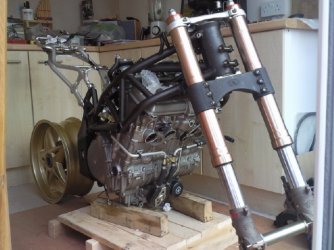
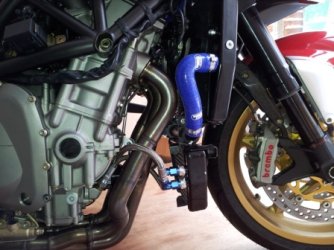
Modern era MV Agusta F4s ( 1999-2009 ) have a water radiator and a water/oil heat exchanger.( as per the second picture ).

Clem is on the money in that at warm up time the heat from the cylinder head jacket is transferred in the exchanger to the oil which then "warms up " faster.
These bikes suffer a fair deal with over heating. Once the engine is at operating temperature a feed from the cooled water from the bottom of the water rad picks up heat from the engine oil in the heat exchanger. This is then fed into the "cool" feed to the cylinder head manifold...Not a particularly steep temperature gradient.

There is alot to this subject and I am probably missing much of it but that is the gist of it.

From 2010 MV ditched the heat exchanger and fitted a proper oil cooler in addition to the radiator. As a little project I have retro fitted a 2010 system to a 2007 engine and when the snow melts I shall try it out.  ;)

joe
 

Attachments

  • samco 2.jpg
    samco 2.jpg
    107.3 KB · Views: 7
  • 50652_full (1).jpg
    50652_full (1).jpg
    114.8 KB · Views: 12
The MVs sufered with overheating due to an inadequate water pump which was upgraded in later models and is available as a kit for earlier models.

My sister in law has a Hyundai diesel SUV which has the auto gearbox oil cooler integral with the radiator. Gear box gave up the ghost when a perforation appeared between the two systems and high pressure fluid from the radiator filled the gearbox with coolant. Apparently not a rare occurance
 
Davo said:
The MVs sufered with overheating due to an inadequate water pump which was upgraded in later models and is available as a kit for earlier models.

My sister in law has a Hyundai diesel SUV which has the auto gearbox oil cooler integral with the radiator. Gear box gave up the ghost when a perforation appeared between the two systems and high pressure fluid from the radiator filled the gearbox with coolant. Apparently not a rare occurance

You are on the money there Davo...I fitted an upgraded pump the old ones have curved paddles that don't shove the coolant through very efficiently...Looked like was designed by Leonardo DaVinci..:)

There are many factors involved in over heating in modern era MVs. What can be said though is that out on the road at speed..they do not over heat..The harder you ride the cooler they run. They are a "race" bike in a sense and people in hot places think that it will be happy sitting in a 20 mile tailback in August in LosAngeles should get themselves a Honda Melody or something cuz that ain't what they are built for..

joe
 
Back
Top