
Hello Gerald, do I just slip the gear of the shaft to gain access to the springs and pins? Or do the 3 rivets have to be drilled out?Hi Russ,
Yes springs, pins, the whole kit. Surface marks on the M27 nut is common from whatever tool was used in the past to undo/fasten.
If the thread is still OK I wouldn't bother.

You are using an out of date browser. It may not display this or other websites correctly.
You should upgrade or use an alternative browser.
You should upgrade or use an alternative browser.
Oil leak alternator side
- Thread starter russo011
- Start date

The Sock
Hero member
- Location
- London, England
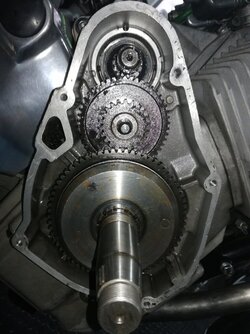
You may get away with it once a new gasket is fitted but, if it doesn't, a couple of light passes to level the jointing face will.Checked and maximum gap; it is around 7 to 8 thou (0,18 to 0,19 mm) at the spot by the opening near the wiring opening, I feel that the gasket was the real issue, very hard and cracked in a couple of places.View attachment 60276View attachment 60277View attachment 60278
The Sock
Hero member
- Location
- London, England
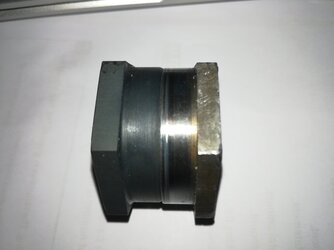
Best to pull the starter gear and freewheel together. Then separate the freewheel inside a poly bag, avoids anything pinging out of sight on the garage floor. No need to remove the rivets.Hello Gerald, do I just slip the gear of the shaft to gain access to the springs and pins? Or do the 3 rivets have to be drilled out?
After examination and re-assembly, with the freewheel outer face downwards, rotate the starter gear into place and check action. With both parts held together, replace on the crankshaft.
Job's a good un.

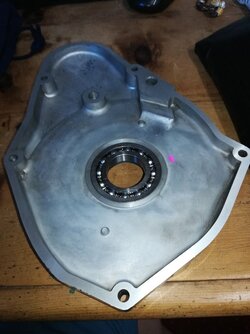
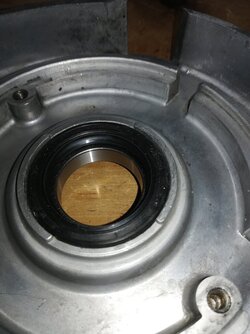
Got my alternator case back from the machinist - apparently some 0,3mm (almost 12 thou) out. Anyways new bearing + oil seal + new retaining nut to be fitted. Just out of interest what is the usual way to tighten up the nut without the "special" tool, I managed to remove it with a rattle gun without any dramas - just a little concerned that I don't over torque / tighten.
Attachments
The Sock
Hero member
- Location
- London, England
I just tighten it with a standard 1/2" Socket T-bar. You can hold the generator flywheel with a strap wrench.
It doesn't need primary sprocket level torque.
It doesn't need primary sprocket level torque.

mmmm bit late my AU$0.02, this type of leak has been covered extensively in the past. Culprits are well known. Micro cracking under the cable via tunnel usually. Perhaps the machining while obvious, does not always help, perhaps. Again been covered previous. Done my time at the alter of alternator cover leaks, including oil soaked boots and back wheel, dangerous leak when allowed to progress.
As for check surface alignment on glass, am a leadlighter for more than 30 years, glass is not "flat" as a given, be that machine glass or hand blown. Common domestic glass is hot machine rolled, overall profile changes as it cools, ambient or forced cooling.
Glass that is 100's of years old actually cold flows under gravity, cathedral ( not the low cost Cathedral garden type glass ) ecclesiastic glass is thicker at the bottom than the upper sections. Antique hand blown glass is surreal to the touch and ringing sound when struck, German product is exceptional again. j
The Sock
Hero member
- Location
- London, England
You're right, of course, John.
I should've said plate glass. which is, indeed, not necessarily absolutely flat but, as my old friend used to say, "Close enough for Jazz."
I should've said plate glass. which is, indeed, not necessarily absolutely flat but, as my old friend used to say, "Close enough for Jazz."

Dellortoman
Hero member
- Location
- Tasmania, Australia
Glass that is 100's of years old actually cold flows under gravity, cathedral ( not the low cost Cathedral garden type glass ) ecclesiastic glass is thicker at the bottom than the upper sections.
While I'm a little reluctant to contradict the word of a 30 year leadlighter, I can't let the "glass flowing under gravity" statement go un-challenged. Sorry John

The story of old window panes flowing over time is a myth. Any sagging or thickening at the bottom of the glass was there the day it was fitted. Once glass solidifies from the molten state, that's the shape it stays. The reason that many old window panes are thicker at the bottom is that it probably just made sense for the glass fitters to install it that way. There may be rare examples to be found where it's thicker at the top, but nobody mentions those.
I suppose the idea that glass flows may have been given some credence because glass doesn't have an obvious melting point. It just goes from hard to soft, to a syrupy liquid as it's heated. So there's a theory that glass is a supercooled liquid. But it's not. It's an amorphous solid (has no crystal structure) but that doesn't mean it can't be rigid. That melting behaviour is typical of amorphous solids (like wax for example) because there's no change of crystal structure and no latent heat of fusion.
Anyway, a simple thought experiment will reveal the truth. If glass did flow, it may indeed get thicker at the bottom, but it won't get thinner at the top. It'll just slump down and get shorter. Anyone who has taken jelly out of a mould or done a concrete slump test knows that. So why isn't there a gap at the top of all those old windows?
There are solid(ish) substances that slowly deform and indeed flow under gravity. Pitch is a good example. Refer to the pitch drop experiment
Pretty much anything will deform if the conditions are right. Rocks like granite can flow, but not under gravity and not in human time scales. It takes geological time scales under extreme pressure and high temperature. Such rocks called "rheids" by geologists. The capacity of a such materials to flow is called "rheidity" (similar concept to viscosity in fluids).
Rheid - Wikipedia
Perhaps glass would flow under similar geological conditions. It's a difficult question for geologists to answer because naturally occurring glass (obsidian) has no crystal structure that would give any clues as to its deformation since it cooled from the molten state. And naturally occurring window panes are pretty rare.
I guess the distinctions between viscosity, rheidity, creep, plastic deformation and change of state can be somewhat blurred. The subject seems to cross over geology, metallurgy, fluid dynamics, physics. chemistry* and maybe even quantum mechanics. I don't know the answers. I'm not an expert in any of this shit. I'm just curious enough to read the occasional book but I don't burden myself with any real or useful knowledge.
* Note that chemistry is just a small branch of physics. That should piss off chemistry gurus out there.
Really hoping the machining has cured the problem, will be at a loss if not. Same as you though, before dismantling my right foot was covered in oil after some 30 kays.mmmm bit late my AU$0.02, this type of leak has been covered extensively in the past. Culprits are well known. Micro cracking under the cable via tunnel usually. Perhaps the machining while obvious, does not always help, perhaps. Again been covered previous. Done my time at the alter of alternator cover leaks, including oil soaked boots and back wheel, dangerous leak when allowed to progress.
As for check surface alignment on glass, am a leadlighter for more than 30 years, glass is not "flat" as a given, be that machine glass or hand blown. Common domestic glass is hot machine rolled, overall profile changes as it cools, ambient or forced cooling.
Glass that is 100's of years old actually cold flows under gravity, cathedral ( not the low cost Cathedral garden type glass ) ecclesiastic glass is thicker at the bottom than the upper sections. Antique hand blown glass is surreal to the touch and ringing sound when struck, German product is exceptional again. j
Just to mention I checked the gap at home on polished marble (kitchen work top
) not glass - good to see it's opened other topics though 
With the flywheel in place though it's not possible to access the nut behind or am I missing something?I just tighten it with a standard 1/2" Socket T-bar. You can hold the generator flywheel with a strap wrench.
It doesn't need primary sprocket level torque.
The Sock
Hero member
- Location
- London, England
My bad!
I just tighten it with a standard 1/2" Socket T-bar.
It doesn't need primary sprocket level torque.
( I'd interpreted "without the "special" tool" as being without the "lollipop", hence)
You can hold the generator flywheel with a strap wrench.
I just tighten it with a standard 1/2" Socket T-bar.
It doesn't need primary sprocket level torque.
( I'd interpreted "without the "special" tool" as being without the "lollipop", hence)
You can hold the generator flywheel with a strap wrench.
I'm talking about the M27 nut behind the alternator not the M22 nut that holds the alternator on the very end of the crankshaft. With the alternator on you can't access the M27 nut - the special tool I was referring to has a keyway cut into it that matches the key at the end of the crankshaft. This is the tool I don't have.My bad!
I just tighten it with a standard 1/2" Socket T-bar.
It doesn't need primary sprocket level torque.
( I'd interpreted "without the "special" tool" as being without the "lollipop", hence)
You can hold the generator flywheel with a strap wrench.
Wows Cam, teaching old dog new tricks, or how to bark, wondered why at times last day or two, been barking a lot differently.... large grin here. Your research and writing is superior to mine, well done you. Did take the glass books on hand here narrative about ecclesiastic glass as accepted "fact" did not do my own research, and it now shows. Not a problem, your more than able to mitigate that issue for me, tah. Read your comprehensive fact reply in my leisure, my compliments.While I'm a little reluctant to contradict the word of a 30 year leadlighter, I can't let the "glass flowing under gravity" statement go un-challenged. Sorry John
The story of old window panes flowing over time is a myth. Any sagging or thickening at the bottom of the glass was there the day it was fitted. Once glass solidifies from the molten state, that's the shape it stays. The reason that many old window panes are thicker at the bottom is that it probably just made sense for the glass fitters to install it that way. There may be rare examples to be found where it's thicker at the top, but nobody mentions those.
I suppose the idea that glass flows may have been given some credence because glass doesn't have an obvious melting point. It just goes from hard to soft, to a syrupy liquid as it's heated. So there's a theory that glass is a supercooled liquid. But it's not. It's an amorphous solid (has no crystal structure) but that doesn't mean it can't be rigid. That melting behaviour is typical of amorphous solids (like wax for example) because there's no change of crystal structure and no latent heat of fusion.
Anyway, a simple thought experiment will reveal the truth. If glass did flow, it may indeed get thicker at the bottom, but it won't get thinner at the top. It'll just slump down and get shorter. Anyone who has taken jelly out of a mould or done a concrete slump test knows that. So why isn't there a gap at the top of all those old windows?
There are solid(ish) substances that slowly deform and indeed flow under gravity. Pitch is a good example. Refer to the pitch drop experiment
Pretty much anything will deform if the conditions are right. Rocks like granite can flow, but not under gravity and not in human time scales. It takes geological time scales under extreme pressure and high temperature. Such rocks called "rheids" by geologists. The capacity of a such materials to flow is called "rheidity" (similar concept to viscosity in fluids).
Rheid - Wikipedia
en.wikipedia.org
Perhaps glass would flow under similar geological conditions. It's a difficult question for geologists to answer because naturally occurring glass (obsidian) has no crystal structure that would give any clues as to its deformation since it cooled from the molten state. And naturally occurring window panes are pretty rare.
I guess the distinctions between viscosity, rheidity, creep, plastic deformation and change of state can be somewhat blurred. The subject seems to cross over geology, metallurgy, fluid dynamics, physics. chemistry* and maybe even quantum mechanics. I don't know the answers. I'm not an expert in any of this shit. I'm just curious enough to read the occasional book but I don't burden myself with any real or useful knowledge.
* Note that chemistry is just a small branch of physics. That should piss off chemistry gurus out there.
Suppose what is "flat" a broad term, in this case glass, does it mean parallel flat both sides or not, dimension measurements would be many, leave it at that, retaining the original post intent. Thank you Cam, j.
yes it now comes about my reply has some of its own "non flat factors", wry smile here. In my own defense, a flimsy one at best, folk i came into contact with using/promoting glass sheet as lapping table for distorted heads. Extrapolating that to infer it was also a checking base for remaining distortion, it could also possibly ( useful ) be a base for checking in regards to shading witness marks with the grinding past, ala poppet valve hand grinding. j.You're right, of course, John.
I should've said plate glass. which is, indeed, not necessarily absolutely flat but, as my old friend used to say, "Close enough for Jazz."
Hello Gerald, wrote the reply in context of many days expended, trying to sort out a persistent ( dangerous ) alternator cover oil leak. The cover was distorted no question, cause or causes would take up another topic on its own. Tried all manner of remedies, yet the leak persisted, based on one precept it was a machined face issue. In my memory of poor calibration, Steve B had raised the issue of possible micro crack ( not visible to the naked eye ) for the inner casting. We are talking more than 17 years ago now the issue at the time.Really hoping the machining has cured the problem, will be at a loss if not. Same as you though, before dismantling my right foot was covered in oil after some 30 kays.
Just to mention I checked the gap at home on polished marble (kitchen work top
Had a leak on a repaired ( not my welding ) primary cover, primary chain adjusting screw and nut had impacted a road, someone welded it up and it was porous and or weakened casting area around the welding, ended up scrapping the cover in the end, it never sealed properly. Anything forward of the back wheel is a danger in my mind. Always re-routed the crank case vent pipe away from anywhere near the back wheel tyre surface.
You may well have a win with machining, many of the modern age faults or similar are different from older types of faults we rectified. New techniques, sure Redax has many new types of "faults" on old motors occurring, which older solutions do not rectify or remedy. j.