Petrol tank sealing or not

Jota Rob

Hero member
Location
England
Hi
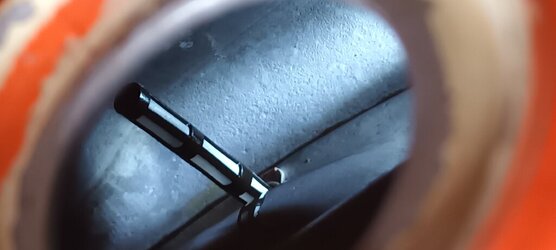
I'm in the process of cleaning my tank and gently working to remove the last rust along the left hand seam.

I've not used a tank sealer before and a bit reticent to do so but given the amount of metal lost, I feel it may be the alternative to getting a porous tank.

I've heard conflicting views on it's lifespan and performance.

I'd welcome opinions on long term users. I'd like to just oil the tank but I know if I have to do this again, I might not get a second chance.
Cheers Rob
20230808_123715.jpg20230808_123847.jpg
 
Phosphate it and you're good for another few decades.
If you oil the inside, you'll be in for double trouble if you need to seal it later.
Paul
 
dont line it,

mine was only good for two years, (Slosh) carefull and lengthy application kept it going for two years, then with external application of chemical metal, another two years, but now have changed tanks and cut the bottom out of the old tank so as to sandblast away (inside and out) all the crap and sealant, the pinholes that are now visible takes some believeing, the sealant was varrying from zero coverage to half an inch, it never did stick properly to the inside of the tank which was pre-cleaned of all visible rust using external plasticine to plug the holes, and filling with dilute citric acid. I will never use internall wonder snake oil tank sealer again.
CLEM
 
Last edited:
Thanks all, I followed the link Rob,that was an eye opener!

I've reviewed every tank liner and they all have some negative reviews often with pics where they've become detached on steel tanks.

I'll oil it for now and see how it copes, since I don't fill the tank every decade.
Thanks all.
Rob
 
Caswell seems to hold up exceptionally well. Haven't used it on my own bike, but a regular riding buddy has done at least 3 tanks over the last dozen years using Caswell with zero issues. Prep is always the key. Definitely and absolutely stay away from any of the cream liners like Kreem. Lasts maybe 2 years, and then your stuck trying to remove the failed liner.
 
Once again, the smallest dent on a lined tank, and we all dent them, you'll need to get the liner out, which involves acetone, which will likely make a mess of the paint.
Not worth it.
Paul
 
From my experience unless you have a fantastic paint job with pin holes in the tank, and how likely is that, if your painting it you might as well pickel the whole thing inside and out and start from a completely clean slate. Rusty tanks are a giant pain to deal with, blocking taps and jets, once was enough.
 
Not to be taken too seriously folks - just for info.... the half-dozen pin holes in the bottom of my SF tank have been blocked up by JB Weld for about five years now. Still going stong. It was a temporary fix, and I just haven't got 'around to doing a proper job. I took inspiration from the float bowl on my Bultaco Sherpa - where my JB weld fix there is 20+ years old and still perfect.
 
Definitely and absolutely stay away from any of the cream liners like Kreem. Lasts maybe 2 years, and then your stuck trying to remove the failed liner.

add a Zero to the 2 years, please... My tank has Kreem Weiß (the white thing) in it since 20+ years. I recently recognized that at the filler, there was some damage and some flakes seem to come off now.

As said before: most people have far to less patience when they prep their tank for the use of that stuff. I followed each and every step carefully 20 years ago, especially the draining and drying process. It is really vital that the tank has enough time to dry between the different steps and also before you fill in petrol again. I think I let it sit for a week in a heated place to make sure all humidity is gone. I also stored it for another 2-3 weeks in that heated place to let the white sealant dry properly (good job for winter time...). No rust at all, the whole tank is still covered (though it has a dent...) and for me, it worked ever since. No guarantee for any other work, but I had good experience with it.

Today, I think I would ask a tank-repair shop to do it that uses phosphate as Paul suggested. Nevertheless, on my tank with the right steps and lots of time and patience, it worked for me.
 
From my experience unless you have a fantastic paint job with pin holes in the tank, and how likely is that, if your painting it you might as well pickel the whole thing inside and out and start from a completely clean slate. Rusty tanks are a giant pain to deal with, blocking taps and jets, once was enough.
Rusty tanks are a pain which is why we de-rust them.
Paul
 
dont do it, dont do it, dont do it
if its holed and if you cannot weld/fabricate, get someone who knows how to do it, (classic car body shop with a wheeling machine) and have them perform on it, I have cut out the total bottom of my 1200TS tank and had the top and the bottom aggressively steel shot blasted, both inside and out, there was the obvious damage now cleaned of all crap and internal and external bodging ready for repair, new steel will be let in all damaged areas, there are thousands of pin holes, all of them on the bottom only, no hole will be left just "brazed up" they will all be cut out to an area at least 25mm bigger, then the holes are replated. The damage occurred before the tank came into my posesion, it is a round recessed badge Jota type but in 1200TS colours ("I never knew thay did that tank on a TS" they didnt!) it is worth the repair, why the touring TS had a smaller tank than the slightly more sporting Jota I can never fathom, but there you go, I might even lead load the area around the flange underneath just to be sure, making it a fillet, havent done that since I put a new wing on a MK11 Jag, the sidelight nacell was lead loaded onto the top and something else as well, I distinctley remember two operations bu cannot remember what the other was, I still have all the kit, and that process probably died out in the late 60's.
CLEM
 
Back
Top