Pipes and jets

phil37 said:
Paul - I don't like the long length of steel exhaust pipe that goes into the head on the 750's - not good practice - I shrink a length (about 20mm) of aluminium tube into exhaust port and use a short flange - like on the triples. Maybe easier for you to put a shorter insert into yours to get extra protrusion of the flange. - regards - Phil

The intention is to get as much as possible of the exhaust heat into the header and out before it dissipates into the head.  The first part of the header should have no contact to the head other than the sealing surface.  Laverda used an even longer set-up on the 500 and 600 engines to help keep the exhaust valves and ports cooler... still not enough, as recent history has shown.

This has been discussed at length in specialist literature, similar lay-outs can be found on Manx Nortons and Matchless/AjS G50/7R where the headers are also fitted deep into the ports.

piet
 
I'm old school Piet - the only direct heat path from the steel flange to the head should be through the small studs retaining the aluminium finned rose that retains the pipes and the Cu washer is a barrier too. The long steel length when inserted into head adds heat, IMHO, and increases temp. of exhaust valves. The triples are much kinder to ex valves than the DOHC twins! - regards - Phil
 
Actually a very old-skool solution, Phil. 

Used on myriads of air-cooled Hondas over the past decades too, the trick is to avoid direct contact between header and head casting for much of the distance to the actual port exit where the outside airstream takes over the cooling.

Because the header reaches into the head closer to the ex. valve, it takes up a lot of heat that would otherwise go straight into the head via the port surface.  Even the smallest of differences in diameter would afford an effective heat shield.  One reason why stainless headers are detrimental to performance, stainless retains heat far longer than mild steel... ::)

piet
 
  Actually a very old-skool solution, Phil. 

yes - Having never ever burnt out any valves myself - I tend to stick with this method. The preferred method these days with the QD pipes held into separate adaptors by springs having a long steel part into head does worry me - probably unnecessarily - but then I did go to an old school myself! ::) ::) - regards - Phil

 
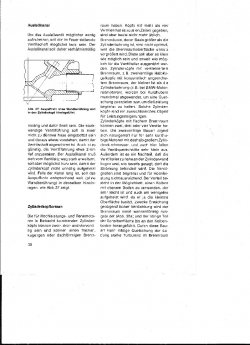
Found it!  Searched my books for an hour or 2... Ludwig Apfelbeck (austro/teutonic equivalent of Philip Edward Irving!), "Wege zum Hochleistungs Viertaktmotor" (Attaining a high-power 4-stroke engine), 1st. edition 1978, page 38.  He was in the business long before that, his career goes back to pre-war days mucking around with all manner of Puchs and BMWs.  He patented a 4-valve radial head with same valves opposite instead of next to another in 1935.  Guess he was too busy to write a book before he reached retirement age.

Ludwig explains that long exhaust ports should have protruding headers to convey heat and therefore preventing it to dissipate in the head itself on its' way out and unnecessarily heating the ex. valve environment.  His example is a bit different to what Laverda actually built, but the principle applies non-the-less.  Guess the further the headers protrude into the ports the better.

piet
 

Attachments

  • Neu_Apfelbeck exhaust ports.jpg
    Neu_Apfelbeck exhaust ports.jpg
    178.5 KB · Views: 31
Try this.... "Any heat which escapes in the exhaust gas is simply a waste product, and, as such, should be dismissed down the pipe as soon as possible and not allowed to embarrass the head any more than is  absolutely unavoidable. To that end, the port should be short and of the smallest diameter consistent with good power production."

Ref "Motorcycle Engineering" -  by (the real) Phil Irving. -  can't scan it as it goes over 2 pages! - regards - Phil
 
You're saying what I am, Phil. :D

Irving and Apfelbeck came to the same conclusions, the hot gases should not come in contact with the head proper more than absolutely necessary and should enter the pipe as quickly as possible.  That means extending the pipe into the port is a legitimate means of "shortening" the port.

BTW, Philip Edward Irving IS the real Phil Irving. :D

piet
 
Wow, erudite argument...I'm with the two Phil's on this, the less contact the pipe has with the head the better in my experience. Aluminium dissipates heat much better and quicker than steel.
I can actually confirm Phil Irving's stance on this as the one and only time I ever met him the conversation concerned pipe materials. He reaffirmed his dislike of stainless which i knew from the book and was emphatic about avoiding heat transfer from the pipe back to the head whenever possible. FWIW we were discussing pipes for Manx Nortons.....
 
Headers protruding into the cylinder to keep the heat in the exhaust is widely apdapted best practice on 2-strokers too.
Anyway, nice to hear that Pauls SF is behaving well again.  (bigthumb)

Regards,
Stefan
 
Well I dunno, can't you just ask a computer, then make one and photocopy it 3d and distribute to us all? :D
 
phil37 said:
Yes Piet - but your quotes were only from a Phil Irving "equivalent"  :D :D

  Enjoyable discussion though! - Regards - Phil

Apfelbeck enjoys much the same significance in the german-speaking piston-head world as Phil Irving in the english-speaking.

piet
 
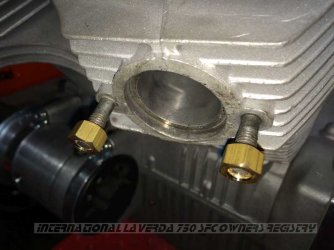
Phil will appreciate the exhaust ports of the 1973 works SFC.

A one season and 4 bikes only affair though.

Marnix
 

Attachments

  • 2015-01-05 21.17.13.jpg
    2015-01-05 21.17.13.jpg
    46.8 KB · Views: 53
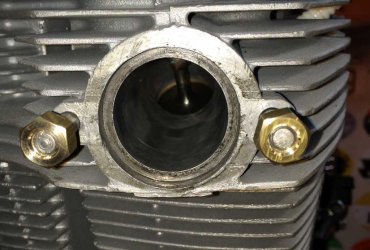
Reckoned it would, Phil. Here's a deeper view. Note the bronze seats.

Marnix
 

Attachments

  • 2015-01-05 21.16.54.jpg
    2015-01-05 21.16.54.jpg
    84.7 KB · Views: 33
Back
Top