Plugs/misfire advice.

philw

Junior member
Location
lincs
Since getting my 77 Jota back from Keith at the end of last year after he rebuilt the head with new valves/guides and cam bearings, and also fittng his Scozia ignitech system with upgraded alternator etc, the bike has been running like a dream all this year...until this afternoon.

Out for a ride earlier and the bike went onto the middle cylinder only, luckily i was able to limp the 1/4 mile home, took the plugs out (b8es) and swapped them for a set of b9es's i had in the garage, new 8's have been ordered. The bike started up straight away on all 3 pots, so i went out again for another ride and all is okay until the revs get up to @4500 > 5000rpm where there is a pronounced misfire that wasn't there before, any advice please on what could be causing this?

One thing i should mention is that i always put 98 Octane petrol in it until recently when my local garages only had 95 available, so i've probably put 2 or 3 tankfulls of that in, would it make a difference to the running? also its odd that 2 plugs would go down at the same time (the two outers),looking at the plugs they seemed to be ok with a nice brown/tan colour.

I had a Jota about 15 years ago and that used to eat plugs on a regular basis too, the current plugs had done about 750 miles from new, another thing is that i was sat idling at some temporary roadworks for a few minutes before the plugs died and the bike was getting hot, with hindsight maybe i should have switched the engine off whilst waiting.

Anyway the bike is perfectly rideable, i'm just a bit niggled about the misfire - any advice welcome...thanks.
p.s i've heard that the iridium plugs make a difference, thoughts please?

Phil.
 
Stay away from Iridium plugs. They bring nothing to the party.
The upgraded ignition may have developed a problem - the trigger plate or HT coil may be breaking down. Obviously before going down that route see what a new set of B8ES do. Replacing the HT coil would be my next step. The Ignitech box itself is usually reliable in my experience.
 
In my experience if it’s plugs then running at higher RPM usually fixes it, at least for a while.
You might need to carry a spare coil as well as spare plugs next time 😁
 
After a re-build, my bike would eat plugs on one cylinder one after the other. The culprit was a choke plunger that was not closing properly. It doe not take long at all for the plug to die. You may have two of them doing it, which is bad luck but perfectly possible. Plenty of threads on here that tell you what to do if you are not sure. Bet it's that.
 
In the days of yore, 120 motors notably would in the broad descriptive term "eat" plugs, was less common on 180 motors, for some reason. The common denominator was the dreadful Bosch BTZ, barely had enough capability to fire a spark plug at the best of times. Been covered over the years. Poison Plug became a later replacement for plugs that will not fire with normal ignition energies. Also for a short time, reconstituted old plugs were reboxed and sold as new NGK plugs from Asia. Had poisoned plugs on the test jig here, some would not fire at all, some would track the actual arc spark down the ceramic nose, ie not to rim body.

At lest you know the engine was running correctly, with existing plugs, BTW you should get around 50,000kms out of NGK plugs, or say 2 years. Photo of the pulled plugs would help, though you noted remained normal tan on the nose, you may like to not hold the plugs so close to face and have a tanned nose....sorry, its me, been like this most of life.... have no shame...

Rare to have a coil fail, save for Motoplat Red's even then there was a difference in which red motoplats failed. Grade 9 plugs while helpful as backup, are a colder plug and will exacerbate the plug fouling if anything. Used to keep 7's on hand for a motor issue of fouling.

Should you have NGK sparl plug covers of an age, then new replacements would be a first easy procedure. This is more so with outer plugs as they fire in series, in the old spark plug books, the clever ones used to reduce the plug air gap to compensate for the increased spark gap across series firing plugs. Not sure it helps, though gives background for problem possibles. j
 
Thanks for the replies Guys. I'll fit the new set of 8's and see what happens, fingers crossed its not a problem with the new ignition system.
 
B9s are too cold for modern fuels.
Are your choke plungers seating properly? Nowadays, choke or richness kills plugs fast.

Paul
 
Interesting you are using 98 octane.

here on Sydney - east coast of AUS, the established wisdom is 95 octane, change to smaller mains and idle , and very careful setting of mixture on idle jet and float level. NGK B8 seem to be the most common plug people use on standard or close to standard motors.
I know fuel in the UK is different (from experience). Our RGS ran beautifully in the UK, like pooh here in AUS.

I spent months trying to get our CORSA (sasche ignition) running properly and not eating brand new NGK B8 plugs.
Brett advised changes to jetting, Marty to fuel octane and viola. No more problems on either the RGS or CORSA.
So Interesting what John said about being a recognised problem in 120's. One my older brain had quite ignored.

As an aside, I also use 95 on our 77 JOTA, tho I couldn't say it fuels wells down low, once on mains it flys. More investigation needed.

From what you state re failing, I would suggest you check ALL of your positive supplies to the coils and ignition module as well as ALL the earths.
On the JOTA, I found the positive supply to the middle coil was cracked thru at the coil terminal, and at around 4k rpm the plug/coil would fail, but still show a good mixture on the plug, just being wet. It kept me in the garage quite a few nights until I chased every wire thru and inspected the terminations. You could also have a wire loose in a terminal if still using the original wiring. The terminals under the rear end of the fuel tank are a likely culprit.
HTH
 
Interesting you are using 98 octane.

here on Sydney - east coast of AUS, the established wisdom is 95 octane, change to smaller mains and idle , and very careful setting of mixture on idle jet and float level. NGK B8 seem to be the most common plug people use on standard or close to standard motors.
I know fuel in the UK is different (from experience). Our RGS ran beautifully in the UK, like pooh here in AUS.
HTH
Interesting..........they must flog you guys rubbish fuel up in NSW. Most fellas in VIC run 98 oct and it burns clean as a whistle.....but hurts the hip pocket!
 
Yep the Motodd runs nicely on 98 [when I can get it] over here in the west. only have 92 available in town so have to make sure I have enough fuel in the tank for the 70kays east or the 120 kays north to the nearest premium fuel. Definitely doesn't like 92.
Just changed the plugs for the first time after 10k kays, not that it wasn't running ok on the old plugs.
Motodd not a plug eater.
 
I use 98 with good results, BP , Caltex, but for some reason will only tolerate 1 or 2 tanks of Shell 98 before it plays up.
Doesn't play well on 95.
And [ducking for cover:eek: ] have always used NGK 7 's. They were in the bike when I bought it and haven't seen the need to change.
I do have a set of 8's that I will try for the first time when I do its next major service.
 
I use 98 with good results, BP , Caltex, but for some reason will only tolerate 1 or 2 tanks of Shell 98 before it plays up.
Doesn't play well on 95.
And [ducking for cover:eek: ] have always used NGK 7 's. They were in the bike when I bought it and haven't seen the need to change.
I do have a set of 8's that I will try for the first time when I do its next major service.
NGK 7s?! As would be said on 'Yes Minister' - 'that is ... courageous, Minister' :eek: Anyone on here who's holed a piston knows what I'm talking about!
 
  • Haha
Reactions: Rob
Took the Coils off the bike this morning to double check all connections, and the HT lead connectors into the bottom of the coils are a push fit, and they didn't seem as snug as they could be, i crimped the ends of the female connection sleeves slightly with a pair of needle nosed pliers and they are now a snugger fit, not sure whether this contributed to the misfire or not- i will find out when i fit the new set of B8es plugs and go for a run.
 
NGK 7s?! As would be said on 'Yes Minister' - 'that is ... courageous, Minister' :eek: Anyone on here who's holed a piston knows what I'm talking about!
This had my attention, in the iis development period of curves, used a highly technical set of documents from light aircraft air cooled engines, have a printed form, not sure the publications survived on WWW at this time. Covered in detail the mis operation of ignition systems. Three states concerned me, pinking ( piston rattle ), uncontrolled detonation, normal operation and exhaust temperature. Uncontrolled detonation makes a racket, imagine an engine on the ground would be shutdown quickly. Pinking can be reduced with careful throttle control, though main culprit is too much advance for the actual cylinder fuel/air load.

Troubled i was from the term "holed piston" from mostly mechanics. Never did see actual fracture punch through in person from fractured punch through in piston crown, others may have all the same. What i did see were melted piston crowns from a lean out of the cylinder fuel/air load. A lean mixture does not burn hotter than a correct stoichometric mixture, nor an over rich.

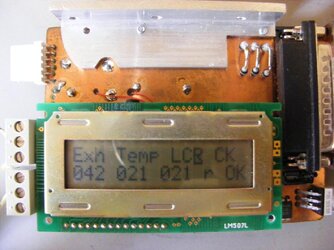
Again this was covered in the light aircraft air cooled motor research papers. It is the lack of cooling incoming mixture unburnt that keeps the around 600C melting point of the piston crown being breached. With this knowledge, made a variant of the iis with onboard temperature readout and closed loop control of the ignition advance, ie limp home mode. Before non contact temperature measurement devices i strapped three thermocouples to the first bend in the exhaust headers, measured around 480C+ in still air. Basic assumption is that the actual exhaust gas temperature is closing in on the melting point of a piston, only cooling is by unburnt fuel/air coming in. Hence my surprise at a modest drop to 7 in plug range would damage a piston, perhaps i am missing something? My kettle ran 7's all its life, then i did design a modern "CDI" for it to mitigate the constant recycled oil fouling the plugs on a cold crank start, looked like a smoke screen of considerable magnitude, neighbors not pleased, rightly so as i went to work. j
 

Attachments

  • IIS_TCT_pcb.JPG
    IIS_TCT_pcb.JPG
    89.8 KB · Views: 15
Last edited:
Miricolo, found the directory of the research documents mentioned. Should someone help me to upload the pdf's to the library will gladly do so. The information contained is remarkable. j
 
Back
Top