A few people commented on the quality of my polishing work so I thought Id post some details on the subject.
Do you really want to do it? its time consuming and back breaking even with the right equipment but its very satisfying especially when someone comments and you can say you did it 8)
Assuming you do want to do it you don't really need to spend a fortune if you have the time and energy but I have rarely achieved that mythical mirror finish when doing it by hand.
If you want to use a bench polisher you need to remove the pats for polishing so order new gaskets for everything you intend to polish.
The results you get will largely depend on what you start with. Some aluminium parts just wont come up perfect. I suspect over time they became slightly porous and no matter how hard you work you still don't get a flawless finish. If you have very deep gouges and scratches over 1mm deep your unlikely to get them out completely.
I use a Draper 250w bench grinder on the draper stand so I can move it outside to work, its stable and at the right height. I suggest getting a higher wattage version as I burned this one out on a few weeks.
On aluminium I often start with 2500 wet/dry to remove light scratches and dings.
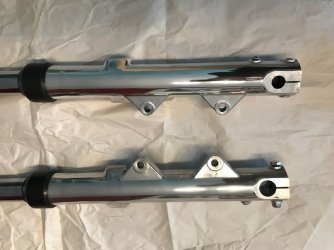
Then I start working the part using the sisal buffing wheel (bottom left) and brown compound until I get a dull uniform finish (a fork leg took an hour).
Next up the colour stitch buffing wheel (top middle) and blue compound until I get what looks like a flawless finish before finishing with the loose fold buffing wheel with more blue compound.
I finish by hand using a microfiber cloth and a dusting of Vienna Lime to remove any smears.
Stainless uses the same mops but different compounds, I don?t want to mix the compounds so I have one set of buffing wheels for aluminium and one set for stainless. Black first with the sisal buffing wheel then Green the colour stitch buffing wheel and then white polishing compound the loose fold buffing wheel. Im really happy with the results.
I have an extension for the polisher that allows ne to use small buffing wheels to get into tight spots and it works ok.
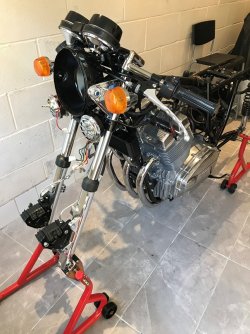
For the engine block Im not looking to polish but clean back the a factory fresh finish, the best results I have gotten are with fine wire wool. Dry rub with the wire wool and finish with a cloth and a little metal polish.
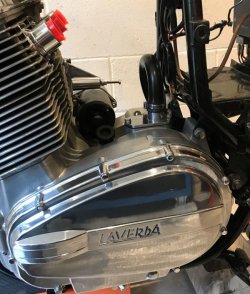
For sharp eyed experts, the primary casings are new and from a 750.
Do you really want to do it? its time consuming and back breaking even with the right equipment but its very satisfying especially when someone comments and you can say you did it 8)
Assuming you do want to do it you don't really need to spend a fortune if you have the time and energy but I have rarely achieved that mythical mirror finish when doing it by hand.
If you want to use a bench polisher you need to remove the pats for polishing so order new gaskets for everything you intend to polish.
The results you get will largely depend on what you start with. Some aluminium parts just wont come up perfect. I suspect over time they became slightly porous and no matter how hard you work you still don't get a flawless finish. If you have very deep gouges and scratches over 1mm deep your unlikely to get them out completely.
I use a Draper 250w bench grinder on the draper stand so I can move it outside to work, its stable and at the right height. I suggest getting a higher wattage version as I burned this one out on a few weeks.
On aluminium I often start with 2500 wet/dry to remove light scratches and dings.
Then I start working the part using the sisal buffing wheel (bottom left) and brown compound until I get a dull uniform finish (a fork leg took an hour).
Next up the colour stitch buffing wheel (top middle) and blue compound until I get what looks like a flawless finish before finishing with the loose fold buffing wheel with more blue compound.
I finish by hand using a microfiber cloth and a dusting of Vienna Lime to remove any smears.
Stainless uses the same mops but different compounds, I don?t want to mix the compounds so I have one set of buffing wheels for aluminium and one set for stainless. Black first with the sisal buffing wheel then Green the colour stitch buffing wheel and then white polishing compound the loose fold buffing wheel. Im really happy with the results.
I have an extension for the polisher that allows ne to use small buffing wheels to get into tight spots and it works ok.
For the engine block Im not looking to polish but clean back the a factory fresh finish, the best results I have gotten are with fine wire wool. Dry rub with the wire wool and finish with a cloth and a little metal polish.
For sharp eyed experts, the primary casings are new and from a 750.