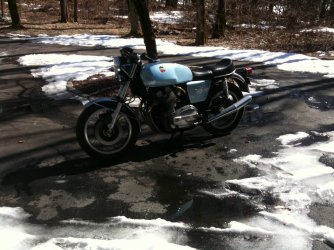
Primary cover needle roller bearing failure

Ken, I know how you feel. The 3CL 100 Pieces in my signature is no joke. The bike is currently splattered across the garage floor, supposedly with parts in containers marked as to where they come from, but...

The wife is still reasonably happy at the moment, but when we hit the middle of summer and her car is still parked outside, who knows :-\

Dave
 
Ken, My 3C had the same problem before I bought it. In fact , the po claimed to have no knowledge of it. It shows up as a machined smooth area where there used to be a"1000". It has not give me any trouble yet other than weeping a little oil. Now I will start worrying about it after reading these posts!

George
 
Piet

Your runout spec for the crank is +/-0.03mm. Does that mean that my highest point on the dial gauge can't be more than 0.06mm higher than the absolute lowest point, or does it mean my total deflection can't be more than 0.03mm?
I did get one bit of good news today, my local crank shop is pretty sure they can true the crank. They absolutely won't rebuild it but if I can get by with truing for a few more years I'll be ahead. My speedometer read 30,000 miles, so assuming it's the actual mileage I'm right at halfway to "normal" rebuild time, so the mains may still have a few spins left in them. Knock on wood.
And I do have a loaner primary cover to use until I can get a replacement (or get mine fixed). I'm hoping my machinist mate will be able (and willing) to take measurements from the loaner to find where the centre of the hole should be. What do you think, alloy or steel bushing insert? I'm thinking steel, the wall is kind of thin.

Ken
 
The crank is designed (regular oil-changes with the right viscosity assumed) for 120.000+ Kilometers (well - originally Piero said, that they were designed for 150.000Km of usage, so almost 100.000 Miles...). Depending on the modell, the bikes usage and the regular oil-changes, I have even seen bikes with 180.000km with first crank and pistons etc. (Hande from Finnland can tell...), so your assumption is not to far from truth, if the millage is correct. If you want to give it a bit more life-time, you could try to scrap and wash out (diesel does a great job here with a an angled welding-wire) the slingers on the crank. Make sure nothing of that goes into the bearings (or wash it seriously out if it does)...!!

Will move the day a bit into the future when the crank does not get oil to the crank bearings of the rods...  ;)

If the local shop could press the crank appart, you could even hone the lower rods' "eyes" to be truly round again. keeps the vibrations down a lot... (new fitting bearings assumed). If not, that should be OK, too, but make sure the timing of the 3 cylinders is still 180? and not 178 or so
 
My 1200 motor has done 170,000 km, cases still virginal and still running original flat top pistons/bores, though I fitted new rings 50,000kays ago. 1500km oil changes have paid off.
Am about to fit new Ross H/C pistons, was thinking of splitting the cases for a looksie, maybe new g/box bearings. Should I attempt to clean out the slingers? Was thinking better to leave alone than run the risk of moving shit into the mains. I'd need to be 100% sure they were clean, anyway of checking?
 
no, there is no way of checking if you get crap into your big end bearings, which you will, stands to reason

you have a slinger full of crap, you start wriggling any form of wire in there and you are going to upset it
so then you have crap going everywhere
right next to the slinger, conviently sitting inside the slinger itself is the bored out big end pin
so crap is going to fall into this bored out pin area
so what happens when you start the engine ?
all this crap is going to go for a journey through your big ends, no where else for it to go
it cannot go backwards against the flow of the oil and be re-deposited in the slingers for example

I'd be way more concerned about destroying the big ends as opposed to the mains, they are just an open bearing
the big ends are in a closed in environment, only way for the crap to get out is to pass through the bearing rollers and then up through the piston spray holes

Rob, when the time comes, if you wish, I can send you a rebuilt crank and you can just swap it when engine is apart and send me back your old crank
is up to you

Tchau
Red

 
I did about 90,000 miles on my first triple with just oil changes every 1500 miles or so and when I removed the crank it had a bit of wear in the small ends but no discernable vertical movement in the big ends and the mains seemed fine. I had a 10,000 miles old crank to compare it to. The bike had not been used gently either.
 
Laverdalothar said:
If the local shop could press the crank appart

Lothar, the local shop (Falicon) actually could get the crank apart for me, they have done it with a couple of Laverdas already. But they weren't able to get them back together for their customer, and had to give them back as a box of bits. Strangely, the customer was not happy...
But they have agreed to true the crank for me without pulling it apart, and these guys are experts on pressed motorcycle cranks (they're mentioned in most of the American printings of Japanese workshop manuals for Yamaha, Suzuki etc, and they actually do build cranks for most of the top American road and drag racers). So I do trust them to do a good job of truing.
And I'm trying to persude them to think objectively about doing Laverda cranks. If they can do Ducati and BMW 1970s cranks with slingers, there's no reason they can't do Laverda cranks, they just need the right fixtures for the press. I just have to persuade them they want to do it.
Sure, I'd like to send my crank to Red or Piet. But they're 5 minutes from my house, and shipping to Brisbane or Bonn adds a lot onto the cost of a crank rebuild. Not to mention the risk of losing the crank in shipping.

Ken
 
Ken,
I would guess that their main issue is that they could not source the correct big end bearings and were not prepared to re-use the old ones.
Just guessing here.

The very first crank that I did I was given by an owner that had taken his crank into Serco in Brisbane.
They do all manners of Jap cranks, Ducati cranks, old British cranks, etc.
Same happened to Old Bill, Serco stripped the crank, then could not source the bearings so refused to put it back together.
Thus I scored a box full of Laverda crank webs and Conrods.
Hence I machined my fixtures as a way of locating the phase in the correct spot.
Plus numerous other fixtures to build his crank back up.
For the big end rollers, we bought 1000 rollers that were longer, went and bought a surface grinder, made fixtures and ground them all down to correct length.
That first crank most likely cost me 3 weeks machining and around $6,000 in machinery and steel.
Took a bit of a loss on that exercise but now I have the fixtures I need.

Next year I plan on making fixtures for the 120 degree cranks and the 500's.

Tchau
Red

 
Red

You're right, they couldn't get bearings was one of the problems, must have been before Wolfgang set up shop and the owner didn't know enough to contact Slaters or Ralph Allen. But they also told me they thought they had press fixtures that would work and discovered (like you did) that they'd need to make new ones. Since these were the first Laverda cranks they'd ever seen they decided that the volume of work probably would never be great and they decided not to invest their time into making fixtures.
I'm trying to persuade them to reconsider. But if they don't have the fixtures they just don't have them. If it takes that much time to make them, they probably won't do it. Never hurts to ask, though.

Ken
 
Hey Red, So I better leave it alone then eh! I'm a, "if it ain't broke don't fix it" sort of guy so maybe I won't split the cases either then. Grant is moving to Oz and bringing me one of his spare cranks and thinking of getting you to redo it with carrillos etc for that day when my crank decides to give up. Doing an exchange service is a great idea. Must be alot of lavs coming up to the time for a new crank so you might find yourself busy.
 
I stopped in at Falicon today to see if they'd confirm that they could true my crank, although what I had given them was my spare (supposedly good) crank. They said that they could definitely true it, but the one I'd given them was about .004 inches out of true. So I guess I need to get that one done before I worry about the one in the bike.
But they suggested welding the left end after trueing to stop it happening again. Their crank welding is only on the surface and doesn't prevent future rebuilds, and they do it on all sorts of crankshafts. But this is the first time I've heard of a welded Laverda crank. OK, I seem to remember idiots building drag racers back in the 70s using welded cranks but they were in a different universe (probably somebody on this forum :-X, good thing I don't remember any names).
Anyone have any thoughts on welded Laverda cranks? I think it's probably unnecessary but Piet's comments about the left end getting out of whack and eating another cover bother me, and I suspect a few others too. Maybe welded cranks can be added to the list of technologies worth adding to Laverdas?
Incidentally, Wolfgang is now selling brand new sandcast primary covers, I think from Ricardo Oro. He's very enthusiastic about their quality, and they're a little cheaper than NOS. He's not ecstatic about some detail work on the lettering, unfortunately, but after a few layers of bitumen spray, engine oil, brake fluid, rabbit/kangaroo fur/skin/guts, and spilt beer, who's gonna notice?

Ken
 
Hi Ken,

Don't think a spot of weld will help much if you fall over and stress the crank end again..... they don't go out of whack from nothing!

The interference fit is quite ample to hold everything in place, no need for welding.  And as long as nothing seriously goes wrong inside the engine, the crank will not twist by itself.

Re. tolerances, 0.03mm is my max/total run-out that I aim for (and usually achieve) when truing a triple crank.  The factory specified +/-0.05mm which gives a possible total of 0.1mm.... no wonder they shake and rumble!!  Your 0.004" are right at the factory limit, let the guys at the crank shop try to whack it back into shape!

Please don't make the common mistake and handle your newly trued crank roughly!  They may weigh a ton and look as though you could pry an oil tanker from the pier with it, but the things are actually VERY delicate, a firm thump can put all your efforts to waste.  Handle it with the utmost care, like a dozen eggs in a paper bag...... once it is firmly tied up in the cases, you can give it all the stick you want.

piet
 
Piet

Thanks a lot, that clears up a couple of things. This week is pretty much shot now, Thanksgiving is on Thursday and most people sre shutting down, so I don't get any riding done :(. Hank the Crank (or whatever the pressed crank expert's name actually is) won't actually be back at Falicon until Monday, so I'll leave the message "no welding , thanks". I did discuss that .004" runout was way more than I was interested in, I wanted to get it down to .001" (tried measurements in millimetres and got some very blank looks). My spare crank is definitely low mileage (well, according to Ralf Vogelhuber  ::)), so I'll be very interested in seeing if I can tell the difference in smoothness.
I wonder if it would be worth trying to fit a couple of dowels to firmly locate the primary cover (since I'll have it in a mill anyway) to reduce the chances of this happening again? But then I'd also have to mill corresponding holes in the crankcases ... forget it :'(

Ken
 
One thing to keep in mind after it is trued is not to tighten the right side[ignition side] nuts by locking the primary side. It could twist it out of true.
 
regarding the new engine covers: I have seen them at Andreghetto's shop last year in Breganze and he claimed to be the one that let them build. That might be very much true, as he showed me several versions and prototypes, some not yet polished, not machined etc.

I can not comment on their accuracy in terms of measurements, but the look was awesome! The only way you could tell it had been sandcasted, was f.e. on the 120? alternator cover the "ring" around the Laverda Logo, which was not as smooth as with the original covers (which had been die-casted). Oh - and from the inner side you see the rougher surface, too. But else, they really do look great, mirror polished. Could slap myself for not buying one last year... He offered the 120? Alternator cover for 230?. Currently, these things are on ebay for almost twice as much...  :o

HTH
 
Ken,

Don't add extra locating dowels to the cover, any inaccuracy, however small, will lead to further loading of one or both needle bearings.  Let the cover locate itself on the bearings.  As long as both shafts run true, or are well inside the tolerances, all will be well.  Once the crank end is trued, the escaping bearing phenomena should never happen again.  Run out must be checked at the needle bearing race, also.  While 0.02-3mm (about 0.001") at the main is acceptable, this shoukld also be carried over to the crank end.  Anything above 0.04mm can cause further troubles.

Check the centre mains for slop before you commit yourself to installing your "new" crank.  The outer races do have a bit of play, these are C3 class bearings with almost 0.03mm radial clearance.... so you will need to asess if the play is excessive or not.  If the play is excessive, ie, more than 0.05mm, the crank will rumble and vibrate.  OK for a stop gap measure to get you over next seasons' riding, but not a long-term solution.

To ascertain if the crank is "low-mileage", take a peek into the oil slingers.  The outer race of the main bearing adjacent to the cam drive just slips off and allows a fair view into the murky regions.  Don't poke around in them with a bit of wire, etc, just try to see if you can recognise a solid build-up of black muck under the oil residue.  Low mileage cranks have very little to no crap at all in there.....

HTH,
piet
 
mcnicol said:
Anyway, I only know of one place in North America that can do anything with Laverda cranks, the mob that Paul LeClair uses in British Columbia. And shipping that lump of steel both ways alone is going to cost a chunk of change :o. I could probably send it to you for not much more. But what actually needs to be done if the runout is excessive, and should I be thinking about sending it to you or try the locals?
By the way, I do have a spare crank, so downtime is not so critical (assuming it's actually the right crank, and not defective). But it's been over 30 years since I last dismantled a Laverda engine, and I suspect I'm not as confident in my own abilities any more, especially with nobody to help me if I mess up. ???
Ken

Hi Ken

when I talked to Falicon two years ago they weren't even interested in LOOKING at a Laverda crank, guess it helps you are just down the street and can drop by.

The outfit Wolfagng has been using, abnd referred me to, for crank rebuilds is found here:

http://www.mongoosemachine.com/

great service, i sent them a copy of the factory manual re cranks, tolerances, etc, and also gave them Wolfgang's number to call with questions. They fitted all new brearings supplied by Wolfgang, fitted the  Carillo rods, and trued everything. When I tried to measure runout when I got the crank back, my modest measuring equipment didn't measure ANY runout at all. I shipped the crank to them, and back from them, in a very well armored crate with home made saddles to locate the crank, and I shipped by GreyHound Bus Lines, about $25 each way if I remember correctly.

oh, and I am the idiot who was welding Kawasaki 900 cranks back in the 70's. At the drag strip with 1400 cc kits, a big slick, and a really hard launch, you would spin the pressed together crank parts within each other if they weren't welded...... wasn't a big deal, Kawasaki cranks were cheap and plentiful, and the drag motors never lasted very long anyways..... :o

Paul LeClair
 
Ken:  Some solidarity from my 3C
(no longer like that though)
 

Attachments

  • rsz_3img_0555.jpg
    rsz_3img_0555.jpg
    194 KB · Views: 24
  • rsz_1img_0558.jpg
    rsz_1img_0558.jpg
    163.6 KB · Views: 44
sfcpiet said:
 Run out must be checked at the needle bearing race, also.  While 0.02-3mm (about 0.001") at the main is acceptable, this shoukld also be carried over to the crank end.  Anything above 0.04mm can cause further troubles.

Piet

The local crank shop (Falicon) has apparently never seen a crankshaft with C3 main bearings. Or maybe they just wanted to get rid of me, but they said my "new" crank wobbled around so much that they couldn't true it with their equipment. They did sit it on V blocks to determine runout, but when they gave it back in "as good as we can get it" shape they didn't charge me anything. So I'm thinking they probably didn't do a whole hell of a lot....
But anyway, I finally pulled off my primary cover and discovered a couple of things. One was that the bearing hasn't spun after all (I think), it was just the inner race on the end of the crank that spun itself out through the primary cover. I did check crank runout at the extreme end, but I only have a lousy dial gauge and I was having trouble finding something heavy and magnetic to attach it to. But it does appear that the runout at the needle bearing is about .0025 in , about .06mm. I think I may not have to pull the crank after all. The inner race of the needle bearing was quite badly worn around about 3/4 of its circumference, so I couldn't see if there was an area worn flat.
What do you think, if I replace the crankshaft outrigger bearing and inner race, Loctiting the inner race in place, can I get another season's riding out of it while I have my spare crank rebuilt properly?

Ken
 
Back
Top