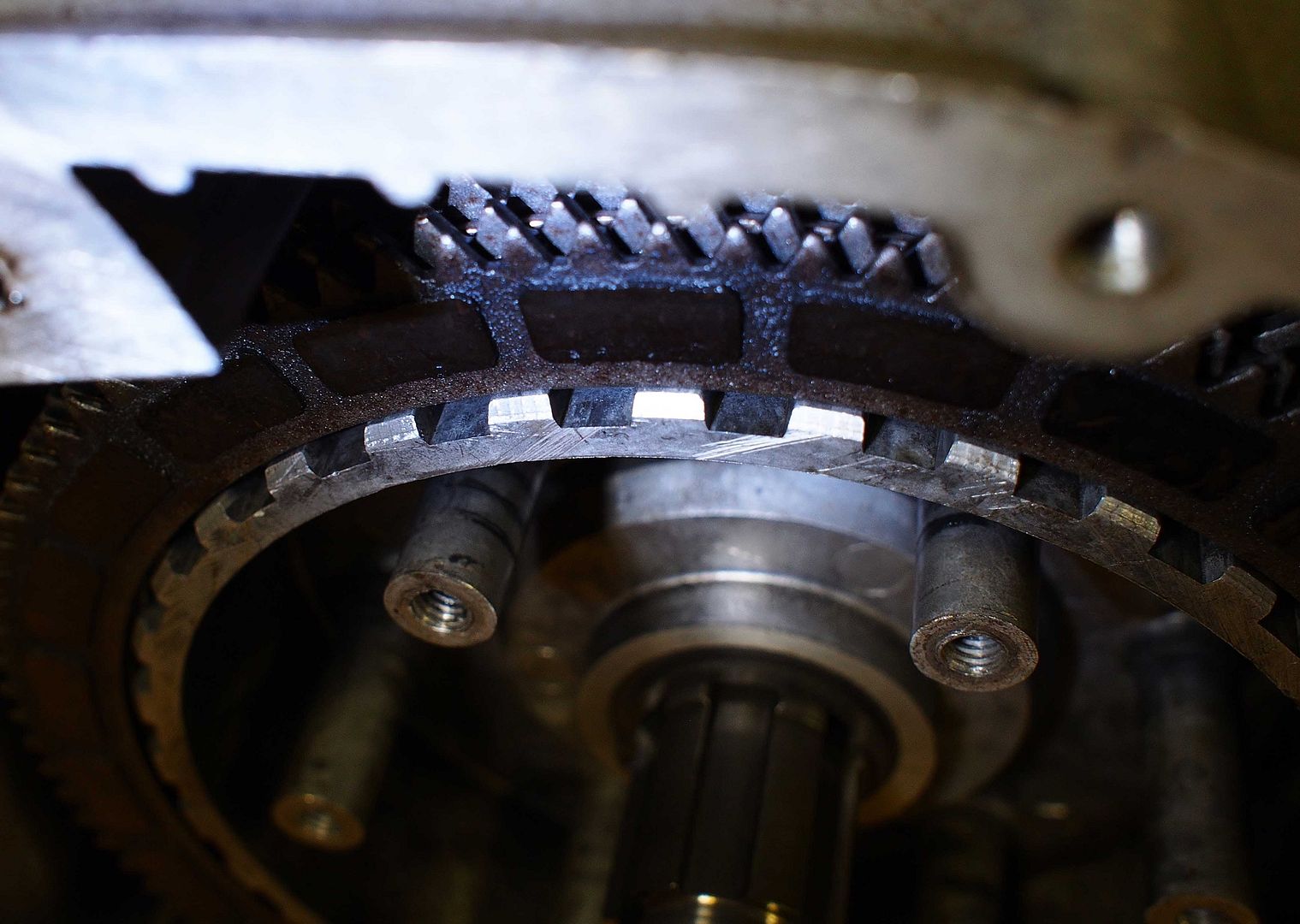
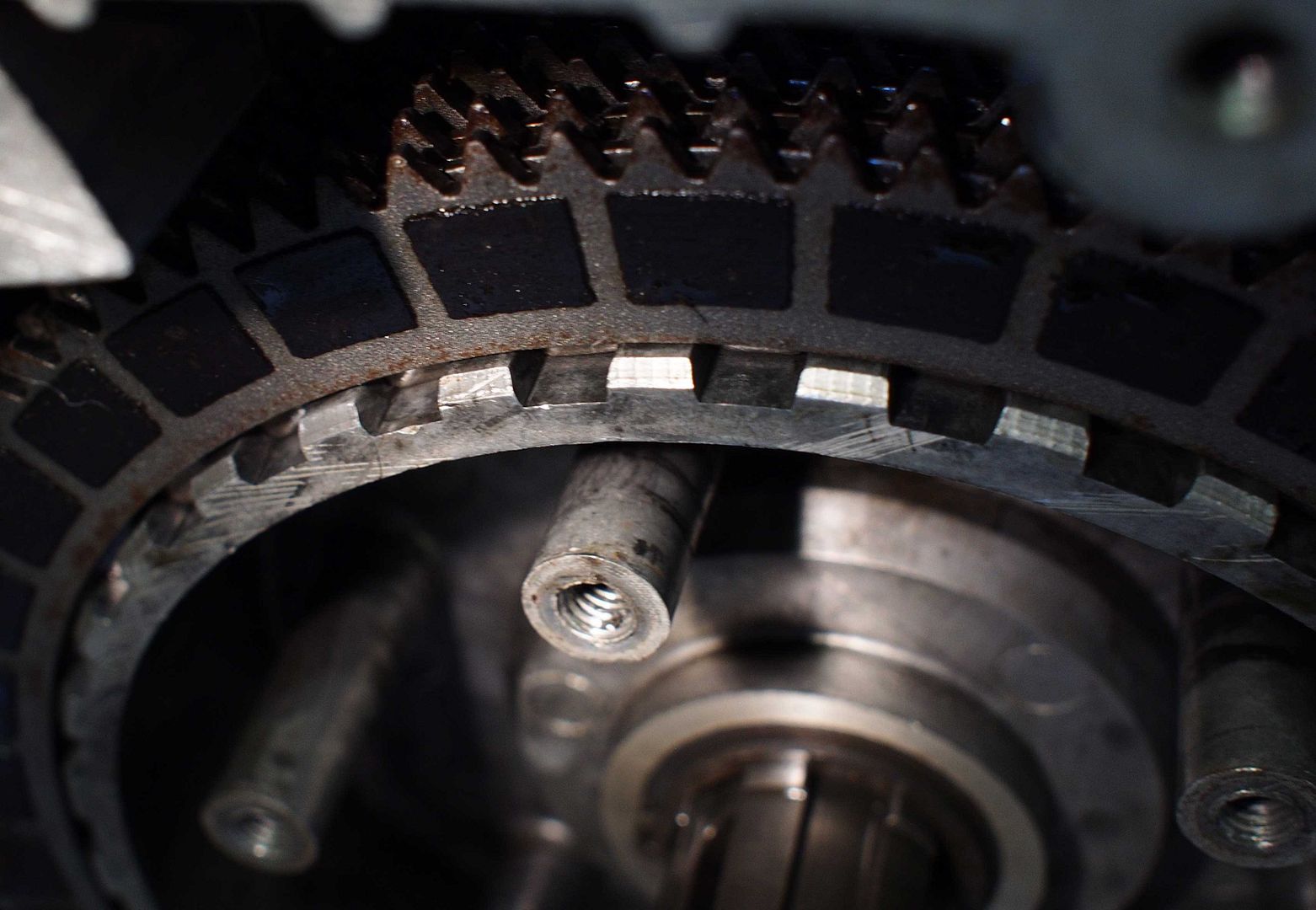
Primary drive chain removal RGS

  • Thread starter Thread starter Reggie3cl
  • Start date Start date
I think you've invented a new scientific term Piet - specific pressure. Not sure what you mean by that.

For the same spring force, the actual pressure (in psi, kg/m2 or Pa) applied to the friction surfaces of a multi-plate clutch remains the same regardless of how many plates there are. That's one of the advantages of a multi-plate clutch, it's easy to increase the friction area without decreasing the pressure.  But you're right about the additional spring preload. An extra friction plate will compress the springs by an additional 3mm. So it's the combined effect of the increased friction surface and spring pressure that stops the thing slipping.

The Laverda clutch must be a pretty marginal design. My Jota clutch started to slip before the plates had worn down to the service limit (thus decreasing the spring force). The one in my RGS engine was re-built with a new set of Red's plates and new springs, 3 of which were heavier than normal. It still couldn't handle the increase in torque that Red built into the engine. There was sufficient room on the splines for the extra plate, so I put one in - problem solved.

Perhaps the next step in the evolution of these engines would be to graft a better clutch onto it. Modern sports bikes are cranking out way more torque than our old Laverdas and their clutches handle it OK with feather-light lever action.
 
Perhaps the next step in the evolution of these engines would be to graft a better clutch onto it.

Oh Gawd, it never ends, does it?

Re: Sticking the extra plate in- is there enough in the actuating mech (slave cylinder, rods) to take up the slack from the extra thickness of the clutch pack, or was a longer clutch rod needed for it to work properly?
 
Clutch slipped, added extra steel plate between the two friction plates, ditched the two springs. Problem solved ???
 
it really depends on if your friction plates are worn down enough, if your plates are fairly new and measure around the 3.00 - 3.10mm mark thickness wise then no, there is not enough room for the extra steel plate
when you remove the pressure plate see how much of the clutch hub spline is showing with all the plates still in place, you should have 2-3mm, any less and you can wind up with worse issues as the pressure plate can clear the clutch hub spline when activated and then have trouble returning smoothly as it searches for the spline again

also, don't forget, a triple pressure plate can only be installed in 2 out of the 6 available positions so make certain the pressure plate is engaging over the clutch hub splines on assembly

 
Dellortoman said:
I think you've invented a new scientific term Piet - specific pressure. Not sure what you mean by that.

For the same spring force, the actual pressure (in psi, kg/m2 or Pa) applied to the friction surfaces of a multi-plate clutch remains the same regardless of how many plates there are. That's one of the advantages of a multi-plate clutch, it's easy to increase the friction area without decreasing the pressure.  But you're right about the additional spring preload. An extra friction plate will compress the springs by an additional 3mm. So it's the combined effect of the increased friction surface and spring pressure that stops the thing slipping.

The Laverda clutch must be a pretty marginal design. My Jota clutch started to slip before the plates had worn down to the service limit (thus decreasing the spring force). The one in my RGS engine was re-built with a new set of Red's plates and new springs, 3 of which were heavier than normal. It still couldn't handle the increase in torque that Red built into the engine. There was sufficient room on the splines for the extra plate, so I put one in - problem solved.

Perhaps the next step in the evolution of these engines would be to graft a better clutch onto it. Modern sports bikes are cranking out way more torque than our old Laverdas and their clutches handle it OK with feather-light lever action.

Cam,

What I meant is the spring pressure in relation to friction area.  Yes, giving it another thought, pressure remains the same, apart from the slight increase through the spring preload (more like 2mm, plain plate is added between the 2 friction plates). 

Don't think the clutch is marginal from a transmission POV, over-engineered but crude would be closer to the point.  The inner splines of the basket are difficult/expensive to machine and the narrow thrust surface of the plates causes sharp indents in the spline surface (modern friction plates usually have thickened tangs engaging with the basket prongs, spreading the load over a greater area).  The sheer number of splines spreads this load a bit, so it does take some time till the indents become deep enough to actually cause problems.  The closed construction of the light alloy basket creates a lot of unnecessary noise, the open pronged baskets make nowhere near as much racket.  The actuation by cable is crude and inefficient, ball/ramp systems work a lot smoother with far less force required and work constantly well over a wide range of adjustment.  The Laverda system works well in only a very small range of movement, lever geometry needs careful setting up.  The actuation would benefit from a form of adjustment between lever and pushrod.  Thankfully, hydraulics have dealt with most of the actuation issues.

If the Laverda clutch were perfect, it would only be half the fun... :D  The stock clutches in both my road triples, as well as the track bike, work and behave nicely, the 750 clutch will get a work-over (anti-rattle springs will be fitted to further quieten things down) next time I renew the primary chain.

piet
 
Hey Brett I can think of a few factory updates that were ill-advised/rushed/badly thought through.
A combination of penny pinching or knee-jerk reaction to impending noise regulations maybe.
Centre main bearing springs to mind as an example.

My Corsa had around 14000 miles on it when it started to slip so not stellar mileage.
I just added the extra plate and the problem evaporated.

I have fitted 2 sets of Red's kevlar plates but to 180s in the last couple of months but too early for any feedback from me. But from others' accounts they solve slip and sticking-together issues.
 
I had a new set of Sure Flex plates fitted 25 years ago to stop the slipping and still remember the look of delight on Norms face as I struggled to stop the drag on first starting the bike at the shop. It took a good 50ks for close to correct operation of the clutch to happen.The complete opposite happened when Reds plates went in.
They worked fantastically well right from the start, no drag or slip and a great feeling friction point. Could have been the bloke doing the work,Norm had issues but thats my experience
 
Well I'll check everything carefully before just dropping in a new plate.  I've got a 50/50 mix of old and new plates in my meagre spares box because, as I said, I couldn't get the clutch to work properly on my 180 with a completely new set.  Should be able to sort out something anyway.

Wonder whether that SKRRRT noise it used to make was the pressure plate struggling to engage properly with the splines as Red mentioned.


Grant said:
Hey Brett I can think of a few factory updates that were ill-advised/rushed/badly thought through.
A combination of penny pinching or knee-jerk reaction to impending noise regulations maybe.
Centre main bearing springs to mind as an example.

My Corsa had around 14000 miles on it when it started to slip so not stellar mileage.
I just added the extra plate and the problem evaporated.

I have fitted 2 sets of Red's kevlar plates but to 180s in the last couple of months but too early for any feedback from me. But from others' accounts they solve slip and sticking-together issues.

Ok valid point I guess but you have to remember that they were chasing noise by then to get the engines quieter to meet regulations plus............as you have stated you got 14000 miles before slip started which is about what I got I guess.. I did try another plate and heavier springs but around Wanneroo was still slipping.. swapped out the used clutch plates both fibre and steel .. for new and back to original set up and again no slip for another 30 odd K's.
Have 25K's now on the RGS ( again with the springs ) with Red's plates so if they are still hanging in in another 10 or so K will deem it a fix. Again please don't tell Tom when I fit them to the Corsa I couldnt stand it by him telling me the plates no original  :D

Now Cam,  Red has already taken the next step in the evolution by using an evolved clutch plate material.

Reggie it may well be you have to make sure that the pressure plate is installed in the correct position

 
My addition of a single (used) plate did the job and was cheaper than total replacement with all new plates.

Red's offering is the way to go, as it seems to cure the plate sticking issue. I've had that on several bikes. Think it's a combination of factors but I suspect oil additives play a big part.
Also had a bike in last year that the owner had left for 5 years or more with fuel taps open. When I drained the oil 8 or 9 litres came out instead of the expected 3 or so. Yep, all the fuel had slipped down into the sump and had been sitting there for several years. Worst case of sticking plates I have seen to date. It got Red's kevlar plates and now working perfectly.
 
I have never had a sticking plate issue but Red did do his drum drilling stuff during one of the builds,allows more oil access
 
Vince said:
I have never had a sticking plate issue but Red did do his drum drilling stuff during one of the builds,allows more oil access
Good thing to one less thing for you to worry about let alone tinker with.... now we lubed the cable and reco'd the pivot,  bet your clutch is perfect and ready for the Snowy run
 
Wondering why glass or sandblasting the plain plates is?nt mentioned.In my experience,no more slipping even in my 80.5mm bore h.comp.RGS (200 000km). My clutch is std except for the "anti rattle"springs which I took out in 1994 (My ears cannot sence any difference in mechanical rattle)
 
Going back a bit the pickup rotor has a woodruff key, so in theory slides off with a two/three legged puller.
Keith Nairn did have problems with clutch slip when my Jota 120 was with him. Unfortunately he didn't have stock of the kevlar plates at the time so sent up some heavier springs to do 50/50 light/heavy and problem fixed. Worth point out my engine is a good used Euro spec one, so power output not as big as some.
Cam, modern bikes seem to get their extra whizz with more rev's.  Not sure if torque is massively more.
 
Clutch sticking usually comes down to oil choice.  Very good experience with Motul 3000 20W50 in the big bangers.

If you guys think the big twins and triples are badly affected, you haven't ridden one of the tiddlers with the wrong oil... freezes after only an hour or 2, and the clutch won't even disengage decently once it's free-ed up.  Change the oil, and it works perfectly!

Perhaps more modern friction materials aren't as fickle as the old stock stuff.  I use 20W50 that I buy in bulk in my road bikes, no clutch issues except in the RGS, that sticks ever so slightly after a week or more standstill. 

piet
 
Per Red's message- this is the clutch pack with an extra friction plate in.  The pack is close to the edge of the angled shoulder of the drum- too close?- or are we talking about to the actual vertical edge of the drum.  Don't want to button it all up and then have to take it apart again...

PA020188small.jpg
 
Reggie,

If you consider total lift of the pressure plate, you're getting precariously close to having the pressure plate going over the edge...

Stick a depth guage down the bore of the mainshaft to measure the lift of the pushrod, pull the clutch.  Compare to what you've got on the hub.  I would need at least 2mm overlap to sooth my conscience.

piet
 
Hmm, did think it looked a bit tight.  I'll make up a pack with the new plates I've got and compare.
 
Ah, now a need to remember what plates are in there- all along I was thinking the pack started with an extra steel plate, but it is of course an extra friction plate.  Pillock.  Add in an extra steel (not friction as I did before) and I think there is enough of the shoulder of the drum showing.

PA030189small.jpg
 
Reggie,

Have a close look at your plain steel plates.  You will notice a rounded and a sharp edge at the splines.  It has shown to be a good idea to position all plates in the same orientation, ie, all rounded edges in the same direction.  I fit them with the rounded edges facing inwards, aiding the plates' movement when the clutch is engaged.  Maybe that's the reason my clutches don't slip? :D

Back in the Moto Witt workshop, we were experiencing a spell of extreme clutch slipping in new H-D Sportsters.  Eventually, a service bulletin stated all plain plates (which were stampings, just like Laverda plates) were to be fitted in the same orientation (ex-factory, they were fitted randomly), this immediately cured all slip in clutches that were otherwise in good servicable condition.  I've applied this practise to all Laverdas ever since...

piet
 
Back
Top