78jotadave
Hero member
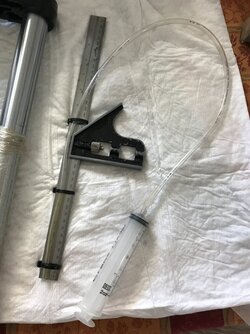
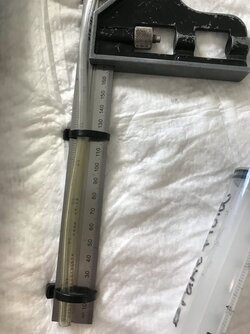
I use my own homemade fork oil level tool with no mess, no fuss, and dead accurate every time.
Cheap, easy to make, and use, you probably have all the pieces in your toolbox or shed.
Adjustable square (preferable with Millimeter measurements)
Plastic tubing, I use the same size tubing that I use for bleeding brakes'
3 zip ties
60 mm irrigation tipped syringe, works easier than a Luer lock syringe.
On my Marzos that have a RaceTech full kit, the oil level is measured from the top of the fork legs with springs removed, emulator in, and the forks fully compressed.
Add oil slowly and then move the stanchion up and down a few times to remove any air bubbles
You set your fork oil level by sliding/setting the measure to the desired depth from the top of fork, insert it into the fork and use the syringe to suck out excess oil, you have your exact measurements every time when you cannot suck any more oil into the tubing, repeat for the other leg.
Fork settings for me an 80kg rider plus gear who favors the sports side of sport touring.
I have my oil level set at 150mm below the top of the fork leg (10wt RaceTech oil). Not all fork oil weights are equal among the many different manufacturers
FEGV S3801NV Emulator with #64 Emulator spring, Emulator preload 2 turns
Racetech springs S3234 085 (.85kg/mm) with 15mm preload I used .95 springs for a while but they were way too harsh
and finally 38-40 psi in the Bridgestone front tire.
This is the very best setting I have come up with I recently tested it on a 1000mile road trip up Highway 1 on the California coast and numerous canyon side roads it worked great, plus it was not harsh on sidestreets or potholed backroads in fact it worked a treat

For several years I ran a more track-oriented setup, 10wgt oil 100mm from the top of the tube with the '95kg/mm springs and the emulator on 4 turn preload, while this was good for the track I don't do track days anymore it was way too harsh on the street even for sport touring.
I hope this is of help to others, Cheers Dave
Cheap, easy to make, and use, you probably have all the pieces in your toolbox or shed.
Adjustable square (preferable with Millimeter measurements)
Plastic tubing, I use the same size tubing that I use for bleeding brakes'
3 zip ties
60 mm irrigation tipped syringe, works easier than a Luer lock syringe.
On my Marzos that have a RaceTech full kit, the oil level is measured from the top of the fork legs with springs removed, emulator in, and the forks fully compressed.
Add oil slowly and then move the stanchion up and down a few times to remove any air bubbles
You set your fork oil level by sliding/setting the measure to the desired depth from the top of fork, insert it into the fork and use the syringe to suck out excess oil, you have your exact measurements every time when you cannot suck any more oil into the tubing, repeat for the other leg.
Fork settings for me an 80kg rider plus gear who favors the sports side of sport touring.
I have my oil level set at 150mm below the top of the fork leg (10wt RaceTech oil). Not all fork oil weights are equal among the many different manufacturers
FEGV S3801NV Emulator with #64 Emulator spring, Emulator preload 2 turns
Racetech springs S3234 085 (.85kg/mm) with 15mm preload I used .95 springs for a while but they were way too harsh
and finally 38-40 psi in the Bridgestone front tire.
This is the very best setting I have come up with I recently tested it on a 1000mile road trip up Highway 1 on the California coast and numerous canyon side roads it worked great, plus it was not harsh on sidestreets or potholed backroads in fact it worked a treat
For several years I ran a more track-oriented setup, 10wgt oil 100mm from the top of the tube with the '95kg/mm springs and the emulator on 4 turn preload, while this was good for the track I don't do track days anymore it was way too harsh on the street even for sport touring.
I hope this is of help to others, Cheers Dave