Re-torquing procedure

Dennis

Senior member
This is probably a basic mechanical question but I have asked several people and get conflicting answers. Best to ask the experts here I think. After reassembling the engine on my 79 triple I see that there is a slight bit of oil weep on the left side of the head gasket (yes the O rings are in place) which I hope will be cured by re-torquing the cylinder head nuts. What is the correct way to do this? Following the correct sequence, do you slacken off the nut and then re-tighten to the specified torque, or do you just re-torque without slackening the nut?
Dennis
 
Just re-torguing to the specified torque.


This is the correct way to do it:
http://www.laverdamania.net/cul_torque3.htm
 
Hi Cyriel, although I thank you to have undust this old file in my website, I think it is better to slack off the nuts one full turn before retightening them. (parcel arrived safely BTW, many thanks again!)
 
Dennis,

1 in 10 attempts at that are actually successful in stemming the oil flow.  Most probably your cylinder liners stand slightly proud of the cylinder casting at the spigot.  This prevents full tightening pressure to be applied evenly over the entire sealing surface and your gasket will merrily keep weeping.  The o-rings are only a supplementary seal due to the proximity of the stud bores to the sealing edge on early engines.  They were carried over to the later gasket/sealing surface design, but if the gasket itself seals correctly, they're not really needed.  

That the liners stand proud is nobodies fault, just a natural phenomenon.   The alloy shrinks over time due to the many repeative heat cycles, the liners don't!

When re-torquing, you should first slacken off the nuts, one at a time.  

You'll probably also find conflicting torque values.
I use 22Nm for the outer M8 studs, 28Nm for the long M9 studs through the cam bearing blocks and 32Nm for the short M9 studs.  The M7 studs each side take 15Nm.  Most manuals state considerably higher values, but I've found my figures to cause less strain on studs and casing threads and result in an oil-tight seal nevertheless.

HTH,
piet
 
dennis,

on fresh engines i simply retorque in the correct sequence
as cyriel has posted

on engines that have been together for awhile
i loosen one 9mm, oil the threads and washer and retorque
then each in turn, again, in the correct sequence

i then go back through the sequence one more time
to make certain all have reached the correct torque

as piet points out there should be a different value for the different length 9mm studs
but i believe he has it backwards, the longer studs need a higher value
as they will stretch more to reach the required clamping pressure
than the shorter studs

i also position my torque wrench in such a way
as to reach the torque value in one smooth pull

if it is a new build it gets the first retorque after the first heat cycle
when completely cooled. after the first road test and cool off it gets another retorque

if you have a slight weep check the closest exhaust rose
any weep here will flow around the side and appear to be a head weep

cheers,
scott
 
jotacorsa said:
dennis,

on fresh engines i simply retorque in the correct sequence
as cyriel has posted

on engines that have been together for awhile
i loosen one 9mm, oil the threads and washer and retorque
then each in turn, again, in the correct sequence

i then go back through the sequence one more time
to make certain all have reached the correct torque

as piet points out there should be a different value for the different length 9mm studs
but i believe he has it backwards, the longer studs need a higher value
as they will stretch more to reach the required clamping pressure
than the shorter studs


i also position my torque wrench in such a way
as to reach the torque value in one smooth pull

if it is a new build it gets the first retorque after the first heat cycle
when completely cooled. after the first road test and cool off it gets another retorque

if you have a slight weep check the closest exhaust rose
any weep here will flow around the side and appear to be a head weep

cheers,
scott

Scott,

I deliberatly try to avoid crumbling/squashing the cam bearing blocks, especially the early type won't stand up to higher torque figures.  The now available billet bearings can thankfully take all you throw at them!! :D  Theoretically, the longer studs should get a slightly higher torque than the shorter ones, but I don't see the slight difference making any real impact. Especially as doing it the other way round is also sufficient.

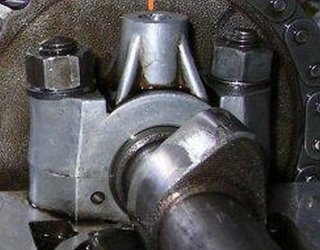
After a re-build, I re-torque after the 2nd. or 3rd. heat cycle and recommend the owner to bring in the bike for a re-torque again at around 500 and again 1000km.  Oil leaks are then a thing of the past, provided the sealing surfaces are OK to begin with.

piet
 
"avoid crumbling/squashing the cam bearing blocks,
especially the early type won't stand up to higher torque figures"

thanks for the reminder piet, it didn't occur to me to mention it
right, too, that the torque differential, in practice,
doesn't seem to have much impact on std engines

cheers,
scott
 
The length of the stud is not a factor in how much torque should be applied. Torquing a long stud and a short stud to the same torque will give exactly the same clamping force. The only difference is that it will take more turns of the nut on a long stud to reach the specified torque because the stud will stretch more.

Cheers,
Cam
 
Often seems to be the LHS that leaks though.  Gonna re torque mine today to try to stem the Torre Canyon type leak, probably won't work though...
 
Squashed bearing block? Look at these, they are in my 3CL since at least 10 years and they will wait until the nest head rebuilding!  :D
 

Attachments

  • cam_bear.jpg
    cam_bear.jpg
    67.1 KB · Views: 44
JLO, one of my head studs on my 3C stripped and having no option I ran it like that for a very long time. Still went ok ha ha! The cam bearings looked like yours too. When I eventually put it all right it seemed to run worse not better! God I used to hammer that bike.
 
Really, loosen off and re-tighten?  This is a new one on me

So, exactly what are the right torque settings in foot/pounds please?

Thanks
 
Cyriel provided a link in his earlier reply that answers your question.  There's also a forum search facility that could do the same  ::)
 
"Really, loosen off and re-tighten?  This is a new one on me"

the nuts should already be tight and the effort to break it loose in the tightened direction may exceed the required torque
due to the tension between the nut and the washer so you don't really know if it is accurately torqued
 
A bit of a physics...

Just to put a name to what Scott described, it's static vs dynamic friction.

Static friction is nearly always higher than dynamic, so it takes more force to get something moving than it does to keep it moving - the "break it loose" effect Scott mentioned. Torque figures in the workshop books refer to dynamic friction (to quote static friction figures would be daft), so you need the nut to be moving when the torque wrench clicks. It's no use trying to test the torque on a tight (stationary) nut, so you need to back it off and re-tighten in a smooth motion.

Just to illustrate the effect to any non-believers: Press your finger on the table top and try moving it very slowly. It moves in short jerks as the lateral force you apply first breaks the static friction and then it slips along for a bit on the reduced dynamic friction until the lateral force is relieved enough to allow it to stop, then the whole cycle repeats. It's exactly the same affect that makes a rusty hinge squeak, a violin sing when stroked with the bow, or makes your engine go "tink, tink" as it cools down.

Encourage your kids to study physics. It will open their eyes to many things.

Cheers,
Cam
 
far too complicated for me
I call, it "stiction", release it by backing of a single nut,(only ever do one at a time and in the corect sequence) then add squirt of clean engine oil under  it, then retorque.

Cam
another example is a locked wheel (if my thinking is correct) but sort of in reverse,it takes a lot of force to lock a motorcycle wheel, but not much force to keep it locked once the tyre is skidding.

CLEM
 
Dennis,
Sure hope that the re-torque  works. Are you using a conventional new head gasket? assume it didn't leak before the teardown? were the surfaces ok i.e level and unscratched?Was it an engine out job or did you try it in the frame...can be difficult to ensure that the o rings dont get partially shoved out of place when replacing the studs...
Nick7
 
Back
Top