
You are using an out of date browser. It may not display this or other websites correctly.
You should upgrade or use an alternative browser.
You should upgrade or use an alternative browser.
Re: What did you do to or for or with your Laverda today?
- Thread starter Paul LeClair
- Start date


Simonr501
Hero member
- Location
- Lympne, Kent. UK
Sir Sidney Ruffdiamond said:JotaJoe's cush drive went while he was last in Ireland- had to be recovered - twas the bearing -
I believe it was the lack of spacer that knackered the bearing - too much side load, very common fault blamed on the bearing when in fact the culprit is the lack of spacer.
See Joe's reply #25:
http://www.laverdaforum.com/forum/index.php/topic,91540.15.html
Obviously, lack of spacer cooks it.
However, cast wheel spocket carrier bearings have a life akin to that of a rear tyre. The wheel is rigid, the only give is in the cush drive rubbers putting all the load on the sprocket carrier bearings.
On wire wheels, the whole lot flexes without putting the load anywhere particular.
Paul
However, cast wheel spocket carrier bearings have a life akin to that of a rear tyre. The wheel is rigid, the only give is in the cush drive rubbers putting all the load on the sprocket carrier bearings.
On wire wheels, the whole lot flexes without putting the load anywhere particular.
Paul
Simonr501
Hero member
- Location
- Lympne, Kent. UK
That may or may not be the case - leave that to one side.
The excessive side load in the case above was caused by tightening up the wheel spindle!
The spacers and inner race of the bearings should take that massive force up and the bearings should spin free - unloaded.
The sprocket carrier bearings should of course be part of this spacer/inner race rigid sandwich of parts, the outer race NOT.
The free-play of the cush drive should be 90 deg to spindle axis with no twist.
G
Grant
Guest
I thought the tyres and suspension did the necessary flexing to absorb road shock.
Grant said:I thought the tyres and suspension did the necessary flexing to absorb road shock.
Not only. Read Tim Parkers comments in the Green Book about the difference in feeling between an SF2 and an SF3.
Hunt down a few pics of big wheel sidecar racing with wire wheels and see the flex spoked wheels can absorb.
Paul
G
Grant
Guest
Don't think I'll bother.
I only had cush bearing issues once on alloy wheeled triples and that was due to me being over enthusiastic with the degreaser to remove chain lube around that area.
Not saying it isn't more inflexible than a flexy flier wire wheeled variant, just that it's not a common problem in my 37 years experience.

Paul Marx said:Not only. Read Tim Parkers comments in the Green Book about the difference in feeling between an SF2 and an SF3.
Hunt down a few pics of big wheel sidecar racing with wire wheels and see the flex spoked wheels can absorb.
Paul
Flex in spoked wheels should be kept to an absolute minimum. The amount of flex cycles is limited, something will then give, either spokes, rim or hub. Of course they do flex, and they require regular maintenance to keep them in good nick.
Sidecar rigs devour spokes and rims at an alarming rate, they would surely prefer something more rigid if their racing rules would allow.
Shouldn't be any pronounced difference between SF2 and 3, except if wheel weights differ greatly. Early cast Laverda wheels weren't the most rigid, on par with a good-condition spoked wheel I'd reckon. Stronger along the centre axis maybe, but not very resilent to axial forces. They don't crack up from nuffin'...

If assembled correctly and not constantly washed out with a pressure washer, the cush drive bearings are trouble-free and very reliable, in all the different Laverda systems.
piet

Rob
Hero member
- Location
- Midlands, UK
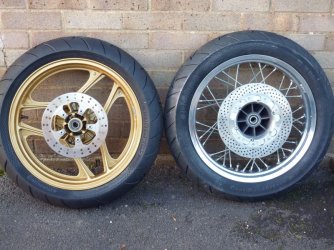
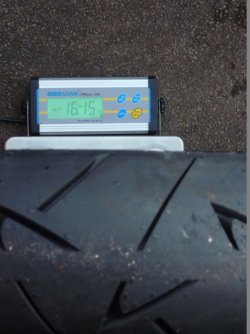
Put some new rubber on the spaceframe and TT1 - once again marvelling at the difference in weight between a Suzuki wheel (13.95 kg rear) and Laverda's equivalent (16.15kg). Extraordinary difference in handling.
Attachments


Dellortoman
Hero member
- Location
- Tasmania, Australia
Took the RGS mongrel out for a ride again today. The ignition rotor managed to hold itself together this time. Getting a little more adventurous with the engine as it now has a couple of hours running on it. Did a couple of quick blasts up through the gears to 8k rpm at about 3/4 throttle. Didn't quite hit the rev limiter at 8.5k. Still heaps of grunt at 8k. The bloody thing just wants to keep revving. Feels like it would pull to 10k. I'm getting to like the raspy exhaust note of the 120 engine through the 3-1 with open megaphone .
.
Yogi
Hero member
- Location
- Bellingen NSW Australia
Dellortoman said:Took the RGS mongrel out for a ride again today. The ignition rotor managed to hold itself together this time. Getting a little more adventurous with the engine as it now has a couple of hours running on it. Did a couple of quick blasts up through the gears to 8k rpm at about 3/4 throttle. Didn't quite hit the rev limiter at 8.5k. Still heaps of grunt at 8k. The bloody thing just wants to keep revving. Feels like it would pull to 10k. I'm getting to like the raspy exhaust note of the 120 engine through the 3-1 with open megaphone
Good onya Cam . Ridden an RGS once with the CLQ boys and it was fun.

Dellortoman said:Getting a little more adventurous with the engine as it now has a couple of hours running on it.
run in now with 2 hours on the engine so get to the dyno quick smart to check the fueling
harpmeister
Full member
- Location
- UK
Hi
Bought the RGS a Clarke CML3 motorcycle lift as a belated Christmas present.
Bought the RGS a Clarke CML3 motorcycle lift as a belated Christmas present.
Grant said:Don't think I'll bother.
I only had cush bearing issues once on alloy wheeled triples and that was due to me being over enthusiastic with the degreaser to remove chain lube around that area.
Not saying it isn't more inflexible than a flexy flier wire wheeled variant, just that it's not a common problem in my 37 years experience.
There you go then.

I've never in 35 years had to change a cush drive bearing on a wire wheeled bike. Have done so regularly on cast wheeled machines.
Paul
G
Grant
Guest
I have first hand experience what you do to cast wheel Laverdas...
Dellortoman
Hero member
- Location
- Tasmania, Australia
redax5 said:run in now with 2 hours on the engine so get to the dyno quick smart to check the fueling
OK. My mate Red (the other Red who has a motorcycle repair/tuning shop here in Tassie) owes me a free dyno session in exchange for some Kawasaki 1300 parts I gave him
http://www.redsmotorcyclerepairs.com.au/
Actually, fuelling feels pretty good by the seat of the pants dyno, but I want to check it to be sure. Also need to dyno it to find the optimum ignition advance.