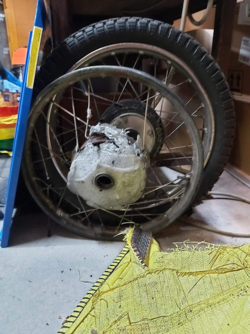
Rear Rim offset Grimeca Hub

Hi,
Can anyone tell me the offset when respoking a Grimeca rear wheel as fitted to early 750’s
Thank you
Hi Norman,
Using a straight edge across the hub and measuring to the flat part of the rim, not the bead, I have 8.25mm to the left and 12.5mm to the right.
I hope that makes sense.

Paul
 
Was told by an expert wheel rebuilder that if your hub flanges are parallel then there is no offset. Don’t know if it’s true but it does seem logical. I await with bated breath to be shot down.😂😂😂
Tom
Not necessarily. Lots of applications call for offset rims, early GS Beemer rears come to mind. To clear the thick shaft-carrying swing arm, wider off-road tyres called for considerable off set. Looked rather wierd when following.

Laverda rims are more-or-less central, mostly...

Equal spoke lengths are also not necessarily an indication of central rims over parallel hubs. Minor off-set requires only very small differences in spoke length, usually not enough to worry about. Re-spoked a Suzuki GT125 2-stroke twin(who remembers those?) last week. Front rim was nicely centered over the hub, rear ended up off-set by around 5mm. Owner omitted measuring before cutting out the hubs, I needed to use a pair of straight edges to line them up, hopefully the frame and swinger are straight! At least using new rims and spokes makes this chore a breeze.

Always wise to take a reference measurement and jotting it down before de-spoking. Doesn't matter if there is an off-set or not, it gives a definite figure to work with when re-spoking and eliminates a lot of guesswork.

piet
 
I lace wheels myself. With rim in center, the spokes have same lengths left and right, if you tighten equally left and right, you can’t go wrong.

Marnix
Hi Marnix, can I just check here that I’m understanding what you’re saying. Basically the rim has no offset from the spoke flanges of the hub. Offset will only occur if the outer edge of the Cush housing or brake drum are used as a line to measure from and one of these may be further from the spoke flange than the other.
Thanks Norman
 
Not necessarily. Lots of applications call for offset rims, early GS Beemer rears come to mind. To clear the thick shaft-carrying swing arm, wider off-road tyres called for considerable off set. Looked rather wierd when following.

Laverda rims are more-or-less central, mostly...

Equal spoke lengths are also not necessarily an indication of central rims over parallel hubs. Minor off-set requires only very small differences in spoke length, usually not enough to worry about. Re-spoked a Suzuki GT125 2-stroke twin(who remembers those?) last week. Front rim was nicely centered over the hub, rear ended up off-set by around 5mm. Owner omitted measuring before cutting out the hubs, I needed to use a pair of straight edges to line them up, hopefully the frame and swinger are straight! At least using new rims and spokes makes this chore a breeze.

Always wise to take a reference measurement and jotting it down before de-spoking. Doesn't matter if there is an off-set or not, it gives a definite figure to work with when re-spoking and eliminates a lot of guesswork.

piet
Thanks Piet,
Unfortuately I bought a bare hub so couldn’t measure before dismantling.
 
I have to say that this is a classic example of what happens in exams that people fail :ROFLMAO:. A simple question gets the most amazingly complex answer full of heaps of supplementary information but not the answer.
Our teachers drummed into us RTQ/ATQ (read the question/answer the question).
But this is the forum and we can rave on about all the buts and ifs and maybes, all good fun.
As Paul points out, it was a very simple question, and there were even diagrams and photos showing how to measure it, but nobody has yet come with the figure.
If someone has a wheel to measure please also give the rim width, the pic Normski put up appears to be wider than a standard WM3.
Thanks, That is indeed a different rim than a standard Borrani, it’s the only wheel I had bare to show in the photo. I was rather assuming any figures would be based on a correct Borrani and that is what I have ready to be laced to the hub.
 
If you're completely flummoxed, sometimes the best way to solve a problem is to go back to first principles.

Find a nice flat level surface where you can set up the bike. A good concrete floor should be accurate enough. A bike lift table might do if you can shim its feet to get it perfectly level. Lay a spirit level in several directions to check for flatness and horizontalness (sorry, can't think of a better word at present). Park the bike on it, then shim the centre stand or paddock stand so the front wheel is perpendicular to the floor. I recognize that moving the bike could be a problem if you have no rear wheel, but you'll find a way (borrow a wheel?). Fit the naked hub in the swing arm, with appropriate spacers to align the rear sprocket with the front sprocket. You can check alignment with a straight edge or one of those fancy laser sprocket alignment tools. The hub is now in its correct position. Now find the centreline of the bike (easier said than done). Hopefully it'll be the centreline of the front wheel if the front end is assembled correctly. Extend that centreline to the rear hub using a straight edge, string lines, chalk lines, squares, spirit levels, lasers, whatever you can find to do the job. Accuracy to a fraction of a millimeter is not required for this purpose. Mark the centreline of the bike on the rear hub. That's the centreline of your rim.
 
That's pretty much how I measured my 3c. For straight edges, I used 2 pieces of 18mm plywood 2.4m x 400mm jacked up as high as I could get them hard up against the rear wheel and past either side of the front wheel, with a section chopped out to get clear of the centre stand. Then I discovered that my front wheel was offset 7mm to the rear wheel and further investigation then revealed that misplaced thick rear washer that wasn't where it was supposed to be, against the other tube spacer and not outside the swingarm. 2 spacers on the same side of the wheel, who knew. Anyway, I was fast heading to offsetting that rim with spoke adjustment till I found the correct fix. BTW this is a good thing to do to prove to yourself the bike is straight, who knows what kind of hits 40-year-old bikes might have had in their past?
 
Hi Marnix, can I just check here that I’m understanding what you’re saying. Basically the rim has no offset from the spoke flanges of the hub. Offset will only occur if the outer edge of the Cush housing or brake drum are used as a line to measure from and one of these may be further from the spoke flange than the other.
Thanks Norman
Correct. The Laverda twins and triples were meant to be laced in the heartline of the hub, in the center of the spoke flanges, yes.

My Rickman CR750 has a ridiculous offset, because of the fact that they had their own very narrow forks that were initially meant for a drum brake, so when they started to mount a single Lockheed disc brake, an extreme offset was needed to bring the rim in the middle of the forks again.

When I restored the Rickman in 2003, I brought the hubs and rims to a reputed local wheel builder. When he looked at the hubs and Borranis he said the combination would not work. When I stated that I had de-spoked the wheels myself so that it must be possible to do it, he became angry said that I had it all wrong, and that it would be absolutely impossible to make a wheel with that hub and rim combination . I then decided to give it a try myself and an hour later I had a nicely laced wheel on the work bench. Since then I lace my own wheels, with thanks to the angry wheel builder!

Marnix
 

Attachments

  • 2023-01-30 09.37.13.jpg
    2023-01-30 09.37.13.jpg
    97.7 KB · Views: 18
  • 2023-01-30 09.37.23.jpg
    2023-01-30 09.37.23.jpg
    123.1 KB · Views: 18
Correct. The Laverda twins and triples were meant to be laced in the heartline of the hub, in the center of the spoke flanges, yes.

My Rickman CR750 has a ridiculous offset, because of the fact that they had their own very narrow forks that were initially meant for a drum brake, so when they started to mount a single Lockheed disc brake, an extreme offset was needed to bring the rim in the middle of the forks again.

When I restored the Rickman in 2003, I brought the hubs and rims to a reputed local wheel builder. When he looked at the hubs and Borranis he said the combination would not work. When I stated that I had de-spoked the wheels myself so that it must be possible to do it, he became angry said that I had it all wrong, and that it would be absolutely impossible to make a wheel with that hub and rim combination . I then decided to give it a try myself and an hour later I had a nicely laced wheel on the work bench. Since then I lace my own wheels, with thanks to the angry wheel builder!

Marnix
Yep, much the same here.

In a sense, your wheelwright is correct. From a technical POV, the loading on the hub and spokes is uneven and should make a very unstable wheel, it looks wierd and wrong. But it works nevertheless, as practice has shown. Some people simply can't manage to think out of their box.

piet
 
The Rickmans started in Scrambles so I guess they had a good idea of what punishment a wheel could take.
 
Absolutely, and not many people know that Lockheed developed the disc brake for motorcycles in cooperation with the Rickman Bros in the mid sixties. They came with the first Lockheed disc brake equipped Rickman Triumph CR in 1966!

Marnix
 
Hydraulic or cable or both? I seem to remember cable-operated very early discs that's fully cable and not half like BMW did.Google to the rescue. Quote MV Agusta followed with their limited production 600 cc touring motorcycle announced in 1965 which had a pair of cable-actuated Campagnolo front disc brakes.
 
Last edited:
Back
Top