RGS Headstock Cracks - an experience to share

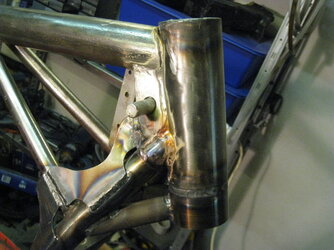
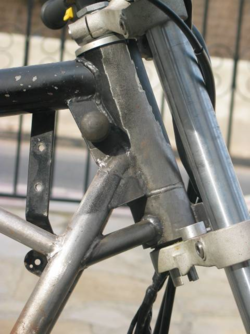
Would this frame cracking problem be lesser if say someone made up two thicker triple crowns, so that the lower one would have double or triple bolting each side and thereby gripping lower down on the forks?

I did see this from for example Moto Officina di Angelo Cleva, but when I kindly asked him how much, I got a quote of half the bikes total worth, mglp. I did try to talk over the friendly gentleman in Australia who did some many years ago, but unfortunately to no avail.
Anyway, someone do these today for the sfc1000? And will they help the aforementioned problem, apart from the gusseting as Laverda described?

Kind regards,
Jacques
if you have a weak bracket it makes no sense to stiffen the load
 
Grant (no longer posts) extended his head tube below std, used a longer triple clamp/crown shaft and braced from the extended part to the down tubes. Clever idea, as it also reduced the free length of the looong forks on the triples. You can search and find his old thread. What was the name of his modded triple???
Pop
 
So it would seem thicker triple crowns, Laverda bracket set welded in, extension of head tube plus extra tubes bracing that, should do the trick.

Andre, nice done. Did you also thicken the mounting area of the rear swing arm?

Kind regards,
Jacques
 
"So it would seem thicker triple crowns, Laverda bracket set welded in, extension of head tube plus extra tubes bracing that, should do the trick"
or an aftermarket frame kit!
CLEM
 
"So it would seem thicker triple crowns, Laverda bracket set welded in, extension of head tube plus extra tubes bracing that, should do the trick"
or an aftermarket frame kit!
CLEM
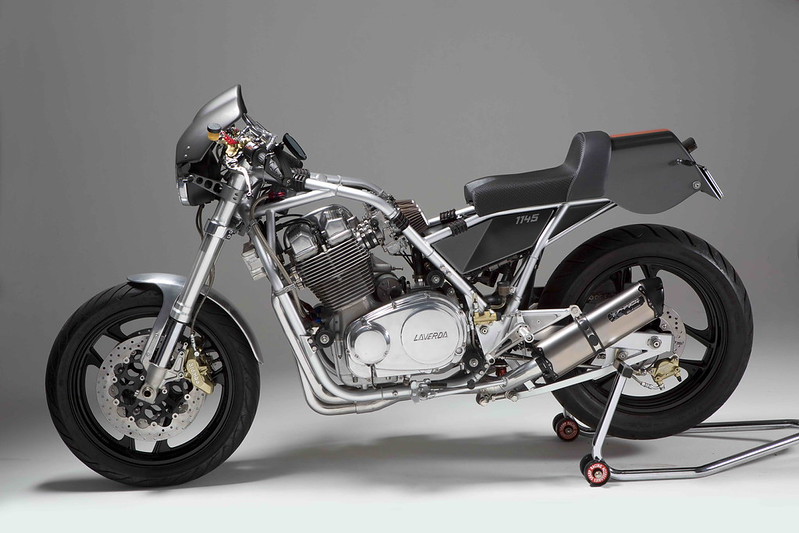
All aftermarket frames made for the triples that used the stock forks retained the silly short headstocks and equally silly long fork legs. All it would have taken would have been a longer steering tube in the yokes to reduce fork flex along with a longer headstock in the frame. Although the aftermarket frames aren't plagued with these cracking issues afaIk, it was a missed chance. Main reason I do not hold any of these frames in high regard. At best, only marginally better than the stock frames, mainly because of the weight savings.

Bright shining light in this regard must be the Mk IV and V Motodds, these finally addressed the issue properly.

piet
 
Last edited:
The Spondon frame developed with Windy Corner (Roger Winterburn) worked well enough.
The whole headstock sat lower and the weight saving was significant.
Was great when out on the open road. Destroyed licences. :cool:
 
The Spondon frame developed with Windy Corner (Roger Winterburn) worked well enough.
The whole headstock sat lower and the weight saving was significant.
Was great when out on the open road. Destroyed licences. :cool:
If the headstock was lower, the forks were probably shortened to suit, a step in the right direction.

Harris, Martin and early Motodd utilised the stock forks. You got a stiff frame with a flimsy fork...

piet
 
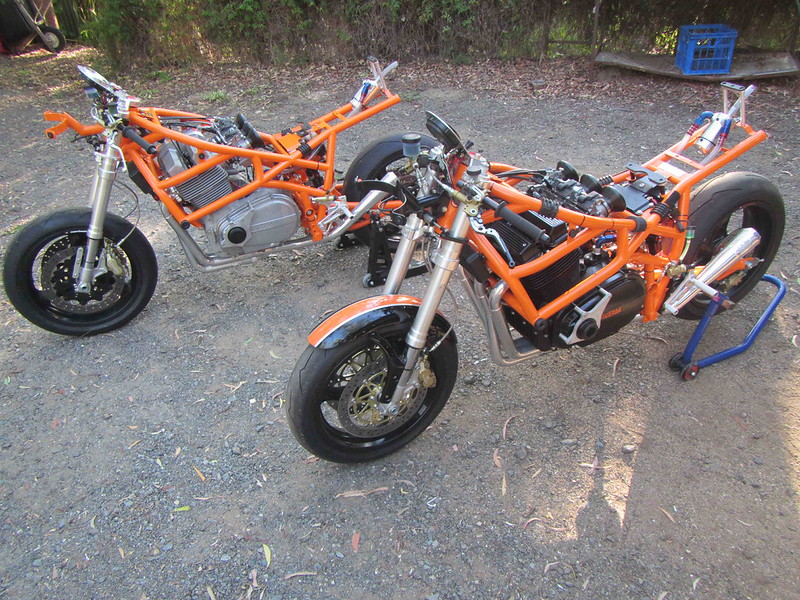
the Scorch based frames that Herman designed and built for our race bikes are based around totally redesigned head stocks using 53mm USD Showa forks from later model Ducati's, they are nothing like any of the previous aftermarket frames and are way more effective then previous aftermarket frames so not all aftermarket frames have the same issue
Though these Scorch frames are designed and built in the last 5 years so have the advantage of tapping in to later suspension technology
Plus we machined our own triple clamps to achieve a specified crankshaft height and fork offset to get our trial and rake where we wanted them

catch tanks

We also did the same when we built Mike's Mk3 Motodd, machined our own triple clamps to accept Ducati Multistrada USD forks so we could position them where we needed to
Regret selling that bare frame, was an awesome bike to ride when finished

 
Last edited:
So it would seem thicker triple crowns, Laverda bracket set welded in, extension of head tube plus extra tubes bracing that, should do the trick.

Andre, nice done. Did you also thicken the mounting area of the rear swing arm?

Kind regards,
Jacques
Hi Jacques,
yes I did but the frame is not a 120 deg type, it is a very old 180 deg. I also use a BMW K 1100 fork which has longer stanchions. somthe fork became stiffer from both sides headstock and stanchions.
 

Attachments

  • CF98374C-C0EE-4E54-8EAE-060700AFBE63.jpeg
    CF98374C-C0EE-4E54-8EAE-060700AFBE63.jpeg
    19.5 KB · Views: 46
Super nice frames and solutions, Redax.

Nicely done Andre. And it remind me of the sfc750 which had those? Or at least I think some aftermarket sfc750 replica bikes had that?

Kind regards,
Jacques
 
My guess, as close as possible to the exhaust but not so close as to hit at full compression or steering lock. We did a quick measure of Crispins Space Frame race bike when it had some overnight work at Martys pro Car workshop years ago. I expected a trail of approx 110ish mm, we were surprised when it actually measured at 75ish mm or less, its been a while. Similar to Moto 2 stuff at the time. Surprisingly modern geometry for a supposedly vintage bike. I wonder what the weight distribution on each wheel is with the rider seated, Reds bikes look nice and short in the wheelbase. The problem with Crispin's bike was the 25litre fuel tank, great for endurance racing but not so much for the 10 laps that mainly happen here. It had SFC tank length as well putting the rider way back on the bike.
 
Offset determines geometry, Vince, not proximity of wheel to exhaust. Modern offsets are short c/w the Laverda's 45mm-ish for parallel Jota clamps. Probs arise when you fit a modern fork and the triple clamps that come with it to an old Laverda; with 29 deg of rake a std frame ends up completely wrong, with way too long trail figures.
 
So why do you think I was referring to the offset being reduced as much as possible and still clearing the exhaust and the tank at full steering lock, so you get a smaller trail dimension and fast steering plus more centralised mass and reduced polar moment of inertia and a reduced wheelbase. All helpful on a race bike, especial when so many tracks have Chicanas that need fast steering inputs. It also produced a more vertical effect, less counter lever on the fork reducing stiction under braking.
 
Less offset = more trail (unless your triple clamps are on backwards).
Trail is determined by fork angle and offset, but also wheel diameter. The big 17" rear tyres end up not so different rolling radius to our old 18" cheesecutters, but the fronts are significantly smaller. This along with steeper rake means modern bikes offset needs to be less to maintain a decent amount of trail. As you rightly point out though, that brings other geometric benefits, and is a 'sweet spot' that's been found.
Hence why Crispin's spaceframe had no trail (and no front stability) after the 17" rims were fitted. With the utmost respect to the spirit of adventure shown, it ran best when it was almost stock at the very beginning. It did look totally badass with the big rims on it though! :D
My SFC has the adjustable offset triple clamps on it. One test day I asked Drmsby if he wanted to try more offset (less trail) to see if it turned better, of course he was up for trying anything. I changed it by 2mm and he came in after two laps saying he was losing the front everywhere under brakes. Swapped it back to where it was before (changing nothing else) and he gave the thumbs up and peeled off a bunch more 1:08's or whatever. Never touched the geometry again. :)
 
Back
Top