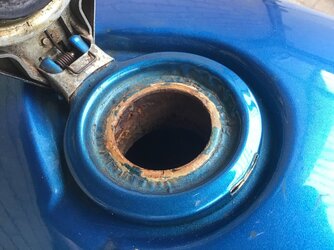
RGS/RGA fuel tank neck.

RGS/RGA. Is there an insert in the filler neck of the fuel tank that is removable ?
On a prior cleaning, getting the liquids out of the tank buy upturning is very difficult due to the internal upstanding.
If there is a removable neck insert, how is it fixed/removed ?
Don't want to use force if it's screwed/ bonded etc.
Any advice appreciated.
Cheers guys.
 
RGS/RGA. Is there an insert in the filler neck of the fuel tank that is removable ?
On a prior cleaning, getting the liquids out of the tank buy upturning is very difficult due to the internal upstanding.
If there is a removable neck insert, how is it fixed/removed ?
Don't want to use force if it's screwed/ bonded etc.
Any advice appreciated.
Cheers guys.
Take the taps off to empty the tank?

Paul
 
There is a removeable flap in the bottom of the tank where the items for the fuel indicator are fixed.
 
The RGS has the long "neck" coming from the tank for the fairing mounted filler cap, so does the Corsa, the RGA has a cap directly on the tank top as does the SFC1000 (a pair in this case). all have the fuel level float underneath, which does provide quite a big hole.
CLEM
 
Last edited:
Sorry all I wasn't very specific with my earlier question.
Bike is an RGA. There's a 40mm sleeve inserted into the tank neck. When upturned, to pour out crud/muck etc, the insert becomes an upstand inside the tank which prevents pouring everything out.
My question was:-
Does this insert come out ?
How is it fixed in ?
Is it welded, does it even come out, or am I wasting my time ?
The muck inside is too thick and flakey to come out of the fuel pipe connections to the carbs.
Hope the photo helps explain
Thanks again
 

Attachments

  • 656E581E-B066-4846-8688-50FAA3D93529.jpeg
    656E581E-B066-4846-8688-50FAA3D93529.jpeg
    169.8 KB · Views: 16
Compressed air, blasted into the cap orifice, will get a lot of loose stuff out.

Looks like it might be rusty in there...
 
fill the tank to the brim with a solution of De-OX C and let it sit for a week, be sure the bleed hole in the top of the insert is clear, kitchen foil over the lid wil stop evaporation, rust will disolve and leave you a clean bare metal surface,. if it doesnt, repeat the process.

CLEM

De- OX C is a powde form of citric aciid, buy it online.
 
The RGS has the long "neck" coming from the tank for the fairing mounted filler cap, so does the Corsa, the RGA has a cap directly on the tank top as does the SFC1000 (a pair in this case). all have the fuel level float underneath, which does provide quite a big hole.
CLEM
There's no fuel level sensor flange/hole in my original RGA tank. It was evidently a secondary process that wasn't necessary on the RGA's.

There is also no residual blanked-off RGS-type filler neck on my RGA tank, it is smooth there. I have heard claimed that some RGA and also SFC1000 tanks had the nozzle cut off and blanked, not sure if that's true or not. The SFC1000 tank that came on Christiane's hotrodded RGS *does* have a blanked off RGS filler tube. Now I *think* that tank was bought as a new spare part from Eades, but am not certain of it. Maybe the factory made a certain stock of RGA/SFC tanks originally, but then needed more so converted some old stock that had already been made as RGS tanks and made them into RGA/SFC tanks which therefore had the blanked off necks and fuel level sensor holes?

To the original thread question @Magnidec that tube does not come out and I assume is a welded/formed part of the filler receptacle. I agree it's a major pain! RGA must be about the worst tank ever made for internal access!
 
That metal funnel is an integral part of the filler cap.
Rinse out, rinse and rinse again.
There's no fuel level sensor flange/hole in my original RGA tank. It was evidently a secondary process that wasn't necessary on the RGA's.

There is also no residual blanked-off RGS-type filler neck on my RGA tank, it is smooth there. I have heard claimed that some RGA and also SFC1000 tanks had the nozzle cut off and blanked, not sure if that's true or not. The SFC1000 tank that came on Christiane's hotrodded RGS *does* have a blanked off RGS filler tube. Now I *think* that tank was bought as a new spare part from Eades, but am not certain of it. Maybe the factory made a certain stock of RGA/SFC tanks originally, but then needed more so converted some old stock that had already been made as RGS tanks and made them into RGA/SFC tanks which therefore had the blanked off necks and fuel level sensor holes?

To the original thread question @Magnidec that tube does not come out and I assume is a welded/formed part of the filler receptacle. I agree it's a major pain! RGA must be about the worst tank ever made for internal access!
 
Thank you all for your comments. The operation/process of cleaning wasn't really the question, but Breganzane answered it with a simple "no" The neck insert doesn't come out. Thanks also for confirming it's a real pain to clean out with extremely poor access, as the insert becomes an upstand when inverted, making it almost impossible to clean out rust flakes completely. I've done mine several times but it still "rustles" with rust flakes that are too stubborn to come out. Even drying is more than awkward. My heat gun nozzle is too big to insert into the filler cap hole, and anyway, it's so fierce it started to soften the paint around the neck after a minute or so. Pulling back a little doesn't put enough heat into the tank to effectively dry it right down in the depths. The peacock outlets are still getting blocked with flakes too big to run out even after several flushes. Anyway, now I know it's not just me it's frustrated I’ll carry on flushing/cleaning/prepping and eventually seal, and hope it does the trick. Think I'll install line filters too just to trap any stray particles that sneak through.
Happy riding.
 
There's no fuel level sensor flange/hole in my original RGA tank. It was evidently a secondary process that wasn't necessary on the RGA's.

There is also no residual blanked-off RGS-type filler neck on my RGA tank, it is smooth there. I have heard claimed that some RGA and also SFC1000 tanks had the nozzle cut off and blanked, not sure if that's true or not. The SFC1000 tank that came on Christiane's hotrodded RGS *does* have a blanked off RGS filler tube. Now I *think* that tank was bought as a new spare part from Eades, but am not certain of it. Maybe the factory made a certain stock of RGA/SFC tanks originally, but then needed more so converted some old stock that had already been made as RGS tanks and made them into RGA/SFC tanks which therefore had the blanked off necks and fuel level sensor holes?

To the original thread question @Magnidec that tube does not come out and I assume is a welded/formed part of the filler receptacle. I agree it's a major pain! RGA must be about the worst tank ever made for internal access!
Thank you my friend 👍
 
Thank you all for your comments. The operation/process of cleaning wasn't really the question, but Breganzane answered it with a simple "no" The neck insert doesn't come out. Thanks also for confirming it's a real pain to clean out with extremely poor access, as the insert becomes an upstand when inverted, making it almost impossible to clean out rust flakes completely. I've done mine several times but it still "rustles" with rust flakes that are too stubborn to come out. Even drying is more than awkward. My heat gun nozzle is too big to insert into the filler cap hole, and anyway, it's so fierce it started to soften the paint around the neck after a minute or so. Pulling back a little doesn't put enough heat into the tank to effectively dry it right down in the depths. The peacock outlets are still getting blocked with flakes too big to run out even after several flushes. Anyway, now I know it's not just me it's frustrated I’ll carry on flushing/cleaning/prepping and eventually seal, and hope it does the trick. Think I'll install line filters too just to trap any stray particles that sneak through.
Happy riding.
Don't seal it. Imagine having to get the resin out. A lot tougher than the rust. Get the rust out and block any further rust with phosphoric acid. The process will be long.
Paul
 
You can dissolve any remaining rust with citric acid. Might be worth filling it with water and adding about 1kg of citric acid crystals (available for a few bucks on ebay). Let it soak for a couple of days and then tip the (by now brown) acid out. Hopefully it'll dissolve those flakes that are rattling around. It's non-toxic so OK to pour down the drain. Then do the phosphoric acid treatment as Paul suggests.

If your tank is badly enough rusted (right through the metal to the paint), dissolving out the rust may end up revealing holes. In that case you have a whole different issue to contend with.

Am I right in thinking those tanks have deep narrow corners at the bottom front end, where water can settle and cause rust? While I'm not a fan of tank linings, I'd be tempted to mix up some epoxy (west System or similar) and pour a cupful down into each of those pockets to seal them off before they rust out.
 
Don't seal it. Imagine having to get the resin out. A lot tougher than the rust. Get the rust out and block any further rust with phosphoric acid. The process will be long.
Paul
Paul is absolutely spot on here, I know only too well! I lined mine and all it has done is create different and harder-to-solve issues. With such poor visibility inside the tank it's impossible to know what's going on in there while coating it. I strongly advise against it.
 
You can dissolve any remaining rust with citric acid. Might be worth filling it with water and adding about 1kg of citric acid crystals (available for a few bucks on ebay). Let it soak for a couple of days and then tip the (by now brown) acid out. Hopefully it'll dissolve those flakes that are rattling around. It's non-toxic so OK to pour down the drain. Then do the phosphoric acid treatment as Paul suggests.

If your tank is badly enough rusted (right through the metal to the paint), dissolving out the rust may end up revealing holes. In that case you have a whole different issue to contend with.

Am I right in thinking those tanks have deep narrow corners at the bottom front end, where water can settle and cause rust? While I'm not a fan of tank linings, I'd be tempted to mix up some epoxy (west System or similar) and pour a cupful down into each of those pockets to seal them off before they rust out.
Yes deep and narrow sectors all around the perimeter base. A nightmare. No way to get to near side of tank from offset filler cap due to internal central ridge. Cannot insert pipe (vacuum or other) into one side to remove the grot. Will have to try and dissolve all rust to liquid and remove through petcock connections.
 
Back
Top