RGS ticking noise from head

last Mohikaner

New member
Location
Norway
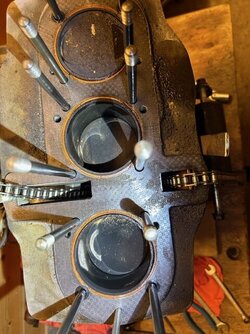
Last winter I fired up my RGS, as I do every month during the winter. I noticed a ticking noise on right side of the head. Had never heard it before. Due to lack of time it has been standing in my workshop up to now.-Engine out, head off and i noticed; intake valve on right cylinder had been "kissing"the piston. I was thinking the valve was bend, but it was ok, the valve spring ok, valve seat ok. the valve clearance within the spec. I checked that both inlet and exhaust camshafts was align to the marks before I started to dismantle the head. Anybody out there with some suggestions what to do? Thank you.

Fredrik
 

Attachments

  • IMG_1009.jpg
    IMG_1009.jpg
    112 KB · Views: 56
Last winter I fired up my RGS, as I do every month during the winter. I noticed a ticking noise on right side of the head. Had never heard it before. Due to lack of time it has been standing in my workshop up to now.-Engine out, head off and i noticed; intake valve on right cylinder had been "kissing"the piston. I was thinking the valve was bend, but it was ok, the valve spring ok, valve seat ok. the valve clearance within the spec. I checked that both inlet and exhaust camshafts was align to the marks before I started to dismantle the head. Anybody out there with some suggestions what to do? Thank you.

Fredrik
What's the thickness of the shim?
Broken valve spring?
Paul
 
Sock is the clever Gezzer, i'll add in valve type/material, old problem for steel and SS valves in the day. Mostly the SS was a problem in warm up period for diametrical clearance. HTH j
 
Per other comments, I've found valve springs so goosed that you could push the valve down with your thumb. Admittedly that was on a very early Series2 Jota which received the last of the 80-spec short valve springs. RGS usually doesn't suffer this but again from previous comments elsewhere on this forum, the RGS revs very freely and prior to rev-limit ignitions it was easy to over-rev which might lead to valve spring softening.
I have also experienced valve seizure when I got a head (this is pre-Redax days) from another source which had SS valves which were too tight and one nipped up. Same symptoms, bad sound but still running and valve surprisingly not bent.
But looking at the photo your engine has not been apart recently? Points to springs then, remove the springs and get them tested. I have some numbers somewhere of what should be expected, or someone more experienced will chime in.
 
Also had issues with ss valve nipping up on a fresh rebuilt motor that fucked the A11 cam and both valves. 50k kays later when redoing the head found a cracked guide.
 
FWIW i actually measured the SS valve in the day, diametrical expansion compared to steel, fabricated a test jig and did measurements at nominated temperatures. The SS expands faster than steel at lower temperatures, if any diametrical issues, the SS will nip at moderate engine warm up. Increased the diametrical clearance to guide for the SS valves, based on what i measured on the test jig. Close to 20 years ago i did all this. HTH j
 
It's definitely never happened to me, Twice. No never happened. Must have dreamed it. It must be a recurring dream. Valves are expensive.
 
Is the expansion issue the reason you can't use stainless valves with cast guides? The cast guides are excellent and wear incredibly slowly - was sad to have to ditch them when i sourced stainless valves - was too much hassle to source compatible valves and I had to remove the 8mm guides for 7mm anyway.
 
Used "steel" guides with SS Valves, can be engineered when all the parameters are accounted for. Know engines here ran SS after correct engineering calculations and test jig conformation. The one odd aspect was that the valve stem was not altered to fit the guides, ie honing the guide to match the valve stem. Been a long time since i have dealt with this guide issue. Corrections from others a given. j
 
Hi, and thanks for feedback! The thickness of the shim is; 2,62mm and valve clearance 0,30. The spring has the same length as the others, compression power almost the same on all springs. Valve and seat look good- its sliding nice in the guide. The timing was correct according to the marks, but can it be something wrong anyway? Is the inlet opening 25 degrees before TDC ? Is it possible that the cam chain is stretched so much that it can cause a problem on the valve timing? My Laverda has genuine 70 000 km on the road. Im the third owner and as far as I know, the engine has never been opened.
Fredrik
 
Points to springs then, remove the springs and get them tested. I have some numbers somewhere of what should be expected, or someone more experienced will chime in.
new standard valve springs are 43mm +/- overall length, closed seat pressure 50-55 lbs, open 150 - 155 lbs @ 9.7mm lift
Laverda engines do not use huge valve loads, 50-55 lbs closed is a fairly low seat pressure

on the 1980 engines with their short valve springs closed seat pressure is near zero especially after 30,000 klms or so which is not good at all

My race engines use dual valve springs with closed seat pressure 85-90 lbs and open 195-200 lbs
How much bhp is used, do you guess, in pushing those valves open?!Presume cams wear quickly? Im no engineer, obviously, but do like the apparent effciency of the Rotary /E
Wankel..have you seen that new Crighton engine..tiny and about 230 hp. Smokes a bit though😉 pity track only...
 
Back
Top