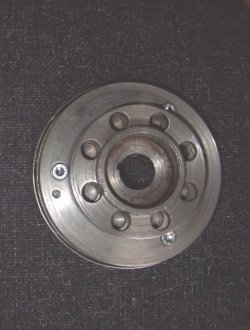
Riveting Technique

SandPebbles

Junior member
Good day to all....I am in the process putting my starter clutch back together ('74 3C) and don't want to mess up on
riveting the tin cover plate back on.  I have three new rivets from Andy W. as I have searched past posts and the rivets are
the preferred reassembly method.  I also have a 2 ton arbor press if needed but would like to know what correct technique is.
The drawings I have available show the rivets are inserted from the clutch free wheel side and exit on the cover side.
The rivets stand quite proud from the cover before riveting.  Do the need shortening?  If anyone has used a press, is a special die used?

Thanks for any advice, I just want to get the riveting right the first time.

Keith

 
Keith,

Not sure about the initial length of the rivets, but they need to stand about 3-4mm proud of the cover.

I support the assembly on the press and simply press the rivet ends with an extension of the press spindle.  It either needs to be firmly fixed to, or large enough and square to the press spindle to prevent it tipping off angle.  Not much pressure required, the steel is quite soft.  Easy once you get the hang of it.

piet

 
there is not enough clearance for the bolt head, and if you don't rivet it "flat enough" not enough clearance for that either, I have done this a few times and did the old fashioned "make your own rivets" black smithing" deal, then fitted the rivets red hot, and  deformed the ends with a purpose made die, plus a big hammer, when cold it is very tight and works well.
CLEM
 
Not enough room for bolt heads - Never thought of that - May be that's why I Tacked  Welded the Starter Clutch cover back on.

Something weird gong on with the Forum Fonts.

I agree with you Clem: However; you can use either Allen or Torks Drive Bolt with Loc-Tite and Grind the Head Down with enough grab to back the Bolts out when necessary.

Like your take of Pining a Cherry Hot Rivet but I would Micro Grind the bottom of the Hole in a Mushroom shape.

Just simply Mig or Tig Tac the Cover to the Starter Clutch Fly Wheel.

One a few culprits we Breganzie Enthusiasts have to deal with.

 
Gentlemen, Thanks to all for the replies. 

Piet, I'm glad you chimed in...I was hoping you would.

Clem, thanks for your input on "flat enough"  as I will now have that in mind when I rivet.

Wish me good fortune on the riveting...
 
square to the press spindle to prevent it tipping off angle

No matter how you attach that Back Plate: Be sure it's Solid, Flat and NOT Warped.

Also Re-New any Seals  (Including the Main Seal) and re-pac with Moly Grease Grease, roller pins are probably OK; but buy new Dog Springs.

Do Auzzie's have a problem with English - LOL.
 
I usually do plain steel rivets with the ball-peen part of an engineer's hammer. That's what it's for. Not done a starter clutch though, so dunno whether there is sufficient access to swing a hammer at it.
 
So there you go - Other making sure it's clean and the back plate isn't warped whether you Rivet, Thread or Spot Weld  - Hit it With a Hammer "Words of Andy" No Chatter - ROLF
 
Dellortoman said:
I usually do plain steel rivets with the ball-peen part of an engineer's hammer. That's what it's for. Not done a starter clutch though, so dunno whether there is sufficient access to swing a hammer at it.

There isn't.

Isn't really enough material for a decent thread, either.  Too thin.  No room for a nut.  Dunno how the inner part of the clutch can be machined to accept a screw larger than M5 either, very, very hard stuff.

Spot weld?  May as well toss the clutch into the scrap before wasting time and effort...

What the fuck is wrong with rivets?  The stock rivets are soft enough not to need to be red hot for fitting, they squash themselves nicely into the bore, locating all components firmly, if done correctly... guess it does help being an engineer/mechanic in this case. :D

piet
 
Spot weld?  May as well toss the clutch into the scrap before wasting time and effort...

A good Spot Weld can be grind out it you ever have to release the Stater clutch Cover.

The thing is that Breganzie Starter Clutch Cover Revits - FAIL.

Anyone who had owned a Breganzie have experienced this crap.  I choosed to Spot Tack and haven't had an issue in some 20 years.

I don't care how you do it - Drill Holes in the Cover other then the Rivet holes.

Spot Welded YES were you can still clean the clutch, change the dogs and springs in her without the problem of a loose Back Plate.

Tac Weld that Starter Clutch back Plate on there and forget about it.
 
In 41 years and hundreds of thousand kms of 750 ownership I've never had an issue with the starter clutch apart from changing out the springs every so often.
What is the issue??
 
What is the issue??

Perhaps your a conservative SF Rider and have never really reve'd her up.

Who knows why them rivets fail but it's a common fault with all Breganzies.

You should not have to change the Dogs/Springs and file the Spline if the back Plat is Solid.

If you had to change out the dogs and springs, I would  look into this loose Back Plate issue and learn why them rivets are a pile of shit.
 
On my proddy 750SF - I modified the s/m clutch over 20 years ago - I thinned the front face so screw heads clear the belt (could have used countersunk head screws and have no need to thin cover) and counter machined the cog behind to miss the nuts - the 5mm screws work fine. - Regards - Phil
 

Attachments

  • smc - mod.jpg
    smc - mod.jpg
    84 KB · Views: 41
SandPebbles said:
Good day to all....I am in the process putting my starter clutch back together ('74 3C)

Keith
Um, am I missing something here, or is a 3C starter clutch exactly the same as an SF starter clutch? :-\ FWIW, I've covered hundreds of thousands of km (and miles  :D) on my SF and have never had a rivet do the dirty on me. Do I ride it fast enough? Obviously not  :-*
 
Piranha Brother 2 said:
Um, am I missing something here, or is a 3C starter clutch exactly the same as an SF starter clutch? :-\ FWIW, I've covered hundreds of thousands of km (and miles  :D) on my SF and have never had a rivet do the dirty on me. Do I ride it fast enough? Obviously not  :-*

No.

Same basic build principles apply, but dimensions totally different.  Shares springs #50 120 001 and pistons #43 501 001 with the other types though.  Has nothing at all to do with how fast you ride.  More a thing of proper engine set-up and basic maintenance.

500 twin clutch rarely makes itself felt, very reliable.

The Mk I triple starter clutch seems to give the least bother, with only a periodical renewal of springs usually being needed.  Bit akward to service though, with it living behind the alternator.

The 750 twin clutch usually needs a bit of a clean and fresh lube next to the springs.

The Mk II/120 triple clutch is the bugger.  Same basic dimensions as the twin unit, but somehow it is nowhere near as reliable as the others. 

Weak batteries and incorrect ignition timing during the start process help lead to premature failure.

It's not the rivets that fail, but the inner thingy with the ramps on which the rollers move.  This is very hard, but quite brittle, and can break when abused.  Once that happens, the rollers can cant themselves excessively, chewing up the housing and the cover plate, as well as themselves, in the process.  More often than not, the drive gear face is damaged too.  The Mk II unit is also often incorrectly assembled, the M5 cover retaining screws often not done up and secured properly. 

Strip the clutch at the first sign of slipping/whining/rumbling and find the cause.  It pays to keep your ears washed. :D

piet
 
Back
Top