Hello Lads, not familiar with Ignitech product, hard core users will run me down no problem at all.
What seems to be a common point of unclear operation with digital and analouge ignitions is the "Base" advance. First up there is no such thing as "advance" in electronic ignitions. How can we trigger an event that has not happened yet?! Rather we have a reference point that is prior to the intended spark event. This becomes our outward reference point or "Index", in IIS case it is 40DBTDC. Next we need an Index to start the engine, something like 6-8DBTDC is nice and easy on the starter motor. This becomes a second index or as i call it a "Hard" index. It needs to be hard when cold cranking a motor, time derived calculation from the forward 40DBTDC is useless, as the instantaneous velocity of the crank varies on compression and battery voltage sag.
This is were confusion reigns supreme with ignitions as to base advance. With a normally running motor all calculations are done from the IIS 40DBTDC, hard index is ignored. Yet the hard index is derived from the stator plate for the crank encoder of choice, it starts the motor and then is ignored. Also on the stator is the forward Index, if you rotate the stator plate you change the reference points for the ignition, the control box only sees the crank position from the sensors, the sensors are calibrated to the crank as to absolute position. On the IIS i use an additional hard TDC sensor, this calculates the rpm (*) and is part of the cold crank timing. If i implement a 32 degree advance curve and the TDC sensor is at TDC crank, then you get 32 degrees maximum advance, if you rotate the encoder stator plate 5 degrees forward from true TDC then that will be added to the overall advance curve, ie 37 degrees peak advance. It will also add to the cold crank advance. Why i supplied a dead stop with all IIS kits, TDC is where all the timing is derived from. It ( Index ) needs to be at TDC, for predictable advance curve operation.
Best approach with ignitions is to accurately set the forward reference point of what ever the designed used, the rest can be taken care of with control hardware and software. Difficult doing this for some, so the more readily base index is turned to, providing a reference point for calibration, a mistake number one. Why is ditched the forward calibration procedure for the IIS, added a TDC sensor to the crank encoder board and use it to set all reference markers, TDC is quickly derived than a forward 40 or 50DBTDC. Hope i make sense. Most likely not.
By the way, some reference lately to tacho and oil dip sticks in posts. First up neither is a scientific instrument. The Oil dip stick is a low oil indicator or consumption indicator, if a motor is designed to take 3 Litres of oil then 3 litres goes in my ride, no analouge dip stick is going to tell em otherwise ( grin ), there are two different line positions on triple motor dip sticks by the way, ie two maximum oil indications on similar looking dip sticks. Been covered on older forums. Tacho, if it reads 7300rpm it could just as well be 6500 or 8500, instantaneous velocity of the crank changes as does the latency in a tacho meter, just an indicator of motor rpm not absolute reading like some assume. The IIS has a one crank revolution calculated instant velocity rpm limiter feature, at 8375rpm. Have ridden RGS with 3 into one, where i hit the limiter every gear yet the tacho indicated far less RPM, as for 180...only hit the limiter 3 times in 10 years, just no need to rev the tits of those motors, ditto my HC 1200.
HTH.


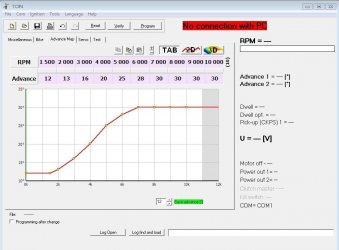

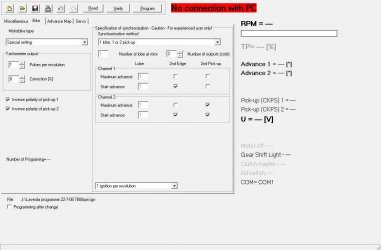
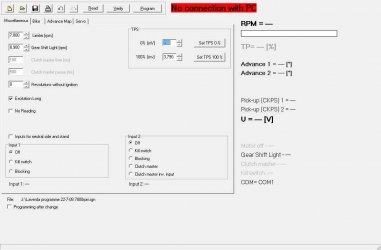
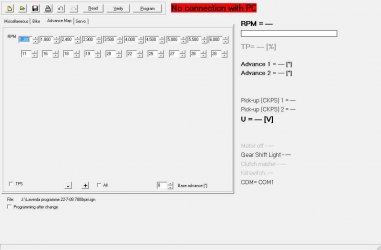


 What can be wrong? :-\