S.O.S. IGNITECH

paparracas

Full member
Location
Andaluc?a-Espa?a
Hi all.

I am trying to install ignition TCIP4 of 1000 Laverda 3CL ignitech in 1977 and am having trouble.

I have coils of 3 ohms.

If I put the curve Ignitech received, it works worse than BTZ system.

If you design the original curve of BTZ, BTZ system works worse.

If you add 10 degrees forward to the previous curves, it works worse than BTZ system.

No where to go, what do you suggest I use?.

I have better spark than with BTZ system?


Thanks.  :-*
 
Hi,

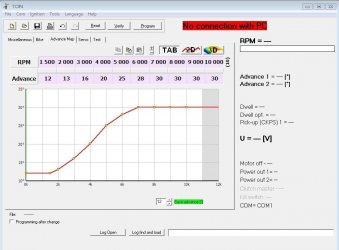
Cam (Dellortoman) has done this already. Attached is a copy of the advance curve he used.

Cheers,

bazzee
 

Attachments

  • 3c_Curve_small.JPG
    3c_Curve_small.JPG
    74.9 KB · Views: 81
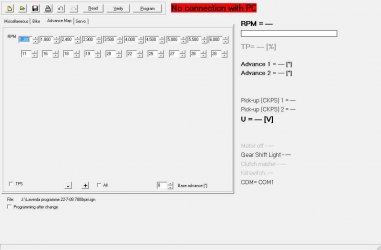
Make sure you set the base advance (pic 3), I've usually found its around 8 degrees but dont assume.

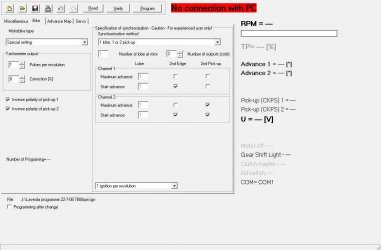
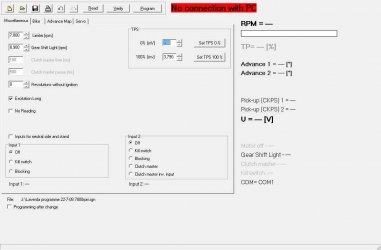
Polarity of the VR's (pick ups) is important as it will run with either or both set wrongly but will mess up the advance curve. You can set or change these in the software easily and usually can hear a dramatic change to adjust while motor running.

Note, the software is an older version than what you are using and the advance curve shown is not what I use anymore. THe inverted poloarity settings are proabably because I wired up the PIckups wrong way round.

Its worth running a laptop direct on the bike while its running, listen to the engine and play with the basic settings shown on these pictures. Use a strobe and watch the timing marks that you have scribed onto the rotor. I scribed TDC 10, 20, 30, 40 degrees Advance for both 1,3 and 2 cylinder.


Rob
 

Attachments

  • Ignitech 01.jpg
    Ignitech 01.jpg
    69 KB · Views: 58
  • Ignitech 02.jpg
    Ignitech 02.jpg
    63.6 KB · Views: 48
  • Ignitech 03.jpg
    Ignitech 03.jpg
    59.3 KB · Views: 47
Good advice from baz and Rob.

The base advance is very important. It's the reference point that the unit uses to calculate it's advance from.

It's also worth re-checking with a strobe after programming in your advance curve to make sure what advance you're actually getting. There are some variables in the pickups that can change the advance so you can end up with something different to the numbers in your advance map. I'm not sure exactly what these variables are (I guess reluctance, capacitance, gap between rotor and pickups, etc. - JW can probably educate us on this) but they may change with engine speed. I found the advance measured with the strobe on the Laverda 3C came out reasonably close to the advance numbers entered into the Ignitech unit, but my Ducati had a retardation error that increased with engine speed up to about 10o. I had to overlay a correction onto the advance map. Programmed in something like 45o max advance to get an actual 35o.

Cheers,
Cam
 
just for my better understanding: the base advance is to be calculated on top of the advance curve, right?

so - if base advance is 8? and the advance settings say 10? @1.000, this means a total of 18? or still 10??
 
Laverdalothar said:
just for my better understanding: the base advance is to be calculated on top of the advance curve, right?

so - if base advance is 8? and the advance settings say 10? @1.000, this means a total of 18? or still 10??
= arguably Still 10 degrees because you used the 8 deg base advance to bring the base timing to zero but yes it does have an impact on the overal figure.

You treat the two seperately. If it needs 8 deg, base advance, you set it as such but do not calculate it into the final figures !  You treat the desired advance curve as if you'd never heard of base advance.

I calculated base advance by getting the motor running and with a strobe at idle you want to see the TDC mark you've already scribed. This won't happen until you factor in a base advance figure which brings idle into line with TDC, kind of synchronisation or calibration if you like. Once done, you can forget about it and adjust curve and remaining full advance as you wish.

If you swapped rotors or fitted some new style pickups, you could expect to recheck the base advance..

I suppose it's a digital way (but much more flexible) of moving the stator back and forward on the m5 slotted bolts, which would advance or retard your base timing and affect your advance curve by the same amount..

Rob
 
Hello Lads, not familiar with Ignitech product,  hard core users will run me down no problem at all.

  What seems to be a common point of unclear operation with digital and analouge ignitions is the "Base" advance.  First up there is no such thing as "advance" in electronic ignitions.  How can we trigger an event that has not happened yet?! Rather we have a reference point that is prior to the intended spark event.  This becomes our outward reference point or "Index",  in IIS case it is 40DBTDC. Next we need an Index to start the engine,  something like 6-8DBTDC is nice and easy on the starter motor.  This becomes a second index or as i call it a "Hard" index. It needs to be hard when cold cranking a motor, time derived calculation from the forward 40DBTDC is useless, as the instantaneous velocity of the crank varies on compression and battery voltage sag.

  This is were confusion reigns supreme with ignitions as to base advance. With a normally running motor all calculations are done from the IIS 40DBTDC, hard index is ignored.  Yet the hard index is derived from the stator plate for the crank encoder of choice,  it starts the motor and then is ignored. Also on the stator is the forward Index,  if you rotate the stator plate you change the reference points for the ignition, the control box only sees the crank position from the sensors, the sensors are calibrated to the crank as to absolute position.  On the IIS i use an additional  hard TDC sensor, this calculates the rpm (*) and is part of the cold crank timing.  If i implement a 32 degree advance curve and the TDC sensor is at TDC crank, then you get 32 degrees maximum advance,  if you rotate the encoder stator plate 5 degrees forward from true TDC then that will be added to the overall advance curve, ie 37 degrees peak advance. It will also add to the cold crank advance.  Why i supplied a dead stop with all IIS kits, TDC is where all the timing is derived from.  It ( Index ) needs to be at TDC,  for predictable advance curve operation.

  Best approach with ignitions is to accurately set the forward reference point of what ever the designed used,  the rest can be taken care of with control hardware and software.  Difficult doing this for some,  so the more readily base index is turned to,  providing a reference point for calibration,  a mistake number one.  Why is ditched the forward calibration procedure for the IIS,  added a TDC sensor to the crank encoder board and use it to set all reference markers,  TDC is quickly derived than a forward 40 or 50DBTDC.  Hope i make sense.  Most likely not.

  By the way,  some reference lately to tacho and oil dip sticks in posts.  First up neither is a scientific instrument.  The Oil dip stick is a low oil indicator or consumption indicator,  if a motor is designed to take 3 Litres of oil then 3 litres goes in my ride,  no analouge dip stick is going to tell em otherwise ( grin ),    there are two different line positions on triple motor dip sticks by the way, ie two maximum oil indications on similar looking dip sticks. Been covered on older forums.  Tacho,  if it reads 7300rpm it could just as well be 6500 or 8500,  instantaneous velocity of the crank changes as does the latency in a tacho meter,  just an indicator of motor rpm not absolute reading like some assume.  The IIS has a one crank revolution calculated instant velocity rpm limiter feature, at 8375rpm.  Have ridden RGS with 3 into one,  where i hit the limiter every gear yet the tacho indicated far less RPM,  as for 180...only hit the limiter 3 times in 10 years,  just no need to rev the tits of those motors,  ditto my HC 1200.

HTH.
 
Understanding the base advance is the trickiest part of the Ignitech.  John has explained the same concept with his IIS systems, although his reference is max advance whereas the Ignitech it is minimum.

The Ignitech' actual "base advance" is the point at which the pickup receives its pulse from the rotor. Changing the base advance number in the Ignitech software does not change the base advance.  The base advance setting in the software tells the electronics where your actual crank pulse is, and the advance map you program is effectively offset from that point.

When cranking over, the ignition will deliver spark at exactly the point it gets a signal from the pickup (ie base advance), so you want this to be around 5-10BTDC and it is controlled entirely by the position of pickup/rotor.  Establish this base advance with degree wheel and strobe (lets say its 8deg) and input 8deg into the software.  Then your advance map will function correctly as an offset from that number.  If the strobed advance does not match the programmed curve, you have wiring issues or an unsuitable pickup/rotor configuration.

Now that the Barry Sheene is over I will be finding some time to try to get a productionised version of an Ignitech pickup system on sale.  The Ignitech is a good system but there are many more degrees (scuse the pun) of freedom, so many more ways to fuck it up.  If you could never work out how to program a VCR, stick with the Sachse or DMC! :-)
 
IIS said:
First up there is no such thing as "advance" in electronic ignitions.  How can we trigger an event that has not happened yet?!

I've sometimes wondered about that. How does the electronic box know that it has to fire the spark plug at some "advance" degrees before the rotor trigger has reached the pick-up? I figured it must be a delay based on the engine revs and the elapsed time since the last time the pickup detected a rotor lobe pass. So what we're thinking is a 32 degree advance is actually a 328 degree retard. Is that correct?

Good to have you back John. Who else could answer these dumb questions?  :D

Cheers,
Cam
 
Thank you gentlemen for the advice received.

I've got a strobe lamp, the first thing I have measured is the spark advance BTZ. Result: any revolution always measured in 35 ? DBTDC. How is it possible?  :o What can be wrong? :-\

In early tests with the ignition ignitech: yes I have forward and backward in the spark, but engine performance is very irregular. I keep trying.

Any advice is welcome.

Greetings.  :-*

Rafael.
 
Rafael,

on the Bosch engines, I have found many with wrong ignition marks, some out for 4?, some even more. Check the ignition marks with a degree-wheel and a piston stop, I bet they are out 3?.
 
Back
Top