Sacrilege,...According to Some....

Grant said:
I would think this was a minimum requirement with USD forks.

But that is only a start, Grant. 

The original triple frames crack just above the horizontal support tube to the spine.  Your system makes the imediate headstock area nice and stiff, but increased stress will now occur just below the support tube.  Probably won't do much harm as there is a long stretch of tubing to the front engine mount that can flex as much as it likes without cracking up.  The spine will also flex, but won't fracture due to its sheer size.  So that's the fracturing out of the way, and will most probably be all you need with stock bendy forks.  Fitting strong rigid USDs might/will accentuate the flexing and open another can of worms...

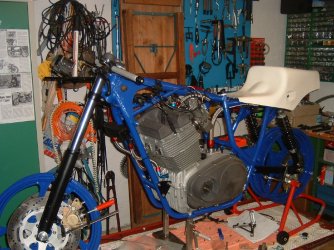
Attached pic is of my shared track bike under construction.  The headstock bracing is way over the top, I wasn't present when it was done, unfortunately.  All finished and powder-coated when I first got to see it! :o  But at least the gusset plate extends a bit below the horizontal tube, but not as much as I would have liked.  Wasn't aware of Gijs' headstock lengthening method at the time and didn't occur to me, would have been great to incorporate that as well to reduce the free length of the forks.  Feedback from the front tyre is rather vague and the bike shakes its head now and then, but overall, it works quite OK.

MotoGP constructers actually seek to include a certain amount of flexibility to enhance traction and ridability. 

Is that sixpence now? :D

piet
 

Attachments

  • Neu_DSCF0023.jpg
    Neu_DSCF0023.jpg
    185.8 KB · Views: 73
The reduced free length of the forks reduces the bending moment applied at the steering head by the forks.
Or something...
 
Marzocchi forks on triples are longer than Ceriani forks on triples.
My modified frame has a headstock extended by 60mm, meaning effectively the distance between the bottom of the bottom yoke and the front axle is 60mm shorter.
Plus Gijs said the forks would not need a fork brace as, due to the 3 points of contact (top yoke, bottom yoke, axle) being more evenly spaced, reducing fork twisting.
If you have the top and bottom yokes close together, and the axle much further away then there is more chance of fork twist between bottom yoke and axle.
The whole fork action and overall handling is the best I have experienced on a 'standard frame' triple, but it does have lots of extra bracing on the frame, Maxton modified forks and monoshock Wilbers rear so hard to say what contribution there is from individual components.
It just feels so planted during sudden direction changes where before you would feel a bit of indecision before it settled in the corner.

Just fitting Zane front and rear ends on a triple frame without addressing the frame deficiencies is asking for future trouble.
 
Oh wow......I'm somewhat gobsmacked, but I will print out and work through every word in this conversation in detail when it has finished

A mate of mine is quite a good race track (Ducati Alchemy etc etc)rider who wants to give the dog (my 3cl) a run, and my thought was, well, if he stacks it, I lose my original front end. and then, on top of that, he will need track slicks. I may as well , then, try and give him something other than an O ring on the arse end

Most of the "correct mods" are done with Gixxer parts, but I've got Zane parts on shelf. So, my response has been to just fit a Zane front end.

The Paoli and Ceriani's are about the same length, but the Zane front wheel is lots smaller. I will probably have to look for a taller front wheel to fit the Paoli USD 41 Super Sports and keep the 3cl "level".

I've been told, by a trusted source, it is a lot machining to fit the Zane swingarm to the 3cl frame. Nothing like a challenge...

Sacralidge. Your getting it all wrong. To me it's sacralidge using Zane parts on a Breganze :P....Sorry lads, we've been here before, just taking the piss.... :D. Please, stop there.... :-[

Regards, Greg
 
blab said:
The forks on the 81 triples are way too long to be solid. A poorly designed front end in my opinion.

It's not really the forks, it's the initial frame design that is poor.  At least it is now.  When it was laid down, it was up there with the best... almost!  It compared well to the far-east products of the time, most other european manufacturers had already started modernising their chassis.  Guzzi introduced their brilliant Tonti-designed frame to replace the old-school garden gate V7, Ducati used a clean sheet for the bevel twins that had nothing in common with their prior singles.  Because the triple was first shown at the 1972 Milan show, development had probably begun around 1969, so one should consider it state-of-the-art at that time.  Just goes to show how chassis design has progressed.

The Laverda triple steering head is far too high up, making the long forks a necessity, along with all their disadvantages.  But this was all well in line with chassis design at the time, and is the foundation of the look and stance of the bikes.  Wonder why Masimo and Luciano decided not to go along the lines of the 750s.  Would have made maintenance a pita for sure, but the 750 frame is far more advanced (compare it to a Kawasaki GPZ900 from '84 :D), despite it being an older design.

piet
 
Greg,

Have you compared the lengths of the 2 swingarms?  At a guess, I'd say the Zane item is a good 12cm longer than the stock triple, stretching the wheelbase by a whopping amount.  Alright in a straight line, but won't do much good around the corners.  I fitted a RGS swinger to my triple, this is 3cm longer.  To compensate, I use fork yokes with a lot less offset, playing well into my ploy of biasing the weight distribution to the front without increasing wheelbase unnecessarily (the Laverda triple is a bloody long bike!).  I was aiming for at least 50% weight on the front wheel, ended up with 52%, comparing well with the GP bikes of the time (early 90's) with their 54-55%.  :D

The track bike also uses a RGS swingarm, but also Beemer yokes, with a bit too much offset for my liking.  Raising the entire bike by re-positioning the rear units and using the slightly longer Beemer forks has compensated the lengthy wheelbase a bit.  Still only 50% weight on the front, but behaves well on the straights and on the brakes.  Needs a hefty nudge around corners though, hence its nickname "Eisenschwein" (iron pig). :D

piet
 
Just measured POP's forks.

bottom of top yoke to centre of front axle: 725mm
bottom of top yoke to bottom of bottom yoke: 235mm
bottom of bottom yoke to centre of front axle: 490mm

This would be 550mm if the modification had not been made.
This makes unsupported length 76% of overall length, vs 67% unsupported for POP.
 
Piet, I was comparing the 81 triple to earlier triples. The forks are significantly longer.
Perhaps it is something to do with the series 2 motor and frame.
Without the factory fairing my 81 looks like a 70's chopper with 3" over forks.
A couple of things were at play here to allow significant fork flex,
one is the length of the stantions,another seems to be the lack of the steel mudguard.
And just maybe, the repro stantions arent as thick walled.
 
I think the 81 triple forks are the same length as 1979 onwards. I've built 3 recently.
Prior to 1979 they had shorter Ceriani forks.
The RGS forks are longer by around 30mm or so. Maybe you have a set of these forks fitted?
 
Nah, standard forks. Measured against Ian's standard 81 Jota.
Way too long in my opinion.
Red supplied me with a new front end complete with custom made fork brace.
Problems only surfaced when riding through sweepers at 130 Kmh + or 150 in a straight line.
At those speeds the problem was a worry.
 
Then I suggest there are other issues to address.
I have owned and ridden a few triples with that length forks and although they are not on rails they handled well at these sort of speeds.
 
my 3-cylinder frame story;
I tend to agree with Piet. For a frame that was designed in the late '60's, for a monster (at the time) engine, in can and does work surprisingly well.
Back when I was 20-something & bullet-proof my first Laverda, a '79 Jota, was a huge dose of adrenaline! yahoo!  :o
So after a couple of years, still in the early '80's, I was beginning to learn there were indeed some 'issues' that could be improved.
But how??  So I know exactly how Blab feels at the mo.  Just that I did that over 30 years ago.
I put my engineering hat on and had a good look at the frame, and pushed and prodded swing-arm and forks and eventually stood back and thought.  Faaark,, just how does this work so well sometimes?? :-\
So with no internet or personal computers, I started a bit of research, on the phone. It was 1983 and I called Richard Slater and he spoke of Harris and Spondon.  I don't recall Motodd getting a mention?  maybe wrong.
Anyhow, the Spondon chassis appealed to me, so next call was Roger Winterburn at Windy Corner. When I first looked at a photo of the Spondon chassis, my spirit-level drafting eye, could see that the steering gooseneck was positioned a lot lower down than the factory frame and therefore the forks were shorter.  also the swing-arm and pivot mounting looked massive, compared to the factory setup.
I'll have one Spondon thanks Roger and also a set of those Forcella Italia 40 mm forks thanks.

Happy-fuckin-days !!  forget the track work, as it was a real hoot out on the open road.  Was surprised, I got away with it, as I just added lights!
spondon4.jpg


Note today:  Clyde, my '78 Redax 1200, still has a standard factory frame.  And I'm very happy with it too.  It does work.  But nothing like a Spondon!
But I'm no longer 20-something & bullet-proof either.  buggar!  :'(

so Greg.  I reckon trying to 'improve' your standard 3-cylinder factory frame is just a waste of time. I suggest you don't have the budget and would be better to spend it on some good beer.  just saying.  8)
 
and Piet, I suggest that Colin Seeley may have a slightly different opinion about the 'clean sheet' frame design ??
sfcpiet said:
,,, Ducati used a clean sheet for the bevel twins that had nothing in common with their prior singles.  ,,, 
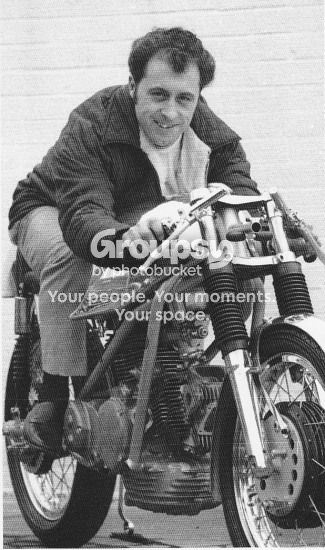
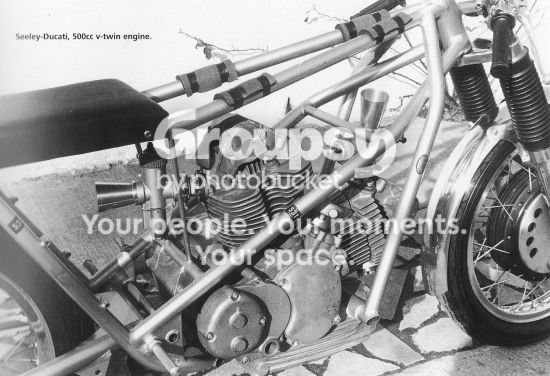
Colin Seeley on the prototype in 1971
SeeleyProto02.jpg

SeeleyProto03.jpg

as I've read that, in 1971, Fabio Taglioni visited the tiny Seeley workshop at Belvedere Kent with some outline drawings along with a dummy engine unit of the new 500 cc V-twin.
yes, I respect Taglioni for what he developed and achieved. I've also admired Seeley frames for decades.
cheers
 
Yes, they did use quite a bit of Seeleys original design, to the point that they are now often credited with the design of the rear axle locating clamps. 

piet
 
blab said:
Piet, I was comparing the 81 triple to earlier triples. The forks are significantly longer.
Perhaps it is something to do with the series 2 motor and frame.
Without the factory fairing my 81 looks like a 70's chopper with 3" over forks.
A couple of things were at play here to allow significant fork flex,
one is the length of the stantions,another seems to be the lack of the steel mudguard.
And just maybe, the repro stantions arent as thick walled.

Frame was basically the same throughout.  The Marzocchi forks are slightly longer than the Cerianis and the rear upper shock mount moved slightly, probably an attempt at increasing cornering clearance.  This also made the longer centre stand necessary.  Don't think the additional 2 cm would have made much of a difference in regard to flex.  The forks are compressed a fair bit for most of the time, and when they are fully extended, there is little load on them.

Marzocchi stanchions are quite a bit thicker walled than Cerianis, but stock surface finish was nowhere as smooth as the Cerianis.  Both are rather bendy, perhaps the Cerianis a little more so.  The wall thickness of repro stanchions must be the same as original, otherwise the damping won't work. 

Later steel mudguards with the sheet brackets did not do much for stiffness, as did the rubber-mounted loop bracket.  Only mudguard bracket that might have added a bit of stiffness would have been the early, rigidly mounted loop type, but that cracked up quickly...

piet
 
markQLD said:
so Greg.  I reckon trying to 'improve' your standard 3-cylinder factory frame is just a waste of time. I suggest you don't have the budget and would be better to spend it on some good beer.  just saying.  8)

That's about where it is looking...Ill go grab some beer, print the discussion out and contemplate it with a highlighter. ;)
 
blab said:
Nah, standard forks. Measured against Ian's standard 81 Jota.
Way too long in my opinion.
Red supplied me with a new front end complete with custom made fork brace.
Problems only surfaced when riding through sweepers at 130 Kmh + or 150 in a straight line.
At those speeds the problem was a worry.

Did you set the fork/spring sag up as per Lothar or JotaJoe's recipe (forget who posted it now: very helpful though)? The Mirage tended to wander a little until I cut the spacer down as per Red's recommendation: now works very well indeed and turns in much quicker..

AndyW 8)
 
Back
Top