sf750 starter spinning

9.5mm is suspiciously close to 3/8in which would be available as an imperial size.
I strongly recommend using the original diameter of 10 x 10 mm!
Overrunning clutches are very sensitive and the forces there are relatively large.

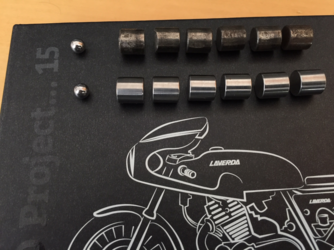
This is what broken and partly flattened rolls look like and how new roles from SKF:

1623418891783.png 1623419196279.png

By the way - the balls for the release lever and the clutch push rods also come from the ball bearing dealer for a few cents.


Thomas aus LAU
 
i am a bit puzzled by this diameter too...anyhow i'm waiting to have in my hand the brand new rollers i've ordered: will measure before fitting and let all you friends know
 
Maybe somebody has indeed replaced the originals with 3/8" rollers, might even have worked for a (short) while.

piet
 
I wasn't suggesting using 3/8in rollers, just offering an explanation as to why they were in there.
Of course not, but it would be plausible.

Rollers generally do not wear that much, they're squared off and totally knackered long before they lose that much diametre.

piet
 
Geez - Just a a light application of Molly Lube in the starter clutch and star reduction cluster on the end of the starter and be done with it.

Most important things are that the rivets are not loose on the starter clutch back plate. The back plate is not dented or warped an that the starter relay is either grounded through the Tranny Neutral Switch or you have Clutch lever depress ground to engage the starter.

To repair a bad incident is ensure the crank snout is polished, probably new dogs and springs and all of the above.

The main reason reason damaging the Breganze Starter Clutch is NOT engaging the starter when the engine is running - So do all you can to prevent it after repairing it. Other words, general maintenance on a Breganzie.
Ron, thanks :):) for the heads up regarding grounding the starter relay through the neutral switch wire. When I rewired my 750 It never occurred to me to do this, just did it now. My Jota still has the factory wiring from new and that will be next to change the relay earth wire. Top Idea, as over the years I have started the Jota in 1st gear a couple of times and nearly gone arse up in the process. o_O
 
Ron, thanks :):) for the heads up regarding grounding the starter relay through the neutral switch wire. When I rewired my 750 It never occurred to me to do this, just did it now. My Jota still has the factory wiring from new and that will be next to change the relay earth wire. Top Idea, as over the years I have started the Jota in 1st gear a couple of times and nearly gone arse up in the process. o_O

Being able to start the bike in gear is a useful “get you home” solution if you break a clutch cable 😉
 
the cable is under the same strain as before, its just that when the cable is moving the mechanical advantage is in the riders favour, if you have extended levers, when it is fully released and you are holding the plates apart, (eg waiting for the OK to move off) the mechanical or hydraulic advantage is gone and the "weight" is the springs resistance in the clutch. doesn't change the breakage rate, this seems to be influenced hugely by, who made the cable, when, and to what spec.
CLEM
 
That's incorrect Clem. If the actuator arm at the clutch end of the cable is extended, then the pull on the cable is less. That's the whole point of the modification. Mechanical advantage doesn't only work when the cable is in motion. It's still in effect when the cable is stationary and you're holding the clutch lever in.

It's only when using a different clutch lever at the handlebar to gain mechanical advantage that the load on the cable remains unchanged. That's because nothing has changed between the clutch springs and the handlebar. In that case, the lower pull force on the lever is because of a shorter distance between the cable attachment and the lever pivot.
 
That's incorrect Clem. If the actuator arm at the clutch end of the cable is extended, then the pull on the cable is less. That's the whole point of the modification. Mechanical advantage doesn't only work when the cable is in motion. It's still in effect when the cable is stationary and you're holding the clutch lever in.

It's only when using a different clutch lever at the handlebar to gain mechanical advantage that the load on the cable remains unchanged. That's because nothing has changed between the clutch springs and the handlebar. In that case, the lower pull force on the lever is because of a shorter distance between the cable attachment and the lever pivot.
Thank god for that. I was having a little head spin when reading Clems reply.

Physics was never a forte of mine.

I put it at the back of my mind, and went on with my life.

Now that has sorted itself out, I’ll go back to my chicken laksa cooking, free in the knowledge that; Better people than me, know better than me.

My main concern now .... how much garlic and chilli to add.
 
That's incorrect Clem. If the actuator arm at the clutch end of the cable is extended, then the pull on the cable is less. That's the whole point of the modification. Mechanical advantage doesn't only work when the cable is in motion. It's still in effect when the cable is stationary and you're holding the clutch lever in.

It's only when using a different clutch lever at the handlebar to gain mechanical advantage that the load on the cable remains unchanged. That's because nothing has changed between the clutch springs and the handlebar. In that case, the lower pull force on the lever is because of a shorter distance between the cable attachment and the lever pivot.
Yeah, I was trying to get my head around it as well - and it didn't add up for me, but I didn't want to mouth off and be thrown to the wolcves again 😧

I see it like a reduction pulley, where the amount of force required is reduced but so too the distance the 'end point' moves (rope has less force applied). So a light clutch extended lever moves the clutch plates and springs a shorter distance than a 'std pull' (but just enough to disengage it and allow getting into and out of gears, if it's done right) - so the workload is reduced, which must mean the stress on the cable is also reduced. That's my explanation and I'm sticking to it!
 
There is so much unintuitive stuff in Physics I baulk at saying anything BUT to me the proof is in the pudding. Before the extended lower lever was fitted I would brake clutch cables 3 or 4 times a year, since fitting a lower extended lever maybe 1 in 10 years.
 
A couple of years ago I was riding with some friends, and a female rider in the group (on a Ducati Multistrada) asked if she could have a go on my Jota, so we did a swap for about an hour. I really liked the Multistrada, and to my surprise, she liked the Jota. She's quite a slim woman with girly sized hands, so I thought she'd have struggled with the (un-modified) clutch on the Jota. I asked her what she thought of it. She said it wasn't a problem. I figure if slightly built 60 year old woman doesn't have an issue with the clutch, then who am I to whinge about it?
 
Well I'm about the ditch the extended lever and go back to original. Have never liked the feel of the extended lever.
I don't have a problem with the SFC clutch so the 1200 should be a breeze compared. As for broken cables I've replaced 1 on the SFC in 40 years of ownership. My records show I've never broken one on the 1200 but have replaced it a couple of times. Just got a replacement for the 1200 from Piet cause the last one was too long and the curve stuck out too far on the left side.
 
Did you ship a clutch cable from Germany, Rob??!! Nothing available here?

Out of interest, how long is the old/new one (casing plus adjuster and length of inner wire)?
 
ah yes but!!! there is heavy resistance in the cable which has bends in it, if the cable was arrow straight between the two points that would be hugely less, when the cable is stationary, the operator is not overcoming that friction.

Another point, is that when new the round inner cable is rubbing against a round outer cable (conduit) this gives "line contact" on the curves, but when worn, a micro "flat" can be perceived on the inner, this increases friction, and when the conduit is worn as well there is an "indent" in the curves and again this increases friction, too much of this and the cable breaks.

argumentative bastard aren't I?

CLEM
 
i am a bit puzzled by this diameter too...anyhow i'm waiting to have in my hand the brand new rollers i've ordered: will measure before fitting and let all you friends know
hi all, received new rollers, their diameter is measured to be much closer to 10mm (my instrument isn't that accurate anyway) by comparison to teh one i removed from the bike.With new rollers the starter ... stopped freewheeling: bike starts like new ... problem solved! thanks again everyone
 
Back
Top