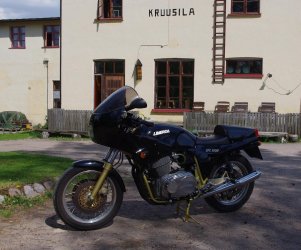
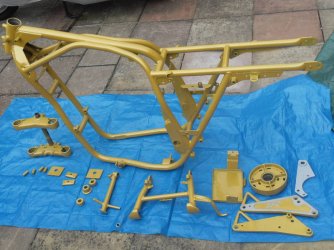
SFC 1000 1988-1989 models

Ouch....2 bad SFC 1000 motors, hard to believe you still are a Laverda fan. I have UK SFC1000 IN 1985 and currently have a Corsa. No problems with either motor. Is there an implication the latter SFC's had problems or were you just really unlucky?


 
clearly the rank and file board members do not generally own crystal balls and after re-reading my 1st post in this thread I can understand that you perhaps thought eehhhh ?  So I will try again, it goes like this...

sfcpiet said:
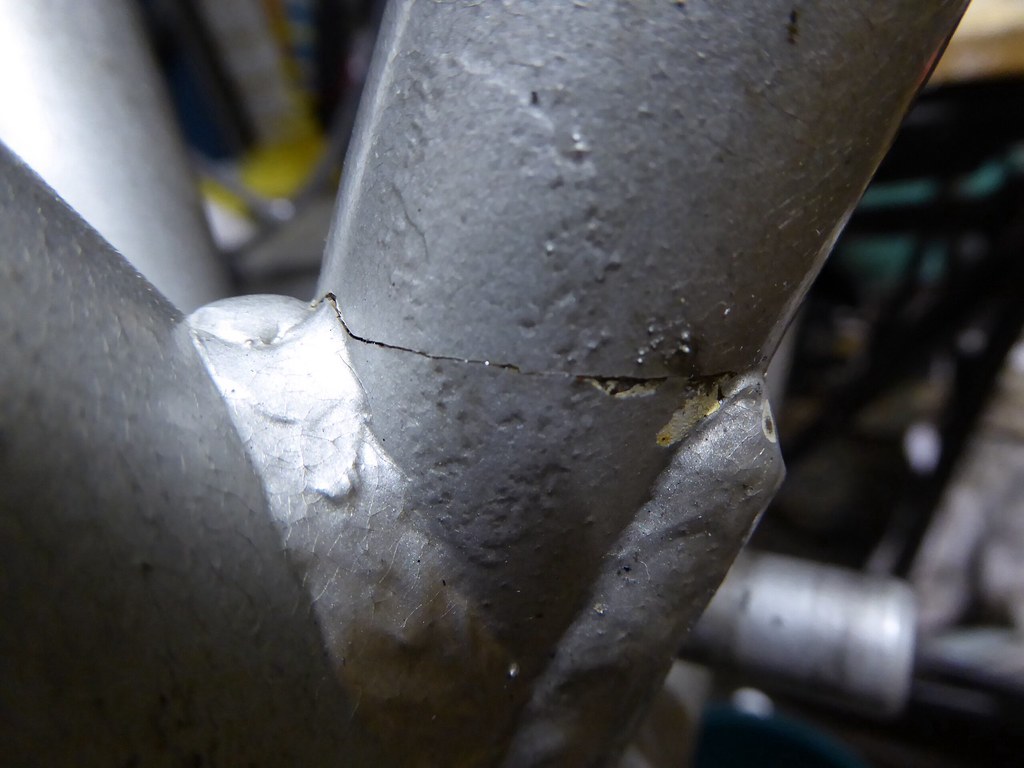
I think I've repaired about 20-25 RGS and SFC frames to date because of the stress cracks in the down tubes.

This question relates to the viewing of a machine to purchase,on an SFC can you get in close enough to assess this without any dismantling, looks like you can't (pic on page 1)? If not, is a full tank removal necessary, and if so what does that involve ? Tools and procedure.

@Andre g Does 2985 have the holes drilled to accept a RH mirror ?  No 2914 also has only a LH Mirror and is on german papers
 
Hi Andy,

you can see it better when tank is removed. It is the downtubes that crack, just follow from where they join the headstock down to roughly hight of the Cam-cover and a bit below. It happens more on 1000 SFC's I think than on the RGS due to the stiffer M1R fork compared to the more flexible 38mm Marzocchi. This, in combination with a relatively short headstock and the slightly better brakes gives a long lever to apply more forces into the downtube.

To remove the Tank, unfortunately you have to remove the seat completely first. there are two obvious screws on the lower "legs" of the seat unit (above the footrests) that need removal as well as 2 hidden screws that connect the seat base to the rear of the frame (horizontally screwed through two holes of the top end of the rear frame. Don't remove the littel vertical nuts under the seat unit, they only hold the metal seat-frame to the plastic seat unit!). don't forget to unplug the tail-light-plug...

After that, there are 3 screws on each side of the tank that fix the front fairing to the tank. these need to be removed, too. Then, after making sure the pet-cocks are closed - you remove the gas lines and slide the tank a bit backwards to remove it from the bike. Heavy sucker if fully filled...
 
can you get in close enough to assess this without any dismantling, looks like you can't

Correct - in my experience, the crack is very difficult to see. Typically it's a hairline crack that only shows as rust starts to appear along it...assuming original paint. Powder coating may hide it for longer  :-\  You may be able to see any remedial bracing without removing the tank, although most won't have used the massive factory brackets!

The crack appeared on my bike closer to the headstock than Lothar suggests - about an inch or so along the downtube.  So you won't see it without removing the tank.  And even then it can be difficult.  Better to ride the bike and see if it shakes its head as you coast down on the overrun - around 30-40mph - with a relaxed grip on the bars 

Not a massive job to fix if you know what you're doing - here's how Keith Nairn did mine
index.php


More tales in this thread - there are others!
http://www.laverdaforum.com/forum/index.php/topic,84340.html
 
Its probably safer to assume there maybe a crack in the frame,  when you think about it the bike is 30 years old who knows what has been happening in all of those years and apart from the loads that transfer through those frame tubes under braking once you have held the bars and felt the fine vibration that transfers through to your fingers and also your feet through the footrests it's no wonder they crack up.
The hardest part of repairing this is probably removing that mongrel fuel tank.
The other solution to all of this is buy a nice 180 degree Jota!
;) ;) ;) ;) ;) ;) ;) ;)
 
Compared to a 3CL, getting the tank off is a PITA, I agree. compared to Japs bikes from the 90's, even the 1000SFC is an easy to service bike. Try to get to the carbs of a 750 VFR... it takes you roughly 30 - 40 minutes until you even see them...  :o My wifes brother has one, I meanwhile have refused to work on it...

so - comparing the SFC with the easiest way may make it look bad. Comparing it with the standard bikes at that time, it is still very nice.

Grant: how easy was it to remove the tank from the 750 S you lately had in your workshop...  :D
 
The RGS/SFC 1000 tank is unnecessarily awkward to remove.
The 750S tank is not required to be removed for access to the engine.
I removed it as the fuel filter was blocked.
Apples and oranges.
 
sfcpiet said:
So what?  If the porosity didn't reach the outside of the casting, it was probably deemed fit for service.  Laverda was building the  bikes to earn money, not to lose money.  I've found porosity in many Laverda castings, as well as in Ducati and MV castings.  Doesn't bother anybody in those camps, and certainly doesn't seem to harm their market prices. ::)
Hello Piet,

Thanks for that historical section.

I think the problem with my valve cover is that there is almost no straight sealing surface, the surfaces are full of those big sized cavities and the straight machined surface is just somewhere on top of those. It needs a lot of silicone and taking the old silicone out needs hours of work every time the cover is opened. I think it is not an acceptable defect. If it would be a single cavity it can be easily sealed just adding a spot of silicone.

Honestly it's not a wrong diagnose those cavities came when the cover was manufactured. People with whom I'm building these for example has builded some Laverda engines from 1970's, did some warranty cases to local importer and helped them and many other Laverda owners in many other way. Some have runned engine factories in Finland including all of the worksteps and service cases and some people even have doctors degree in engineering etc.

I have understood that the corporation was under liquidation (if that is the correct word?) in 1988-1989 and I think these faults doesn't have an impact what I think overall about quality of Laverda motorcycles. I think these 1988-1989 models just need to be completely rebuild and problems solved out. A local motorcycle shop (didn't had anything to do with Laverda) near me went brankrupted a couple of years ago and the authorities didn't gave the owner almost no any kind of possibility to influence what is going to happen.

I thought I said "rejected parts" that doesn't necessary mean they had parts laying around or a some kind of bin. I work on a factory and "rejected part" there may mean almost anything. It can be for example the best component known and just was on a wrong place.

I wish I didn't wrote anything that kind of that can be understood some other way I meant.
I wish also I didn't annoyed you or anyone else.

Now I would like to answer Mr. Lothars questions.

With kind regards,
-Jouni

Edit: typos
 

Attachments

  • Laverda_ralli_14_3_raj50.JPG
    Laverda_ralli_14_3_raj50.JPG
    184.4 KB · Views: 57
hope this pic comes out its mine which has been plated at the headstock and around the swinging arm pivet, the tank is no harder or better to take off than anyother laverda i dont think
 

Attachments

  • rsz_sdc12738.jpg
    rsz_sdc12738.jpg
    110 KB · Views: 72
Laverdalothar said:
...

Can you put some pics up here, please, regarding the differences of the primary cover? There was a modification (dutch?) available in the 90's with a bigger ignition cover that should protect the ignition when dropping the bike. It was an aftermarket solution my brother had on his 1000 SFC and his 120? Jota I think to remember...  Maybe that is what you mean?!?

What Frame number is yours? I know a second 1000 SFC Classic in Finland, owned by Hanu living roughly 150km north of Helsinki or so.
Most of my pics are on a computer that is now broken and I don't have better picture at the moment. The frame and engine numbers are #3370, matching then.

I don't know what the pick-up cover is. The primary cover is cutted that way there is almost no recess for pickups. Then pickup cover is made of two parts. It has a machined end plate and a cylindrical part that looks like if it was cutted away from some another primary cover. The end plate was 4mm thick when I bought the bike and the rotor rattled against it. The end plate was thinned to 3mm on a lathe and the rotor does not scratch it anymore. There is no any kind of gaskets on it and it needs to be sealed always with silicone or it will be full of water.
 
Thanks for the detailed description Lothar.

Grant I assume that's your own gusseting solution, not the factory  http://www.laverdaforum.com/forum/index.php/topic,90792.0.html Looks pretty substantial.

Rob, after seeing these and other pics and threads here, especially for an SFC, I think the tank has to come off or no deal.

nice pics Patrick. Your bookmarked. '76 3CL ?  Interesting that the cracked pic (painted) looks much more dramatic than the uncoated pic where one can just about make out a witness mark.
https://www.flickr.com/photos/129012777@N08/16101086300/in/photostream/

laverdas, the factory kit ?

Thanks Andre
 
Grants pic is actually of the factory effort, as found on the very last 1000SFCs to leave the factory.

piet
 
Interesting story Piet.

Did you ever seen that? (picture below). It was my SFC 1000, 1988 model, serial number 3354, cast wheels (not Classic model). it was bought to Enzo in Belgium and it came from the factory with these Jota 120 instruments. 2 other problems, a porosity on the upper side of the crankcases and an occasional electrical short on a wire (the wire for the rev counter on the RGS).

I met the owner of #3355, still bought to Enzo and wonder what? 12?0 Jota instruments, porosity of the upper side of the crankcases and an occasional electrical short with the same wire!!

Curious to know how many SFC 1000s came from the factory with these instruments...

 
and no mirror, interesting.

Just to add something to my no. 2985. It was first registered in Wiesbaden, could it been assembled by Schenk- just with the left side mirror?

Also the center nut of the yokes is not drilled at my one.

Andre

 
Hi J-LO,

Never seen that... can only imagine it to have been a quick solution for the just as quickly failing Smiths clocks.  Hard to believe it came from the factory like that.  The alloy dash was a central design point of the bike.

Would have thought Mr.Bevilaqua would have been able to address those issues after all that time... wrong LH switchgear as well. :D  No surprise the mirrors are missing, the rego laws in Belgium were extremely lax at the time, we were always green with envy this side of the border.

piet
 
Back
Top