SFC1000 alternator - paired blue/white and yellow wires - what are they for?

stivesvelo

Junior member
Location
Cambridgeshire
As a no-electrical type of person (can follow wires on a wiring diagram) In the process of reassembling the bike having dismantled it about 3 years ago, I'm just putting the wiring back in place and find that the yellow and the blue/white wires from the alternator which go to the regulator/rectifier have been paired up but don't appear to have anything to connect to and wonder why they are there?

When I bought it long ago it had a DMC 1 ignition system & later on replaced to with the later optical system, these don't appear on any wiring diagrams & wonder if the connectors had anything to do with a previous ignition system or suchlike?

Any suggestions,

Also being a pilloc, forgot to put the earth which went under the battery tray, now looking for another location as I don't want to take it out again!
DSC04646.JPG

DSC04660.JPG
 
They are just duplicates of their color coded mates. They are from the three phase alternator and go to the regulator, ignore the duplicates.

I cant see my bike right now but I think I ran this ground to the crankcase breather bolt.
 
As Henry says, they’re just duplicates and you can leave them disconnected. Nobody seems to know what they’re for, but we’ve all wondered and asked the same question you have 😁
The earth to the frame can go anywhere convenient, remember to remove any paint from under the lug and add a smear of grease to prevent corrosion. The engine earth commonly bolts to the crankcase breather but I prefer it on the starter motor bolt, where the greatest power is required.
 
They are just duplicates of their color coded mates. They are from the three phase alternator and go to the regulator, ignore the duplicates.

I cant see my bike right now but I think I ran this ground to the crankcase breather bolt.
Thanks Henry, that makes sense, have taken the battery tray out again & will remove paint & add conductive grease to keep the rust away as the original earthing cable is good & fits.

Went out for a ride today & met up with a mate, had lunch at a cafe & the only thing he could think of for the 2 extra wires was provision of easy access wires to plug into for testing the alternator.

What do you think?

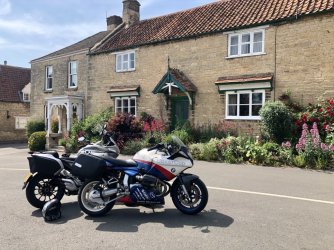
Good cafe opposite side of the square to the bikes.IMG_5519.jpeg- 'Hatties' - in Corby Glen, run by the late Queens Chef - Special lunch for 'Seniors' on Wednesday!
 
Last edited:
As Henry says, they’re just duplicates and you can leave them disconnected. Nobody seems to know what they’re for, but we’ve all wondered and asked the same question you have 😁
The earth to the frame can go anywhere convenient, remember to remove any paint from under the lug and add a smear of grease to prevent corrosion. The engine earth commonly bolts to the crankcase breather but I prefer it on the starter motor bolt, where the greatest power is required.
I'll take another look this evening Andy, there are 2 earthing straps, one from the engine to the battery & the other from frame to battery (I think), the one I'm thinking of is the battery to frame.

Probably an idea to get a new battery before I bolt anything up as a new set of straps may make sense, note to self - order a battery, last one I had was Odyssey any recommendations anyone?
 
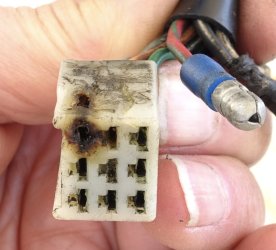
Do yourself a favour and replace the overheated bullet crimp connection on that yellow wire...and the others too if they look similar
Here's the remains of some I've already done, the lheadlight one was burned out - the headlamp bulb was 100/80 W replaced with original spec candle for now.

Last picture should be first!
DSC04621.JPGDSC04645.JPGDSC04620.JPG
 
Here's the remains of some I've already done, the lheadlight one was burned out - the headlamp bulb was 100/80 W replaced with original spec candle for now.
This is the simple reason relays were invented. They're almost universal in modern automotive design - bypass the handlebar switch and run whatever wattage headlight globe the alternator can handle!! While you're at it, they're also a great way to reduce amps going through your ignition switch.

People shy away with concerns about the relays failing (which is far less likely to happen than overheated old wires wreaking havoc) - a simple bridging wire between the 'signal' feed wire and 'to' wire of the relay will get you home ... but in 50 years+ I've never had a relay fail on me.
 
Anybody know why one phase of the alternator detours to the light switch on the handlebars & back to the Rec/Reg, does it do anything apart go through the switch whilst it's there? Looking at the diagram (not sure I have understood the chart showing connections as all it seems to do is connect to the R/R when the lights are turned on) is there a reason why I shouldn't take it straight from the alternator to the R/R ?

I'm thinking of taking the direct route but worry that the old burned connector block below indicates something else, (the green/white into the switch from alternator connects to red/green wire out of the switch shown with the bullet and connects to the red/white to the RR) now replaced with a new connector block, would a bad connection cause enough resistance to do this or could there be another reason?

I'm looking at the RGS wiring diagram with DMC 2, & think I'm being a bit dim (like the headlight) hope the explanation makes sense?

DSC04448.JPG
 
This "mystery "has been covered many times in posts, that's where I first discovered it . You will find lots of info with the right search.

Yes you can re route it and if you have not already done so, put in relays for the headlight while your at it. So when your all done the headlight switches then are just triggering relays not carrying the higher load to the bulb. This gets you a brighter headlight and no more burnt wiring.

The DMC wiring, if your still having issues with it??? is not related to any of this.

I managed to do all this with help from the Forum and my basic auto electrical abilities...and it actually worked!
 
This "mystery "has been covered many times in posts, that's where I first discovered it . You will find lots of info with the right search.

Yes you can re route it and if you have not already done so, put in relays for the headlight while your at it. So when your all done the headlight switches then are just triggering relays not carrying the higher load to the bulb. This gets you a brighter headlight and no more burnt wiring.

The DMC wiring, if your still having issues with it??? is not related to any of this.

I managed to do all this with help from the Forum and my basic auto electrical abilities...and it actually worked!
Thanks Henry, I've just been reading your DMC saga, I have the DMC2 (after problems with the earlier version) which was good and after the various comments I may replace the R/R (there's company called 'Electrex' in UK who make one which looks like it will fit) the bike was running fine last time I used it but I've discovered these problems since taking it to bits to 'tidy' things up. The burned connector must have happened before I owned it, fingers crossed, it should go like a rocked when I've finished.
 
As Henry says, you can bypass the loop up to the switch. It was a good idea at the time, to reduce charging capacity while the headlight was turned off, to prevent overcharging the battery, but now we run our headlights all the time so it’s redundant, especially if you fit a modern regulator.
The damage to the connector block is completely typical of a bad connection caused by corrosion and heat, and unlikely to be caused by anything else unless other changes have been made. Once the metal connector has suffered this amount of heat damage it is not repairable so you were right to replace it. I always add a smear of grease to connector pins to prevent corrosion and ease removal, it doesn’t affect the electrical connection and reduces future problems.
 
I believe the actual reasoning was that the original r/r was not rated for the full output of the alternator. So switching one phase (of the three) when the headlight is on prevented overload. The downside is that the connections and switch contacts continuously carry a high current (6-7 amps). A poor contact overheats with age.
 
I believe the actual reasoning was that the original r/r was not rated for the full output of the alternator. So switching one phase (of the three) when the headlight is on prevented overload. The downside is that the connections and switch contacts continuously carry a high current (6-7 amps). A poor contact overheats with age.
Sounds daft, must have been the accountant, "we need to put a proper r/regulator in there, yes, but not until you've used all of those old ones over there on the shelf"
 
The OEM RR was of the era, higher power RR were available like the Shindengen. The basic oem electrical harness was designed by mechanics, electrical people can only look on in wonderment why a mechanic designs electrical systems and interconnects, the absolute worst in Moto Guzzi electrical wiring in the day. Battery negative to starter motor direct, quality welding cable is best. Forget the bizarre "earth" connections of OEM. HTH j
 
Back
Top