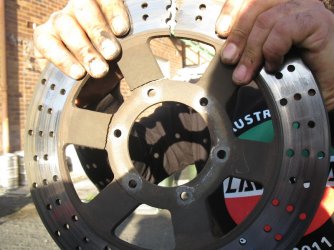
SFC1000 mishap

I think what happened was that in all the kerfluffle with the disc lock up and having to trailer my bike home I may have neglected to turn off the fuel taps. The puddle under the bike did not appear until several days after I parked the bike in my garage. This would support Scrumpy's theory of fuel leaking into the sump, as it would take a day or so to begin leaking out. It is still bitterly cold here so it will be a few days before I can do a thorough check. Temperature is supposed to skyrocket up to -25 tomorrow! Good news is that we return to normal temps by weekend so I will be able to keep the shop warm. I really appreciate all the feedback on this and will let all know the final diagnosis.
Dennis
 
Think the case of the fractured disc as mentioned here and also what happened to Cosi's RGS on the way to the BSFOS a couple of years ago may be caused by worn brake pads. A long time ago in a galaxy far away I was in a situation where I had to ride a fair distance using the rear brake only. When I arrived at my destination (Vehicle inspection station at Regency Park SA) I found that the rear wheel would bearly move and the disc was very hot. Rotating the wheel backwards freed the pads and on further inspection the pads were found to be worn into a werdge shape. From then on I've kept an eye on the pads and change them as soon as uneven wear is noticed.
 
I have had the dragging pads thing happen a couple of times over the years,its pretty obvious its happening.Be hard to not notice and keep riding to the point where the disc gets that hot it explodes.The last time it happened to me was on an expressway on a plus 40c day and I didn't have a 10mm spanner to back the adjuster off.Ended up using a 13 with a 10c coin packing the spanner out.It took about 5 minutes riding to heat the brake to the point where it slowed the bike enough to notice.Even them the wheel still turned a bit
 
Could be an argument there for reversing the pads occasionally Terry. A bit like revolving (as distinct from rotating) tyres on a car - keeps the wear even.

Good theory Steve. Remains to be seen whether it applied in this case, but certainly a possibility. I reckon Dennis would be well advised to check that the MC piston returns reliably to its rest position.

Cam
 
When I took my Jota out of the box and fired it up for the first time I was really excited, desperately wanted to take it for a ride, but I dutifully changed the oil and checked chain tensions, even checked the fluid level in the front master cylinder. Didn't look at the back one. Finally fired it up and headed for a bit of a circuit of the neighbourhood. After a few ks I noticed performance was very sluggish, and as I pulled off the main road to head home the bike wouldn't even move. I managed to get close to the edge of the road and started checking whatever I could think of, stomped on the rear brake pedal a few times. After stomps, back wheel was now turning fine. I headed home, opened the rear master cylinder cap; what a stink! Rotting hydraulic fluid, and the rubber bellows had partially dissolved in the goo.
Looked a bit closer, the rear disc was badly warped. Took the disc down to the local brake place, they chucked it up and started to true it but stopped when they saw it had over 1 mm runout. Then they noticed that it was also cracked, almost all the way across the disc in 2 places. Replaced the disc, rebuilt the caliper, new pads, but had to replace the master cylinder because the alloy had got so soft I could dig chunks out of it with a fingernail.
So now I never assume rear disc brakes don't give any trouble.

Ken
 
"Could be an argument there for reversing the pads occasionally Terry. A bit like revolving (as distinct from rotating) tyres on a car - keeps the wear even."

Good point Cam, now part of my periodic maintenance programme (goodjob)

 
Well in trying to link everything together I didn't take in the mention of 1/2 a litre of oil, so unless he's got some kind of special endurance racing master cylinder, I'm shot down in flames. :)
 
pour out half a litre of oil on the ground, its a lot of fcking oil

as far as my rear caliper went, it certainly wasn't locking up, I reckon you might notice that at 180-200 on the run into Walcha,

As we were doing a 2500k run all fluids were done and calipers were cleaned and checked, I noticed the same thing on Wilfred before I gave it to joey, not quite as severe but there were hairline fractures on the lower part of 2 of the carrier webs, his brakes weren't sticking either

I wonder why it seems that only the rears seem to go? anyone had a front one fail?
 
Cosi said:
anyone had a front one fail?

I had a stainless front disk on my Kawasaki Z1300 fail. Didn't crack, just bent out of shape. Might have had something to do with failure to remove the disk lock  :-[

It's still hanging on the wall of my shed as a personal reminder not to be a dickhead.
 
Cosi said:
I wonder why it seems that only the rears seem to go? anyone had a front one fail?

Could be crap wheel alignment after adjusting the chain - rotor not running true in the caliper?
 
"as far as my rear caliper went, it certainly wasn't locking up, I reckon you might notice that at 180-200 on the run into Walcha,"
Walcha, isn't that up north? I came up from the south with the mexicans :D

Just looking at a possible cause for the rear disc fractures, reckon overheating may have something to do with it.
Does the fault occur on one-piece discs as well as the discs with seperate carriers or limited to one type?
 
I reckon cracking would be more likely to happen in the one-piece disks because the heat stresses would be more extreme than with the bolted-up versions, which have some (minimal) freedom of movement between disk and carrier. I'd guess that floating disks would be least likely to build up heat stress.
 
Less cooling on the rear? How much heat is produced if the rear is usually ineffectual.Looks like the only cause might be dragging pads.What other loads or force are excerpted on the rear disc's.
 
Applying Occam's Razor indicates (to me at least) that the fractures are caused by heat build-up which is most probably a result of dragging pads. IMHO ;)
 
I know that this happened to bikes tested by Uwe Witt and 2 other German Resellers on the dyno. Bikes were just run-in, so nothing to do with fatigue of material or old calipers. seems it is an issue caused by the design or the material of the (solid) rear disk. Later ones had the 2-part rear disks with bolt-on-carriers and these do not seem to have said problem.

HTH
 
Back
Top