Sludge Traps Oh My!

triumphguy

Junior member
Good morning,
My 1979 1200 Jota America came to me with 72,000 miles on the clock.  It had passed through several hands 'for restoration' but fortunately was still in mostly one piece (To paraphrase Miracle Max, 'It was only mostly dead').  Everything on it is worn, albeit not 'too worn', and had it not been allowed to sit for years accumulating dirt and dust everywhere, it would probably run as is.  As I'm preparing to recommission it, I'm wondering if  there is an alternative to disassembling the crank to clean the sludge traps? Can I just remove the bottom (or top) case and get at them?  How about a thorough kerosene flush followed by a remote spin-on filter (which I am going to add regardless) and high detergent oil changed frequently for a year or so?  I don't want to cut corners, but on the other hand I don't want to do more work than I have to.  I will do whatever the collective wisdom tells me it takes.

Cheers,
Patrick Cherry
Ojai, California USA
Where it has rained for something like 22 of the past 30 days -- finally!
 
Cut corners, pay twice.
72,000 miles is a lot if still on original crank.
Pull the crank out, measure everything and that will tell you how far you need to go with it.
Sludge in the traps will be rock hard and tough to shift but do half a job and it could break up and travel to places you really don't want it to go.
 
Mmmh, 72,000 mls and years of resting.  You might find the center mains pretty much knackered, once you opened the case. :o
I'm with Grant, leave the sludge traps alone. Don't think you can clean them as neccessary with the crank still assembled, any effort to do so will most probably cause the big end bearings being flushed with lots of debris in the aftermath, spin-on filter won't help much here.
If you aim to use the crank as is, you might check first wether there is still oil passing from the traps through the big end bearings...lubricating the big end is the main purpose of them, for which they are called oil slingers instead of sludge traps by some of the experts.

Regards,
Stefan
 
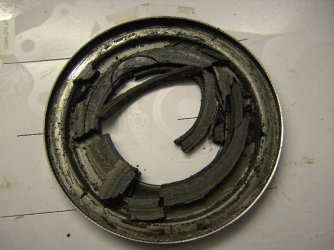
Here's what I generally find in Laverda oil slingers/sludge traps.  The pic shows a filled-to-the-limit 750 item, the triple part just has a smaller diametre and thus a slighly lower capacity.  Scratching this lot out while the slinger is attached to the web takes the best part of an hour, lots of cleaning fluid and a good litre of brake cleaner for final rinsing.  Most of the stuff that is dislodged through poking around with a welding rod, etc, will immediately find its way through the big end bearing upon starting up anew.

At that mileage, the centre mains will probably rock around excessively.  Renewing these will restore a level of mechanical quietness that you hardly imagine possible.

Either leave it alone and hope for the best, or tear it apart completely.  Sorry, I don't see any alternative.  Chemically cleaned cranks have in the past lost their big-end bearing cages... spotless, but the cages dissolved into nothingness!  :D

piet
 

Attachments

  • Neu_PICT1318.jpg
    Neu_PICT1318.jpg
    140 KB · Views: 118
is interesting when you cut the slingers off, the entrapped sludge inside is like a timeline to what the engine has been through over the years
sometimes you can even see different colours like tide lines in the entrapped metal fines
going from dark through to alloy build up where the engine has suffered some abnormal wear or "event" in its life
I find it most interesting

 
Well, that actually makes the decision pretty easy. When I first started working on cars and bikes 45 years ago, I used to routinely buy two parts in order to fix one, figuring I'd destroy the first one learning how to do the job right.  I just considered it tuition. I no longer enjoy doing stuff twice.  Out it comes. Like Red said, it will be interesting to see what it reveals.

Thanks to all,
Patrick
 
Good decission...! Not sure how much was in the slingers on my 1000 SFC engine I collected from OCT some weeks ago, but I defenitely put a "slingers cleaning job" on the todo list, when I asked them to overhaul the engine...
 
chrisk said:
That bit of swarf at 5 o'clock makes you wonder how it managed to make it in there ............. unless it's a grey hair from Pats noggan.

Gotta disappoint you Chris, I think that's only a fresh scratch in the surface of the slinger... that stuff is rock-hard at the outer circumference, and quite difficult to remove.

piet
 
Whilst on the subject. We have a 750 crank here needing the slingers cleaned. It has been completely apart before at least once and we are loath to press out the centre splined section yet again as this is the weak heel of the 750 cranks. Thought to press off the outers and clean it with the rods and bigends removed, the idea being that the roller mains should be possible to thoroughly rinse out. A bit of a dilemma, do it "properly" and weaken the crank, or take the risk with the mains and keep the crank strong. The factory didn?t intend the centres to be serviceable but they don?t make them anymore either.
 
Lee,

Not too much of a drama.  When the centre shaft is out, I grind off the sharp edges of the splines so they cannot do any damage when pressed back in.  If the traps are full, the centre mains will be knackered as well.  Easier to reassemble by removing crank pins and replacing them into the outer webs first.

piet
 
sfcpiet said:
Gotta disappoint you Chris, I think that's only a fresh scratch in the surface of the slinger... .

piet

It's OK Piet, I'm not a mechanic.

Tippie, REDAX have new slingers. Not sure if Red has them in stock, but I do know he bangs up new ones.
 
Back
Top