Small diameter tube fabrication (no Laverda content)

Basketcase

Senior member
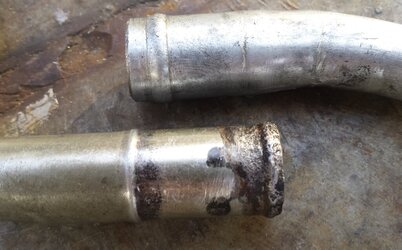
I had to make a one-off heater pipe for my Toyota Prado that is unobtainable. This seems to be an electrolysis point that eats away the joint. Used ones at the wreckers are crap.

The original is an impossibly small mandrel 25mm bend radius on 17mm tube. So I made an internal radius lathe turning tool and then made a bending die from scrap that at least copes with 45 degree without collapse. Round and straight die pair for maximum wall support.

The original tube is 17mm OD but I can only get 16mm zinc plated from Bunnings, wall thickness 1.2mm.

I made a swage to get the ends up to 17mm and then made an internal beading tool for the seal. This was a crimp type tool that fits in a vice and I rotate the tube between crimps.

Looks a bit rough but works. I might even try filling some tube with lead to see if I can get a clean 90 degree bend.

Smaller versions could be made for oil and fuel pipes using this technique in the home workshop.

Rob
 

Attachments

  • Heater pipe (1).jpg
    Heater pipe (1).jpg
    215.2 KB · Views: 31
  • Heater pipe (2).jpg
    Heater pipe (2).jpg
    112.9 KB · Views: 31
Tricky job, Rob! That's perseverance! Shame they didn't do the original in heavy stainless.
I am not sure that the modern organic acid long life coolant inhibitors are compatible with chromium in stainless.

The organic acid inhibitor coolant is definitely not compatible with copper. Thick walled copper tubing would be really easy to bend in a small radius.

Hence the thin wall galvanised steel like the Toyota original which lasted 25 years.
 
That's nice work, but how about aluminium? Should agree well with coolant and the green church even has some in 16x1mm, 1m length, <$5. 6063-T5, so might need annealing to bend nicely, but I have sand-bent 19mm ally tubing (6061-T6) nicely for my fairing bracket before.

Bloody cars... my BMW had two lines in plastic, no corrosion worries but they degrade with heat and age. They were still ok after 13 years and 220,000km but I replaced them when I was doing nearby work and had them accessible. The ironic upside of plastic is that they're known to fail so are half a dozen different brands of replacements, including original, which I used. Hard to fathom that something known to fail on a Prado does not have a significant OEM or aftermarket supply of alternatives?

Nice work on your improv though. (y)
 
Yes. Well done. I like to see people fixing things themselves. Seems a lot of vehicle components are consumble these days.
I've had to replace most of the cooling system in my Mitsubishi over the years. Stuff like plastic header tank and plastic radiator that degrade over time.

The water pump also went tits-up a while back. A bearing failed, which allowed the shaft to wobble around and destroy the seal. The spare parts bloke at the Mitsubishi dealer told me that the water pump was not a repairable component. You had to buy the complete assembly. Fuck that. I hate that sort of nonsense so I pressed the thing apart and found that the bearings and seals were readily available from my local bearing shop. So I reassembled it with new parts for about 5% of the cost of a new pump.
 
Yes. Well done. I like to see people fixing things themselves. Seems a lot of vehicle components are consumble these days.
I've had to replace most of the cooling system in my Mitsubishi over the years. Stuff like plastic header tank and plastic radiator that degrade over time.

The water pump also went tits-up a while back. A bearing failed, which allowed the shaft to wobble around and destroy the seal. The spare parts bloke at the Mitsubishi dealer told me that the water pump was not a repairable component. You had to buy the complete assembly. Fuck that. I hate that sort of nonsense so I pressed the thing apart and found that the bearings and seals were readily available from my local bearing shop. So I reassembled it with new parts for about 5% of the cost of a new pump.
I bought a new after-market water pump for the Prado while the heads were off.

The pump gasket face machining was appalling and stepped.

So like you, I renewed the bearing and seal in the original casting. Interestingly, that is when I learned about special ethylene glycol resistant silastic sealer.
 
Last edited:
that is when I learned about special ethylene glycol resistant silastic sealer.
I didn't know there was such a thing.

It's been a couple of years since I did mine and I don't remember whether I used a sealer. I may have just let the gasket do the job, and there's no leaks so far. If I did use a sealer, it would have been from a tube of red Loctite 515 gasket sealer that I use for that sort of thing. Loctite is supposed to have a shelf life of 2 years, but I reckon I've had it for 10 years and it still works OK.
 
could you not have used a stub from each end and linked it back up using hose?
CLEM
The bend has to be rigid to avoid other other hoses in a crowded area as well as the bracket supporting another hose.

It also means two extra joints.
 
Last edited:
Sand does a similar job if you are ever short of lead.
Sand needs drying, sifting, ramming and the tube ends welded closed on such a short length. Even then, for cold bending the forces are very high and it seems to crush a bit more than lead.

Sand works very well for hot bending where the forces are much less. I have made exhaust pipes with this method.
 
Sand needs drying, sifting, ramming and the tube ends welded closed on such a short length. Even then, for cold bending the forces are very high and it seems to crush a bit more than lead.

Sand works very well for hot bending where the forces are much less. I have made exhaust pipes with this method.
I remember watching a plumber using sand for an odd size copper pipe once.
He was a really really old plumber 😉
 
I remember watching a plumber using sand for an odd size copper pipe once.
He was a really really old plumber 😉
Copper is very easy to cold bend due to low tensile strength. The easier stretch means less compressive force on the inside bend and less tendency to ripple and collapse. I find steel ripples more in thin wall due to buckling under stress.

There is even a steel coil support that slides over copper tube for custom cold bending.
 
Copper is very easy to cold bend due to low tensile strength. The easier stretch means less compressive force on the inside bend and less tendency to ripple and collapse. I find steel ripples more in thin wall due to buckling under stress.

There is even a steel coil support that slides over copper tube for custom cold bending.
Interesting, the only spring type benders I’ve seen go inside the pipe. Although using an external former is more usual.
Old steel electrical conduit could be bent cold around any curved object or even just put the end in a hole and lean on it. But the new stuff (still used for special jobs) can only be bent nicely using the correct former.
The lead method is new to me, but I’ll keep it in the back of my mind for a special case 😉
 
Interesting, the only spring type benders I’ve seen go inside the pipe. Although using an external former is more usual.
Old steel electrical conduit could be bent cold around any curved object or even just put the end in a hole and lean on it. But the new stuff (still used for special jobs) can only be bent nicely using the correct former.
The lead method is new to me, but I’ll keep it in the back of my mind for a special case 😉
They don’t cal it Gal Mal for nuffink😉
Got the internal bending springs in Aus also...... but hey we have been using Pex for some time now.

Just had all plastics go up close to 40% recently 😱 and just completed a gas fitting line in copper.....was cheaper!! Go figure.
 
Me too. I've tried the sand packing method but it didn't work for me.
Lead sounds a much better idea. It's effectively a piece of solid bar inside the pipe. I wonder if it'll work on plastic conduit ;)
Good luck buying lead..... but I’m sure you have plenty of ole sinkers in the shed Cam 👍
 
Back
Top