G'day Craig
Sometimes the simplest fixes turn into a headache. But as with most problems, there are several solutions:
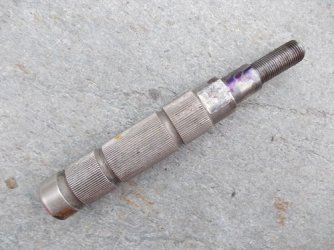
1. You could replace the bolt on your new foot peg with one that fits the existing thread in the frame, or use a longer bolt and a nut. I dunno how practical that is. Might need cutting and welding a new threaded section on if it's a solid peg.
2. If welding is necessary, I think I'd be more inclined to weld up the hole in the frame, re-drill and tap it to the correct thread.
3. Is the threaded hole in a large area (like a gusset plate) or a tubular socket welded to the frame? If it's a tube type mounting, there may not be enough wall thickness to put an insert into it. In that case you may be able to cut it off, make up a new socket and weld it on.
4. If it's practical to go with the insert option, as you've discovered, Timesert doesn't list a 12 x 1.0 threaded insert. They will make custom inserts, but their minimum order quantity is 1000. I don't suppose you could find a use for 999 spares

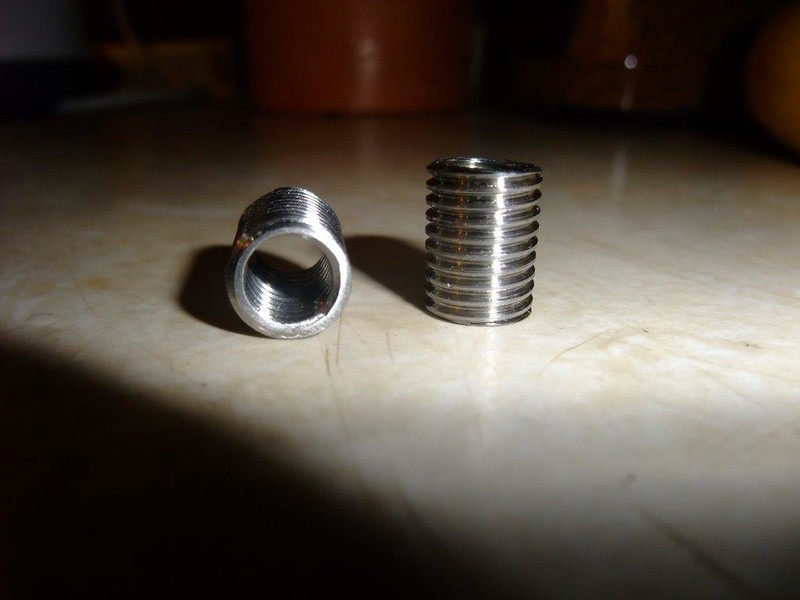
It's not a difficult job to make a custom insert. Any engineering shop could do it, or someone with a lathe capable of thread cutting.
The threaded hole in the frame is probably not a 13 mm thread. That's not a standard size. If the thread in the frame measures 13 mm ID, then the actual thread size will be larger. Measuring the diameter of the thread on the bolt will give you a better indication of what the thread is. If that's where you measured the 13mm, then the hole won't be big enough for an insert. But it could be anything - metric, Imperial ... who knows? If you can identify the thread and determine that it'll take a 12mm insert, all well and good. But you may have to re-drill and tap the hole.
Inserts can be made with quite thin walls if the internal and external threads are synchronised (matched pitch), but that's not going to happen with a 12 x 1.0 internal thread. The reason being that you'll never find a tap (to tap the hole in the frame) for the larger external thread with 1.0 mm pitch. So at some point, the OD of the internal thread is going to line up with the ID of the external thread, resulting in a localised thin wall.
For example, the thread root diameter for M14 x 1.5 is 12.3 mm. So if you were to make an insert with 12 x 1.0 internal and 14 x 1.5 external threads, the threads would miss each other by a very thin 0.15 mm. So I'd suggest you go bigger than M14 on the external thread. M15 is non-standard, so would be difficult to find a tap. M16 would do, in either standard 2.0 pitch or fine 1.5 pitch (13.8 and 14.4 mm thread root dia respectively). Preference would be the 1.5 mm pitch if you can find a tap at a reasonable price. That'll give you a healthy 1.2 mm of metal between internal and external thread roots (M16 x 2.0 would give you 0.8 mm thickness)
Normal thread dimensions allow for a bit of clearance, but for an insert, you want it to be somewhat tighter fit in the thread, but you don't want it so tight that you can't screw it in. I'd suggest you ask whoever is making the insert to cut the external thread slightly over-size. Give them the tap that you'll be using to tap the frame hole with. They'll use it to tap a gauge hole to trial fit on the external thread of the insert.
Install the insert with Loctite or an equivalent product.







 ). Offer much appreciated!
