martymoose
Hero member
- Location
- Sydney, Australia


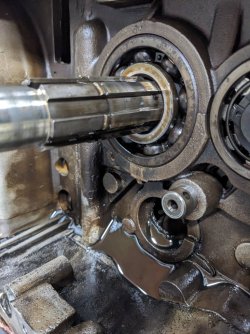
 Not to forget the other side...:


Yeah - mine looks similarely..
View attachment 103758
View attachment 103757
Here is when it happened (SPA, 2010):
View attachment 103759


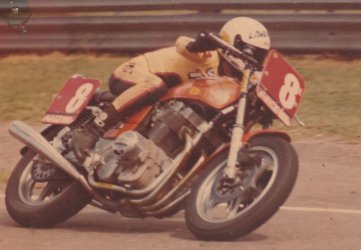
On The bosh engine, the right side sticks out 3cm or so more, hard not to touch ground on narrow roads. The ND engine has more ground clearance, takes a bit more angle to ground it. To be fair though, my weight takes away a lot of ground clearance already while standing upright...View attachment 103760
Getting the generator cover down, on track, is relatively easy. Although I have done it on the road, on occasion.
Never managed to ground the primary chain adjuster. Maybe because I'm right side dominant?


I should first built myself ultralight, else that is useless...Yes, such a street bike is far too heavy for a little fresh race at Spa, you should build a TT1, and build it ultra light (170 kg) it will do at Spa



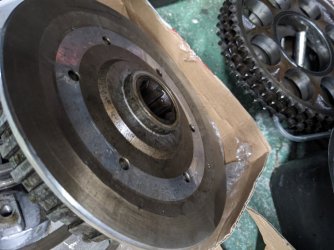
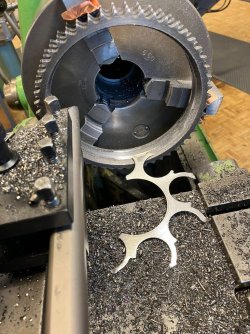
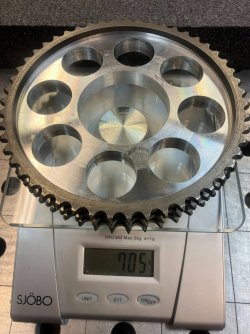
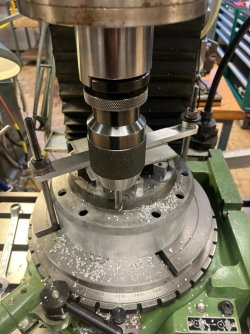
Looks good but I would not turn the clutch chain wheel on the lathe in a three jaw chuck. It will be close but not concentric.Special racing parts:

It doesn’t spin anywhere near crank speed and the factory finish on the clutch outer is so rough you’re unlikely to make it any worse!Looks good but I would not turn the clutch chain wheel on the lathe in a three jaw chuck. It will be close but not concentric.
Yes, but if you are going to the trouble of making "special racing parts" then you do the best you can to make the parts better than the factory did.It doesn’t spin anywhere near crank speed and the factory finish on the clutch outer is so rough you’re unlikely to make it any worse!
You've got crap chucks... even the cheapo chinese do better than that!Yes, but if you are going to the trouble of making "special racing parts" then you do the best you can to make the parts better than the factory did.
A three jaw chuck is never a precision piece of tooling. At best you will have about .08 mm of run out on a new chuck. A chuck with a few miles of use on it will probably have twice that at .16 mm of run out. And a old chuck, who knows?
I would have made an mandrel to go in the center of the clutch and machine off that. Would it make a difference for this bike, maybe but when running machine tools (lathe or mill) you are trying to be better than what the factory could achieve. If the factory level of precision is OK, then there is no point in trying to make better parts.