Steering Head Bearings

bazzee

Hero member
Location
Sydney
Here's a short article relating to steering head bearings:

I have gone down the path of installing tapered rollers on a number of bikes, can't say that I'm sensitive enough to have noticed the difference. Perhaps there was none. I understand also that what is deemed appropriate for racing use is not automatically 'best practice' for road bikes, which are not torn down and rebuilt every second weekend. I also wonder how the approach taken with my 3C - tapered rollers at the bottom of the steering stem, where I'd expect the majority of loading forces to occur, and balls at the top - fits in. It does seem like a sensible medium to me.

Any comments from the learned denizens of this forum?

Cheers,

bazzee
 
I did 2 tapers in the kit Andy Wagner sold. They are slightly reduced in diameter to fit the typical egg shaped resess in the frame. Andy wanted them glued in with bearing retainer. I added some shim stock were the egg shape left a gap as well as glue. Some suggest using a tapered steel plug and a big hammer to take out that egg shape. My experience was it takes multiple adjustments to get it perfect. Way easier to use one roller and one taper.
 
Likewise in the past I replaced ball bearings with taper rollers for longer life, mainly. I think the Laverda ball and roller combination is very practical and effective.
 
Likewise in the past I replaced ball bearings with taper rollers for longer life, mainly. I think the Laverda ball and roller combination is very practical and effective.
Twin tapers for years with zero complaints. SFC has ball top, taper roller ... zero complaints :cool:
 
This is my experiance with 2 tapered bearings.The adjustment on 3cs requires a thin 32mm open ender to hold the big hex nut. If it's not held it turns when the upper nut is tightened I found you needed to make allowance by leaving at slightly loose as everything moves tighter when you nip up the top nut and ends over tight. It's a bit more art then science. Overnight is very obvious,you get a horrible steering result. It becomes very hard to steer straight.
 
What is often overseen when fitting a tapered bearing in place of the ball bearing at the top of the steering stem is that it changes the distance between the yokes, the tapered bearing is 2(?)mm wider than the ball bearing. This affects the fit of the headlight brackets and the alignment of the yokes in the case of the "angled" 38mm Ceriani forks. The headlight bracket issue can be solved with shimming the tubes between the yokes... easy. But the (granted, very small) misalignment of the yoke bores due to their angled nature will put undue stresses in the stanchion clamps. Yes, they can be shoved into place with medium force, but, from an engineering POV, totally wrong.

Of course, bikes without headlight bracket tubes and/or parallel bored yokes are not affected in any way other than said 2mm may have an influence on front ride height.;)

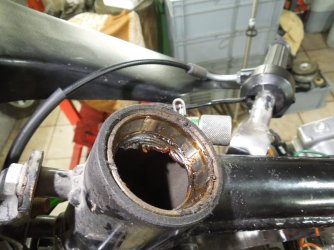
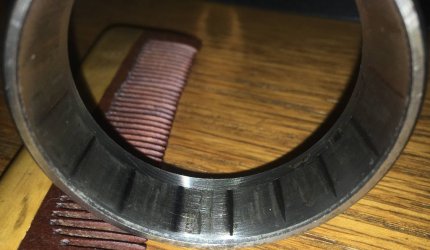
Strictly speaking, ball or roller bearings are meant for rotating, ie spinning parts. Oscillating components, such as forks or swingarms in our case, are usually better off with plain bearings or bushes. While this is desirable and practical in a swingarm pivot, the steering bearing poses a whole bunch of additional problems. Both axial and radial loads, light action and adjustability need to be considered, which balls and tapered rollers cater for excellently. What they cannot handle though is the minimal oscillating movement of a swingarm or fork, resulting in rather rapid wear, despite proper maintenance. Let's face it, forks are pointed straight ahead for 95% of their life with enormous brake and suspension forces passing through them. The rolling components of these bearings have no other choice than to dig into their races, there are only 4-5 rolling components at any one time in contact with the races when the loads peak. This is why the tapered races show only a few defined contact lines that cause the notchiness that in turn causes high-speed weaving. But until somebody comes up with a better solution, we'll just have to live with it...

piet

DSCN1522.JPGDSCN1520.JPG
 
Spot on, Piet!
Also interesting to see how the wear concentrates toward the bottom of the cone.
Makes it obvious why removed bearings should not be replaced.
Steering head bearings June 2020 1.JPG
 
No
I use tapered at the bottom and plain at the top. Am I doing it all wrong?
No Chris.

Tapered bottom takes the brunt of the axial loads, for which it was designed. Top is only loaded radially, for which it is totally adequate.

Top race is loaded axially by the weight of the fork/wheel assembly only when the front end is lifted, pretty rare in our cases. :ROFLMAO:

piet
 
I have used two taper rollers for mega miles, I removed all the tin bearing spacers, which are factory installed to vater for manufacturing measurement discrepancies (not bearing support as thought, because they wont add any strength), once I had assembled the whole caboodle, I then measuredthe distance required for the headlight brackets and had a pal turn me up some spcers to hold the rubber rings and obtain just the right amount of pinch, mega miles since and no issues, I did the same on the old duffers Anni, decades ago as well .Couldnt find suitable pics, so her is one of the old duffer (RIP)
 

Attachments

  • Duff in Breganze.jpg
    Duff in Breganze.jpg
    199.1 KB · Views: 18
Back
Top