Steering head bearings

Edd

New member
Location
Cooloola cove
Decided to replace the steering head bearings in my 79 jota and found both top and bottom bearings where 30205 taper roller bearings, but according to the green book the top one should be a 6205 sealed ball bearing. My question is it ok to install the 6205 in place of the 30205 only asking as I already have the replacement bearings or should I install both top and bottom with the taper bearings

Edd
 
some owners use tapered top and bottom
some use the standard set up of ball on top and tapered below

personally, I use the ball/tapered set up as per standard

don't forget to reinstall the shims when changing out the headstock bearings

 
Technical question; what is the advantage, if any, to having ball on top and tapered below? My RGS came with tapered top and bottom.
 
Here's my theory ...

Two opposed tapered roller bearings need to be adjusted accurately. If they're not tightened up properly, there will be clearance between the rollers and cones. Any clearance will allow lateral movement which is not a good thing in a steering head.

A ball bearing in the top is a bit more tolerant of loose adjustment. It's the bottom bearing that carries all the load, so the bottom tapered roller will always have weight on it which keeps the rollers and cones in contact, and therefore centred. The top bearing just keeps the top end of the steering head aligned. A ball bearing at the top will remain centred even if the nut on top of the steering head is loose.

It's possible to over-tighten either system. Tapered rollers are better at carrying axial (thrust) loads than ball bearings, so if you like to run your steering with the top nut tightened up so there's stiffness in the movement, go for 2 x tapered rollers.

 
Ideally you set up a crush tube between the two bearings, so the top nut can be properly tightened without affecting bearings.  The ball bearing upper is even better in this instance, since as Cam pointed out it is not particularly sensitive to adjustment.
RGS's used tapered upper bearings standard, earlier bikes used the ball upper.  If changing to a tapered upper the headlight ears do not fit properly on early bikes.  I've come around to figuring that the ball upper is the go for all bikes, just makes more sense.
Most photos of recent race bikes I've seen (including MotoGP Yamaha M1) now use a ball LOWER bearing as well, but not your deep groove type, rather one rated for axial load.  I presume there is less friction.
 
breganzane said:
Ideally you set up a crush tube between the two bearings, so the top nut can be properly tightened without affecting bearings.  The ball bearing upper is even better in this instance, since as Cam pointed out it is not particularly sensitive to adjustment.
RGS's used tapered upper bearings standard, earlier bikes used the ball upper.  If changing to a tapered upper the headlight ears do not fit properly on early bikes.  I've come around to figuring that the ball upper is the go for all bikes, just makes more sense.
Most photos of recent race bikes I've seen (including MotoGP Yamaha M1) now use a ball LOWER bearing as well, but not your deep groove type, rather one rated for axial load.  I presume there is less friction.

Pretty old hat Steve... Norton Commandos had the same system, as did the 2003-2008 MZ 1000 twins. :D

Have thought about using this set up on my triple.  Steering lock is rendered redundant, internal lock support is in the way of the tube.

Ball bearings always have less friction than rollers, they only have point contact, while rollers have line contact. 

piet
 
I have installed the crush tube between the twin taper rollers on my Egli, but that has a very heafty solid welded lower triple tree/fork yolk, and a substantial upper yolk but from a single sheet. no bolts, everything welded, so the removing and fitting 4000 times in order to get the crush tube faced to the correct length for zero backlash/zero resistance on the bearing is much easier than it would be with conventional cast alloy yolks, I don't think a crush tube is need in this case since the adjuster nut (the thin one) is locked into place by the top nut (the sleeve one),
#what you must be careful of is that when the adjustment is being done, that the tope yolk is in place, but not clamped tight, just Japanese tight (nipped) and that when you tighten the sleeve nut, that the adjuster nut absolutely does not move, since the two lock together, then the pinch clamp in the centre of the top yolk fixes (again) the sleeve nut, as mentioned above, if you use twin taper rollers the headlamp tubes may not pinch on the rubbers in side the lower end, they shrink over time (say 40 years) anyway, and it is wise to replace them at the same time as the bearings or you might still get a rattle.
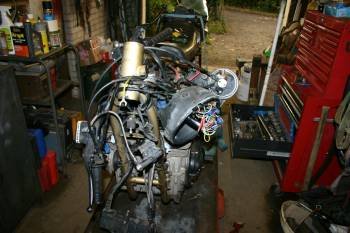
picture below is The Old Duffers bike last week
CLEM
 

Attachments

  • head stock duffs bike.jpg
    head stock duffs bike.jpg
    30.8 KB · Views: 130
Should the taper bearing have a nilos av seal to protect it?

Looking at Simply bearings web site http://simplybearings.co.uk/shop/p563187/30205AV-Nilos-Ring-for-30205-Series-Bearings/product_info.html

it would seam a good idea?

Paul
 
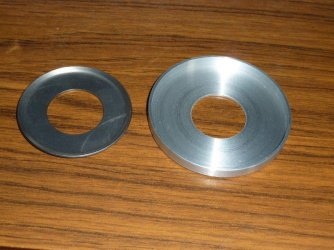
The factory fitted a suitable shield for this very purpose - the larger one in the pic sits fully over the top of the  steering head above the taper roller bearing.  Ball bearing is specified with a dust shield so not needed. Smaller shield is for bottom taper roller bearing.
 

Attachments

  • steering head dustcovers.jpg
    steering head dustcovers.jpg
    83.9 KB · Views: 22
redax5 said:
don't forget to reinstall the shims when changing out the headstock bearings

What do the shims actually do? I only ask because when I had my headstock repaired and the frame straightened on a jig, the guys handed the shims to me and said "these were in there, you don't need them". They are still on my workbench.
 
Various said:
What do the shims actually do? I only ask because when I had my headstock repaired and the frame straightened on a jig, the guys handed the shims to me and said "these were in there, you don't need them". They are still on my workbench.

The shims offer a positive stop for bearing location.  The edge of the machined bore of the headstock is very narrow, the bearings have a large chamfer.  Location will be hit-or-miss at best without the shims... your frame straighteners apparently do not understand mechanical basics.  Your bearings will now be located at least 1mm too deep in the headstock, clever buggers. :D

piet
 
sfcpiet said:
The shims offer a positive stop for bearing location.  The edge of the machined bore of the headstock is very narrow, the bearings have a large chamfer.  Location will be hit-or-miss at best without the shims... your frame straighteners apparently do not understand mechanical basics.  Your bearings will now be located at least 1mm too deep in the headstock, clever buggers. :D

piet

Maybe that's where I'll look when I'm trying to cure the high speed weave then. After looking at the 15 year old tyres!

Thanks

Matt
 
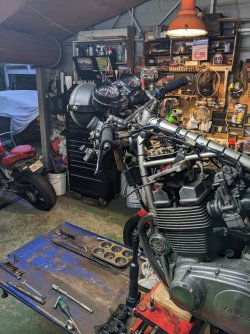
Went with the axial load ball bearings last time on the 120 Jota, shot after 25,000km. Machine up to 120,000 km now. will go back to tapered rollers.
 

Attachments

  • PXL_20251125_084027946.jpg
    PXL_20251125_084027946.jpg
    215 KB · Views: 28
Back
Top