Suggestions / input welcome

Eurocycleguy

Hero member
Location
Chicagoland-USA
I am looking for information / experience before I purchase a wheel truing stand. I will be rebuilding my Laverda and Gilera wheels this winter.
Any advice or recommendations? What to avoid?
thanks
 
If you are building wheels wire I assume all you need is a support frame that will pick up the axle with enough room for the wheel to rotate within, easy to make just have provision for a run out indicator to be mounted both radially and transversely.
I have one that is a simple pair of vertical legs with a pair of angle vee blocks to support the axle.
I would take a picture but it is so rough I would have to expect a heap of abuse so you will have to use your imagination.
 
I don't use a stand at all. The wheel doesn't have to rotate in the vertical plane to test for run-out. I just clamp the axle vertically in a vice (using suitable soft jaws), so the wheel spins in the horizontal plane. ith Mount a pointer on the bench and bob's your uncle. A wire pointer is a good enough run-out indicator to get the wheel to within a millimeter. I've tried using a dial gauge on occasions but it's a bit too sensitive. The needle waggles all over the dial.

As for general advice, it depends on how much you know already. But here's a couple of basics ...

Measure and photograph the old wheel before you disassemble it. Easiest way to disassemble an old wheel with rusted spoke ferrules is to cut the old spokes with bolt cutters or an angle grinder.

Make sure you get the offset right when reassembling. Most rims are central with the hub, but occasionally there might be an axial offset.

A common mistake people make is to over-tighten the spokes. They only need to be sufficiently tight so they won't rattle loose. Perhaps no more than 1 turn from when they take up. Obviously some will have to be more or less tight if the rim isn't perfect and needs to be pulled into shape.

Think of it this way: With the wheel set up and adjusted true, the spokes will be under some static load to hold the rim firmly in place. When the wheel is put into service, it will be subject to quite substantial dynamic loads as well. Imagine the bike landing after a jump. The entire impact load is taken by the tension in few spokes at the top sector of the wheel. If the static load on a spoke is too high from over-tightening, then the dynamic load can push it over the limit and break it.

Cheers,
Cam
 
A lot of those in the dirtbike world now use a Spoke Toque wrench to equalise the tension,its better than the musical tap method so I hear,O dear a pun.There is a good one for sale out of New Zeland,company called Torp 7.Been meaning to try this but havnt,mates have tried it and like the results.
 
I use an Excel Spoke torque Wrench.
Guzzi spec 3Nm for the front wheel spokes and
4Nm for the rear wheel spokes.
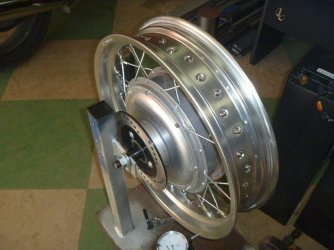
Here is my homemade truing stand complete with 8Kw Hub motor laced into 3.5" Rim.

Cheers
Bruce
 

Attachments

  • P1000810.jpg
    P1000810.jpg
    101.7 KB · Views: 37
I always do it how Cam explained. Horizontal in the vice and use pointers until it is very close, then fine tune it with a dial gauge and always seem to get to under half a millimeter.
Bruce, you should always use the pointer to the surface that the tyre sits, i.e inside the side of the rim, not outside as in your pic.
I find it a good idea to keep a few of the original spokes just in case for future reference.

 
If you're doing a steel rim, don't bother with a dial gauge. The rims are made by rolling the steel into a circle and butt welding the ends together. There's usually a lump or deflection at the weld site that will give the dial gauge a headache.

New aluminium rims are likely to be a bit smoother, so you're more likely to get less deflection of the gauge needle. But don't bother trying to get the rim perfectly accurate to a fraction of a millimeter. The whole point of the exercise is to get the tyre to run as true as possible, and tyres aren't made to that sort of accuracy. You could spend all day chasing 0.1mm out of the rim only to find the tyre has 1mm run-out when fitted.

I suppose if you wanted to be really pedantic, you could do the final adjustment of the spokes after the tyre has been fitted. That way you could adjust the rim to compensate for any irregularities in the tyre.
 
Thanks All, for the advice.
I just plan on polishing the (semi)shiny wheel bits this winter and eventually rebuilding the Gilera rims.
Only had to rebuild a rim once before back in 197? at Honda school. Planned on photographing the before rims so I get them back together right, etc.
 
Back
Top