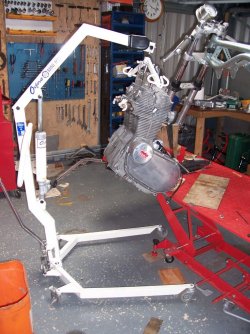
swapped manifold and lifting engine with blood sweat and tears

michipons

Hero member
Hi!

Today, exchanging emails with Ernesto, he pointed out that I have put the carburetor manifolds swapped, which I agree completely, I review the photos of the original bike, and indeed, those little tubes marked in the photo (I don't know the name in english) were pointing upwards inwards.

When I installed them yesterday, I assumed otherwise, that they had to be pointing down as the tube wouldn't be visible then... wrongly.

I guess that this connection between the two manifolds are to equalize the pressures between both intakes, and that it doesn' t really matters which way are they... isn't it? I thought that the unique advantage of having them "standard" is the lower risk that they fell down by gravity (dunno)

I guess I will swap them, I wanted to justify myself leaving them like they are as I have already all in place and I am lazy to remove everything again and again... :LOL: :LOL:

Also just for curiosity!

Last but not least, yesterday I almost die rising the engine to the frame with two other friends without the assistance of a lifter (I couldn't wait for it to arrive next week) what is the clever way to install the engine in the 750 frame without blood? :LOL: :LOL:

IMG_5862.jpg

IMG_8678.JPG

IMG_4642.JPG

IMG_3116.JPG

IMG_1234.JPG
 
I have to do this job alone, so i found the following cheap trick.
I use the fact, that right down in the middle of the oil filter is the center of gravity of the 750 engine.

- Take a normal cheap jack and attach a metal plate (2-5 mm) to the support point.
Drill centered the 4 holes 6.5 mm identical to the oil filter cover.
DSC06983.JPG


- Remove the oil filter cover on your engine and place the engine on the 4 times perforated plate so that the 4 stud bolts go through the holes.
DSC06981.JPG


- Now you can drive the motor under the frame, turn it if necessary and also lift it up to the right position.
DSC06980.JPG


- First insert the upper retaining bolts.

- Since some frame brackets are relatively scarce, you can pull the motor into the frame with a tension belt in this case.
DSC06982.JPG


- Always remember that the rear retaining screws must have a fine thread!

Installation is usually done in 10-15 minutes without scratching the frame.


Best Thomas aus LAU

 
Wow! Nice tutorial! Thanks a lot! I ordered this little lifter:

https://www.motea.com/es/moto-elevador-de-tijera-peana-aparcamiento-constands-mid-lift-m-mover-500-kg-en-rojo-510213-0

I hole it will work! I thiught it would be useful too when I have to remove a wheel or similar.

I would like to have this originality to find that sort of creative solutions😄 my neighbour does the same, finds always a cheap and original solution than my one ordered on the web🤪🤷🏼‍♂️ (He is 77 may be that plays its role)

Miguel
 
michipons said:
I thiught it would be useful too when I have to remove a wheel or similar.
Miguel

Forget it!
Lifting a complete 750 Laverda with a lift under the engine will not work. That is too unstable because this Laverda is very top-heavy bike.

You'll need to use a stand for the swingarm and/or a lifter for the fork.

As the 750 has worldwide the best and most stabil center stand, you can easy work on or remove the rear wheel.
You can remove the rear wheel more easily, if you put a 2-3 cm thick wooden board under the main stand beforehand. This will allow you to pass the mudguard with the wheel.

To remove the fork or the front wheel, you can of course also lift the front with a pulley or lashing strap while the Laverda is on the center stand.

The center stand is so stable that I (90 kg, 180 cm) e.g. slept several times a night in a sleeping bag on the Laverda (feet in front) e.g. waiting at the port for the ferry. Best theft protection ever.  :D

Thomas aus LAU
 
Clever use of a trolly jack, Thomas.

In all my 46+ years of owning and working on my and other's SFs I've never had help fitting or removing engines. I simply slide the engine into position on carpet or wood with it leaning fwd, using a bit of wood supporting the cases either side of the sump. With a little wiggling you can get the rear lower engine bolts in. I'll then either lift by hand or use a scissor jack (or one of my two Holden bottle jacks from my HR days - for the Oz owners among us  :D) to pivot the motor upwards and have one of the top front studs ready to fit into the top frame lugs. I can actually lift it by hand by leaning over the bike and this doesn't strain the back,. it's heavy but can definitely be done with no special lifters or muscle men at all - and i'm not much beyond the std 90lb weakling!

An alternative to fitting the stud at the top mount is to use a thinner length of rod (a Phillips head screwdriver for eg) so it's not immediately necessary to line everything up. Once the top is secure any jack can be used to lift it the last bit and fit the top studs and lower bolts. Easy peasy!
 
I had several times frames where the "Piranha Brother 2"-method did not work.
When the rear lower engine bolts are inserted, the upper right motor bracket collides with the counterpart on the motor housing when tilting up.

That was the reason why i looked for another solution.

But there are many ways to come to Rom.  ;)


Thomas aus LAU

 
Many ways to skin a cat, but all roads lead to Rome. A famously unpopular Queensland parliamentarian used to say "you can lead a horse to water but you can't make him gather moss". Sorry for the diversion.
I have always done like Quentin, supporting the engine on a block of wood to lift it a bit so I can get the lower rear bolts inserted, the whole lot resting on a trolley plate (piece of thick plywood on casters I use for moving any heavy stuff around). Last time I simply lifted the engine off this and up into the frame using ratchet straps, after getting a CBR engine into a Honda that way. It was very easy.
 
Miguel,

I imagine that it's important to keep the tube between the inlets on top to avoid condensation or fuel collecting in it.

I put my 750 engines in alone. Tilt the rear up to slip lower rear engine bolts in (easier if the engine is on a board with wheels) and then with a trolley jack under the engine, tilt the engine up. Have done it many times like that.

Paul
 
michipons said:
Hi!

...

I guess that this connection between the two manifolds are to equalize the pressures between both intakes, and that it doesn' t really matters which way are they... isn't it? I thought that the unique advantage of having them "standard" is the lower risk that they fell down by gravity (dunno)

I guess I will swap them, I wanted to justify myself leaving them like they are as I have already all in place and I am lazy to remove everything again and again... :LOL: :LOL:

Also just for curiosity!

Last but not least, yesterday I almost die rising the engine to the frame with two other friends without the assistance of a lifter (I couldn't wait for it to arrive next week) what is the clever way to install the engine in the 750 frame without blood? :LOL: :LOL:

You are right, the two connectors on the manifolds are for balancing the carbs and are connected by a bit of fuel-line to "self-balance" the carbs. However, leaving them pointing down bears the danger of gas, dirt, condensing water or similar running into the fuel-line connecting them, which would cause this passage to potentially block and lose this ability for self-balancing. Also, they are harder to reach to if they point down to actually connect a balancer clock to it.

further more, the tank normally hides it when it is installed correctly. not so if pointing downwards... ;-)

Regarding engine install: it is always the best methode (no matter of triple or twin) to put the frame over the engine while no other components are installed and lift the whole thing up after the engine hangs already in the frame to install the rest. If you need to drop the engine and re-install it and don't want to completely dismantel the bike, I also used ratchet straps to lift it up. works, once the engine is in balance. It will lean a bit more forward, which is OK as you can insert the rear bolts first, then lift it further on the front and install the bolts holding it up at the cam cover. Not very complicated that way, but make sure the straps don't move and slip of... IIRC, I put one between the fore studs where the oil-filter plate is mounted, one below the exhaust studs (or was it below the head? Not 100% sure anymore...). Make sure not to brake off any of the cooling fins of the head though!!! 
 
Laverda SF said:
What is that thing a 74/75 ?

That is a '77 SF3 one of the last produced, that I modified to fit SF2 seat. When I bought it, the frame was cut probably as a result of a race preparation, so I had to make it all new, I had the choice to go 100% original, or make it look like an sf2 but with alloy and disc brakes, as I was between both ways, I chose the one I liked. I have to say, I regret a bit, as NOW I start to appreciate the aesthetic of an SF3 with the whale tail (?)

Or are you asking about Thomas photos?? :LOL:

Miguel
 
Put the engine on a small trolley (made myself) wheel it into position, back bolts first which is then your hinge. Ratch strap around engine and up to the roof and pull the front of the engine up.
All done on my own with some help from the wife.
Regards Andy 😁
 
Here's  a post I did in the ILOC  forum a while back :-
I expect most of you will have your own methods for removing the 750's motor but may find this a different or more easy way as it involves virtually no physical effort.
I made a front axle stand out of a piece of 7*3 inch wood with a hinge screwed to it - as I prefer to remove the front wheel when removing motor this leaves the front supported. This is clamped in the front wheel clamp of my ramp - it could be mounted on a base and used on the floor. I use a screw type car jack - I never  pay more than ?3 for one at a car boot sale under the oil filter plate - with a piece of wood between jack and plate to support motor whilst removing all the bolts and studs except the lower rear ones. I then wind the jack down and the motor pivots on the rear bolts ( or a bar that goes through both lugs) until the top front mounting is clear of the lugs - I then use a tie down strap through a bar in the top mounting on cylinder head to gently lower motor to the floor - with jack removed of course. Easy to move engine to another location with my hoist (?45 @car boot sale). Re - fitting is simply the reversal of this procedure! - Regards - Phil
 

Attachments

  • axle supp sm.jpg
    axle supp sm.jpg
    118.2 KB · Views: 89
  • 750 eng out.jpg
    750 eng out.jpg
    165.9 KB · Views: 86
  • eng liftsm.jpg
    eng liftsm.jpg
    179 KB · Views: 87
Back
Top