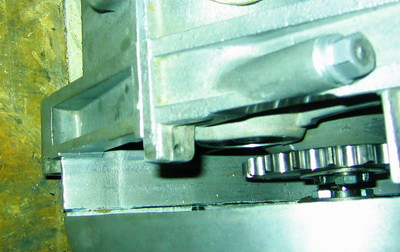
The Drive Chain Hits The case

If you want to get blank platewheels just ask your local bearing guy 10B-1. The gearing is the same and they will just need skimming down.

Andy
 
Street Fighter said:
My chain seems to be barely rubbing on the inside of the case its adjusted right but it seems to be to close to the motor when I notoced it I took a felt ben and made it black so I could see where and how much it rubs.
Check out the pic.


http://www.laverdaforum.com/gallery/displayimage.php?pid=2632

My 1974 3c is chain sensitive too..a Heavy Duty 530 non "O" ring chain would slightly wipe the engine case. Not near as bad as yours..but it did touch.

Went to a Tsubaki QR Pro Gold non "O" ring chain and I have about 2mm clearance. I've been about 5000 miles and have abundant adjustment remaining. I use a "moly" industrial chain lube.

I think these early designs..back in the late 60's..were configured with the standard 530 chains of the day..which were just industrial specs on motorcycles. With the newer chains now being designed for motorcycles..thicker side plates and bigger rollers made the chains wider. My partner with a Vincent Black Shadow cannot use a motorcycle spec chain..it wont travel through the counter-shaft housing..too thick. He uses an industrial Reynolds 530 chain. Both bikes take a 106 link chain, same as my Laverda..he broke his drive chain one day and we tried to install my 530 spare motorcycle chain..no go. He had to order an online Vincent replacement 530 chain..which narrow compared with the bike chain. It fit fine.

Andy would know exactly why the older 530 chains were so narrow.


Hi, Lothar.

I think you see this sprockets/chain thing a lot more complicated than it really is:

but if you machine away the inside of the sprocket and put on a STANDARD 520 chainwheel
Who says it's a standard rear sprocket. At least it's made of aluminium whereas the standard ones are steel. It was surely manufactured to the customer's needs, including offset etc.

For "just" a lighter (and cheaper) chain that produces less friction and power-loss, you can machine away the outside of the sprocket's teeth (and still no issue with the lock-plate, as you don't machine away in that area, Ernesto) and go with a standard 520 Chain-wheel.
In his catalogue, Andy mentions that the whole set will save you app. 1 kg, but the main issue is the clea-
rance with O- (or whatever ring)ring chains. Getting the chain away from the inner part of the case.
Anyway, the outside of his gearbox sprocket is absolutely flat, no problem with 1 locking tab.

Hope that came clearer now. I can make a drawing by hand if you like...  
No thanks. IMHO no need for this, as Grant's pics show everything very clearly.
If still in doubt ask Andy W. himself.

Ernesto
 
Come on guys this is old history.

Basically the old chains were of a super quality. Renold made a fantastic product that worked well on bikes of that time.

BHP was around the 40 mark even on race machines. Nowadays bikes are up round 100BHP as a matter of course.

The basic problem is simple put a 40BHP through a chain program and it will not accept it or recommend an inch duplex. Given this any chain should be a no go.

Back in the 60s when the Japanese hit the markets in force they could not meet the breaking loads of the established makers like Renold, iwis and Sedis. To achieve a high breaking load with average materials you just make the plates wider to increase cross section. However this increases weight and above all it cannot be designated to DIN, as every manufacturers parts must be common in dimension and this did not happen even with Japanese makers. They also made their own chain designations. 10B-1 became 530 (5/8  x  3/8), 520 (5/8  x 1/4), 420 (1/2  x  1/4) see the pattern its 1/8s. It gets complicated with 415 (1/2  x  3/16) as it is 4-1/8s (1/2")  x 2-1/8s plus half an 1/8. Now figure out why 428 is wrong :D :D :D :D

All this is a red herring as a basic law of physics has been ignored in as much as high speed is low torque so the higher the speed, as with race engines, is actually good for chain. However with high speed the heavy chains tend to wear out more by centrifugal force.

Renold and iwis long ago put motorcycles on the back burner in favour of industrial and automotive and the heavy marketing of "heavy duty" chain
did not help the cause. My father worked for Renold sales tech and both him and myself have shares in Renold. It goes without saying that the "new" Renold is not a patch on the original and I had many complaints before I stopped selling it.

The are too many pros and cons regarding chain to go into but as we have seen on the forum it can get very personal. I will give advice as I see it and if your views are different then no problem I will just use my 40 years experience and then fall back on my fathers knowledge (if can remember it as he is 87).

Bikes and chains are not interesting to companies like Renold, iwis and Sedis and it is a shame. Regina are still playing the game but I can say that compared with their total sales bikes are very minor.

Going for a lie down.

For those who doubt that I have a skinny iwis chain on the Bandit just ask those who have been over and looked. Anybody is welcome to come over and take her for a rip to see how smooth it is and how slick the gear change is.

Andy


Just to put a couple of things straight...

The sprocket Grant posted is machined on the INSIDE to match a specially made rear sprocket for his GSXR rear wheel.  This kicks the #520 chain out as far as possible without going too deep in the tricks dept.  

If fitting a flat #520 rear sprocket on a stock wheel, the front needs to be machined on the OUTSIDE in order to line things up again.  Tyre and case clearance is as stock.

If greater tyre clearance on stock wheels/sprockets is the goal, use a #530 rear machined on the INSIDE, and a #530 front, also machined on the INSIDE.  Only the area covered by the chain is machined to avoid needing stupid spacers.


Tippie,

Quite easy to machine the suckers, just need a sturdy jig to fit the sprocket in the lathe chuck and ceramic tipped tools.  Will have to sacrifice a couple of tips though, I use worn, dull ones for the roughing and only ruin one new one for the final finishing cut :D.  

piet
 
Spondonrider said:
I'm running a non o-ring 520 on my Spondon with no issues but mileage isn't very high on that one. If I remember correctly the front sprocket is made from a machined down Laverda center with a 520 Norton outer welded on. Does anyone actually make a 520 sprocket for a Laverda? I'd like to play with the gearing a bit but have no front options.

Ed,

No Breganze big twin or triple used a #520 chain, so obviously, todays' #520 sprockets for Lavs are specially made to take advantage of the developements in chain design.  Those on offer from OCT, Andy W. or whoever, are simply machined down #530 originals, or aftermarket items by now.  As these were available mainly in 19t with an 18t option for the US, choice is quite slim.  Anyway, not much room around the gearbox output to fit much larger than maybe 20 or 21t, smaller than 18t you get close to the minimum the chain will happily play along with.  (Andy(chain) can definitely clear us up on that issue)

Lots easier to fool around with the rear sprockets... :D

piet
 
sfcpiet said:
Just to put a couple of things straight...

The sprocket Grant posted is machined on the INSIDE to match a specially made rear sprocket for his GSXR rear wheel.  This kicks the #520 chain out as far as possible without going too deep in the tricks dept.  

If fitting a flat #520 rear sprocket on a stock wheel, the front needs to be machined on the OUTSIDE in order to line things up again.  Tyre and case clearance is as stock.

If greater tyre clearance on stock wheels/sprockets is the goal, use a #530 rear machined on the INSIDE, and a #530 front, also machined on the INSIDE.  Only the area covered by the chain is machined to avoid needing stupid spacers.


piet

different words but exactly what I said...  ;) Thanks for putting it straight, Piet.
 
Hey Piet...exactly. They are not soft. I had thought a tool-post grinder might be best.
Has anyone experience with replacing the outer toothed section as Spondonrider mentioned?
I have enquired here but re-hardening to anything like the original hardness seems to be an issue. I could use a 20, which I think would fit, to get more options. On my racebike the sprocket carrier for the rear MX hub is at its limit with a 41.
Back to the origin of this topic, couldn?t the problem be caused by someone having belted on one of these tight non-genuine sprockets, thereby pushing in the output gearshaft?
 
Tippie said:
Hey Piet...exactly. They are not soft. I had thought a tool-post grinder might be best.
Has anyone experience with replacing the outer toothed section as Spondonrider mentioned?
I have enquired here but re-hardening to anything like the original hardness seems to be an issue. I could use a 20, which I think would fit, to get more options. On my racebike the sprocket carrier for the rear MX hub is at its limit with a 41.
Back to the origin of this topic, couldn?t the problem be caused by someone having belted on one of these tight non-genuine sprockets, thereby pushing in the output gearshaft?

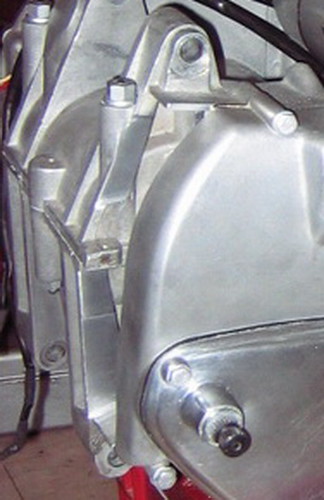
In short, no, they could fit it that way but the lock tab would not be able to engage in it's groove without drawing the shaft back out through the bearing again (damage done), there is no spare room for this type of abuse to take place.

I think... but stand to be corrected, if you belt it through, it forces a circlip holding 4th gear on the mainshaft splines (no, I haven't done that, just had that area apart with other problems a few times).

cheers Rob

If the mainshaft spigot had snapped or the bushings inside of the output shaft had collapsed, this would cause a lot of slop in the drive sprocket and it would "bend" backward under load, but this is unlikely on a stock bike. They do still ride like this.
 
Err, if you belt in the gearbox sprocket you tend to lose 5th gear when you bend the selector fork.
Don't ask me how I know...
 
These PIC's aren't the best but gives you an idea on how I solved the problem to run Wider 530 Chains on my 750SF. I used a Stone with a 1/4" Drill and Wide Flat File on the Casing for most the work then Polished with 600 wet to widen the entry and around the Drive Sprocket - There's lots of meat and the work looks neat and finished.

6326354015_46ff0d8e57.jpg


6326353925_f77d95bbc0.jpg

Notice the additional clearance I shaved from the Casting Ribs behind the Drive Sprocket.

I imagine that Boss Extrusion you see in the Entrance to the Drive Casing was intended to mount a Chain Oiler - Never used it :o

I've also noted that Wider Chains have a tendency to rub the Trailing Arm if they slacken and not kept adjusted.

 
I can't wonder why anyone would bother changing and modifying, shimming sprockets to 520 when these Bikes with a simple deburring can run a Modern Wider Super Bike 530 X-Ring Hi-Tinsel Chains which are red-ably available.

I always check the Master Clipped Link but would sooner use a Peened Master Link.

More then once the Master Clip has slid out. Maybe 3 times in 40 years but I've always manage to save my sprockets, perhaps my ride & my life.
 
"I can't wonder why anyone would bother changing and modifying, shimming sprockets to 520 when these Bikes with a simple deburring can run a Modern Wider Super Bike 530 X-Ring Hi-Tinsel Chains which are red-ably available"

LavSF
The idea of running 520 chains is to gain clearance to fit wider rear tyres.
Probably not necessary for gutless old 750s but fire breathing triples need extra rubber on the road!! >:D Also my Motodd looked ridiculous with the original skinny rear wheel/tyre when I first built it. First upgrade I did was to fit a 3.5" Astralite with a 150 section tyre.
Once I get my Suzuki rims, 4" rear I'll be able to fit a 160 tyre with a 520 chain. As it is now the 150 misses the 530 chain by a micky hair.
 
gutless old 750s

Where you from - A 8000rpm 750 Twin Breganze will burn most - You got a lot to learn.

I run a 140 70x18" profile with a Wide 530 Super Bike X-Chain on the STK 2.85" Borrani Rims without scuffing the trailing arms or Tire and it's all STK - Think about it when you got the guts to pass me at 130+mph, providing you can skip with me through the Country Side before stepping onto the Free-Way - I'll tip my Visor - If you can keep up.

LaverdaForum is all about support & nothing to do about boasting - So Bug Off with your Triple Junior - LOL

Do you build your mount and ride or do you dress up pretending to be a Motorcyclists?

I've owned a Suzuki 1100SE - Great Ride and FAST but nowhere near the hands on confidence I've experienced with Breganzes over the my 50 years of riding and most of all - I'm still Riding :o
 
Tippie said:
Hey Piet...exactly. They are not soft. I had thought a tool-post grinder might be best.
Has anyone experience with replacing the outer toothed section as Spondonrider mentioned?
I have enquired here but re-hardening to anything like the original hardness seems to be an issue. I could use a 20, which I think would fit, to get more options. On my racebike the sprocket carrier for the rear MX hub is at its limit with a 41.

I do quite a lot of sprocket retoothing - here in NZ continental stuff is thin on the ground so retoothing front sprockets makes economic sense. I buy aftermarket sprockets in the size I want, machine the center out to suit the original splined center and TIG weld.
Experience has taught me to soften both the old center and the new outer first - heat to cherry red and allow to cool at room temp.
Cut the teeth off the old center with a disc grinder prior to machining with a carbide tip and you won't sacrifice expensive tips....
If you're worried about rehardening post weld, heat to cherry again and quench in oil..
I've got customer bikes I see regularly which have been using retoothed sprockets for years with good sprocket life.
 
Back
Top