
You are using an out of date browser. It may not display this or other websites correctly.
You should upgrade or use an alternative browser.
You should upgrade or use an alternative browser.
Top end issues
- Thread starter oehlin
- Start date


Tippie
Hero member
- Location
- Dr?bak, Norway
No, never. I never found one that was stuck to the surfaces either as happens with many other types of bike. The only one I always replaced was the top cover because it always split at the corner. I never use grease either and have heard of punch-ups in workshops over it´s use between adherents and opponents. With paper gaskets as found on Ducati etc we were taught to soak them in water and they would soften and be as good as new, same deal, no silicone or grease. If re-using engine side-cover gaskets as on Laverda I use an almost invisible smear of silicone, another trick on such is to so that and let it set overnight before fitting if you have time. Of course most all workshops will use new gaskets everywhere as they cannot take the chance.Would you use gasket silicon when reusing gaskets Tippee ?
Tippie
Hero member
- Location
- Dr?bak, Norway
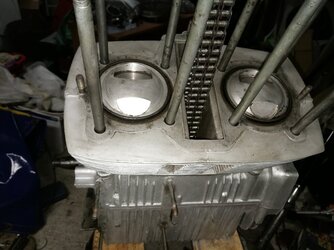
Hmmm.That looks very like an electronica piston. Strange that it doesn't even come to the top of the liner though - experts can answer this.My pistons.

Deck height is not the same on the Electronica pistons. Or the engine isn't at TDC.Hmmm.That looks very like an electronica piston. Strange that it doesn't even come to the top of the liner though - experts can answer this.
If it's an Electronica piston, both will need changing.
Paul
The pistons are at TDC on that photo and the bike is not a Electronica as far as I knowDeck height is not the same on the Electronica pistons. Or the engine isn't at TDC.
If it's an Electronica piston, both will need changing.
Paul

MarnixSFC
Hero member
Elettronicas have different liners that the SF with much lower spigots and a totally different all aluminium cylinder head with wider valve angle and different shape combustion chamber. Fitting these pistons in an SF actually radically lowers compression, whereas in an Elettronica you get a ratio of 10,5:1.Marnix Marnix wghere are you hoo hoo hoo
definately not a (stock comp) Mondial 1200 piston, which is flat on top, which the first picture looked like.
CLEM
Marnix
Tippie
Hero member
- Location
- Dr?bak, Norway
No, your bike is definitely not. You need to source new pistons now, there are numerous sources. And air filters. Can you refresh us on the history of the bike?The pistons are at TDC on that photo and the bike is not a Electronica as far as I know
Do you mean that my pistons are Electronica pistons ?No, your bike is definitely not. You need to source new pistons now, there are numerous sources. And air filters. Can you refresh us on the history of the bike?
I have tested the compression with these pistons and got 10,5:1 before the issue.

piranha-bro2
Hero member
- Location
- Melbourne
Yes, it seems you have Elettronica pistons - and they will make your bike slower. If you want to use the correct pistons to raise the compression source something based on the 1974 SFC - Wolfgang sells Ross pistons that replicate them. I have a pair of ASSO pistons I sourced from Riccardo Oro that are identical to 74 SFC.
Out of interest, how did you calculate your compression ratio (what method did you use to get 10.5:1)?
Out of interest, how did you calculate your compression ratio (what method did you use to get 10.5:1)?
My compression tester showed 10,5 kg/cm2 on both cylindersYes, it seems you have Elettronica pistons - and they will make your bike slower. If you want to use the correct pistons to raise the compression source something based on the 1974 SFC - Wolfgang sells Ross pistons that replicate them. I have a pair of ASSO pistons I sourced from Riccardo Oro that are identical to 74 SFC.
Out of interest, how did you calculate your compression ratio (what method did you use to get 10.5:1)?


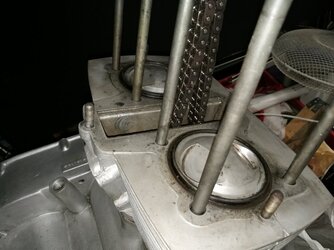
Shure looks the same as mine, thanksPistons look the same as my SF3 pistons.

Mine bike is an SF1
Tippie
Hero member
- Location
- Dr?bak, Norway
The only realistic way to check compression ratio is to measure the volume of the combustion chamber with liquid (I use 50/50 oil and kerosene) carefully measured very accurately to the cc. This volume is added to the swept volume of the cylinder to give the total volume that will be compressed into the combustion chamber. The volume of the combustion chamber is then divided into that figure. It is a very straightforward process I am sure you could manage (a bit of pithagoras maths involved). Compression test figure have virtually no relevance to this. With your bike so far dismantled it would be very easy to refit the head and measure the TDC compression side that has both the valves closed, as both sides will be virtually the same. Do it with the engine tilted so that the spark plug hole is the highest point and I learnt to take it half way up the plug hole. As Paul says, high compression is risky on pump fuel, it is best to stay under 10:1 on a street motor of this type.

CLEMTOG
Hero member
CC's are quite big things about the same as a sugar lump, very often the head gasket is omitted because mathematical calculations are used, this is innacurate, measure the volume of the combustion chamber with a burette and the motor positioned on the bench so that the spark plug thread is perpendicular to the ground, fill to the threads lowest face, with the piston at TDC (timing disc needed) the combustion chamber, I use petrol and parrafin mixed, then position the motor at BDC and measure again, tedious on an 80 or 75 mm bore, but percivere, its worth it, (more than 370cc needed for a so called 1200) divide one by the other, its failsafe, and take into account rebores or oversize bores, all those that think they bought 10.5:1 Jota pistons etc will get a shock.
compression tester shows the pressure , if you have 10.5kg/cm squared then your cmpression pressure is OK (ish) if all at the same (+ or_ 10%) at around 150PSI but for an SF a bit on the low side which does figure.
CLEM
compression tester shows the pressure , if you have 10.5kg/cm squared then your cmpression pressure is OK (ish) if all at the same (+ or_ 10%) at around 150PSI but for an SF a bit on the low side which does figure.
CLEM
Yes. Electronica is the last series of SFC. Head and liners are specific. Pistons are specific with a low deck, height from gudgeon pin to the top of the piston, meaning that used in a standard engine, they give a compression ratio of near 5/1. Compression ratio is not the pressure measured in the combustion chamber.Could it be 750SFC pistons?
The picture of your engine with the head off and the crank at TDC clearly shows the top of the piston too low prompting the Electronica piston remark.
Paul

Dellortoman
Hero member
- Location
- Tasmania, Australia
That is not a measure of compression ratio. The reason being that air heats up when you compress it. That's how Diesel engines work. The air/fuel mixture gets hot enough to ignite the mix.My compression tester showed 10,5 kg/cm2 on both cylinders
You may remember from school physics that the pressure of a gas increases when you heat it.
So the heat generated by compression increases the gas pressure in the cylinder beyond the simple ratio of volumes (compression ratio), usually by a factor of around 20% in most engines. It's rarely more than that with a cold engine because some heat is lost to the cool cylinder head and there's always a bit of leakage past the piston. Compression figures are usually higher in a hot engine because less heat is lost to the surrounding metal.
With your compression test figures I'd guestimate a CR of around 8.5:1
I can't give you an exact figure because of the variables mentioned above.