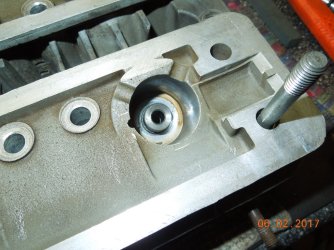
IMPO lubricating the studs and washers is a must (and even more important in engines that use stretch bolts since they are usually torqued up, and then a measurement of degree turned is ADDED this might be 40 degrees or more, lubing is vital in this case contrary to what Hamish says) BUT>><>BUT>>>BUT the ACTUAL torque wrench is very important as well, the bendy bar type with a remaining straight pointer onto a scale should have hopefullly all been scrapped by now, a 3/8" drive tool is more likely to be "in range" than a 1/2" one. A wrench that can do 200ft/lbs or even 300ft/bs will not be very good at a mere 25ft/lbs! idealy you need a wrench that goes to about 50 or 60ft/lbs, then the magical 25ft/lbs will be somewhere in the middle of the scale. my wrenches are decades old (SnapOn) my son took them to work a year or two ago to be sure they are calibrated correctly and they were, so that can be an issue as well, but to be fair, they dont get the use they would in a professional environment.
The next thing is the tightening sequence, its not just "start in the middle" and work out, it nearly is but not quite, see below, then, I always start at 10ft/lbs, and go all round the 9mm (long type from crankcase 12 of) studs (be carefull the 9mm and 8mm studs have the same size hexagon heads in the Laverda triple) then go all around at 15, then 20, then 25. (do this in reverse if removing) the two studs front and rear cam chain tunnel, 8mmx2 and lastly the studs by the plugs.7mmx2
I can only support what Clem says here regarding the right (quality) tool for the right job. I was always uncertain about my torque wrenches and how good they really are. I bought me a tool to measure the actual setting against what was set on the torque wrench and found surprising results...
-some cheap ones were correct in a certain setting but WAY off in others
-the higher the range, the more off they were at some point
-quality tools were off just a Nm or two mostly
-even 40 year old but only rarely used professional tools were almost spot on still
-even on high-end tools, the first "click" is a higher value than all following ones, sometimes (on cheap tools) the difference between first and the following was 5-8%! On the quality tools, it was in a range of a Nm or max 1,5Nm.
The highest difference I found was on supermarket tool which had a range of 40 - 300Nm. Setting it to 130Nm showed a real torque value of way over 200Nm, so more than 50% difference! We adjusted it to 130Nm, which caused every other setting to be way off still.
I measured around 30 different ones meanwhile for friends and family, neighbours etc., adjusted them best possible and made tables for them so they know what values they produce by every 10Nm setting (on the ones with very small ranges like 10 - 40Nm, I did that for every 5Nm). Most torque wrenches also need to be "relaxed" after usage (adjusted to "Zero"), which is critical to keep them accurate. Some modern ones don't need that, but surely it is a good habbit to do, just to avoid using it with the wrong setting and/or for peace of mind.
For the Cylinder heads of my bikes, I bought me a Gedore 10 - 50Nm. Even that one, I check before using every time... Borrowed the "Würth" one that I normally use for the tire bolts on my cars to someone who I can not remember who it was and it wasn't returned unfortunately, so I used one cheap one and just set it with my measuring tool to the needed 175Nm for the Tesla's screws and same for the 120Nm of the Mini and the Astra of my son. Took me 3 minutes to find a setting that lasted beyond the first 2 clicks...

Will never borrow any tools again without taking notes to whom...


![20251026_182144[1].jpg](/data/attachments/100/100182-5b4e87c581fcf1d77ab6e958dc78aa6e.jpg?hash=F2hJj_ZhFF)