I need some info re Triple trees for triples.Do the 3 types I know of,The Maz,The Cer with the top and bottom parallel with the frame and the Cer with the 1.5 deg variation from the frame have the same fork leg spacing and offset.What about triple trees used on Ducatis,what leg spacing and offset do they use.BTW they need to work on 38mm forks,spoked wheels and disc brakes.My bike is not around to measure.I am mainly interested in what offsets were used that would work on 38mm legs,spoked wheels and disc brakes.

You are using an out of date browser. It may not display this or other websites correctly.
You should upgrade or use an alternative browser.
You should upgrade or use an alternative browser.
Triple Trees
- Thread starter Vince
- Start date

motoddrob
Hero member
- Location
- S/W Australia
Hey Vince, I have sets of all 3, the stanchions have the same spacing, the Cerianis have more offset than the Marzo, 64mm to marzo 44mm, measured roughly so ~1mm. Obviously that changes slightly on the bottom yoke of the 1.5? early triple yokes.
Question for the ones that know, did the SF2/3 Cerianis use the same offset yokes the early triples used??
Question for the ones that know, did the SF2/3 Cerianis use the same offset yokes the early triples used??

Marmite
Hero member
Curious about this subject too, as I am assembling some 38mm forks for my early 3C (not an irreversible change, just that the roads around here are so bad, the smaller forks are a bit challenged).
For info:
Took me a while to find some Ceriani yokes, as the stem is a different length to Ducatis.
Some Ducati fork legs are the same, apart from having a crackle finish (dead easy to remove, as it practically falls off).
Ducati stanchions are different lengths to Laverda. Nearest I found were 610mm (vs 595mm for the early triples).
The Laverda top fork caps fit the Ducati 610mm stanchions. I assume internals are the same.
Pete
motoddrob
Hero member
- Location
- S/W Australia
Yep measured centres. Maybe a good idea to mention to the computrack guy that the early Cerianis have that 1.5? offset.
Never really thought about it but 20mm between the Cerianis and the Marzo is quite abit.
Main reason that I brought new Cerianis yokes instead of using the spare Marzos I have here is steering lock, as the Motodd frame down tubes are pretty wide and restricts the steering lock so that extra 20mm makes a big difference.
I already mentioned the 1.5,he seemed to think it was to fix a design problem on the frame?He said that on the fly,after a blank stare for a while.He said that was a new one on him .Easier to play with the trees than change the frame.Speaking of which,was there any frame geometry changes to the steering head over the years on the 180s?

tom3c75
Hero member
- Location
- Cape Town South Africa
Vince,
I have both types of Cerianis.
The parallel ones, ie. the SFC 750 type, are fitted to my 3C.
I'll measure them up today and provide the figures.
I have both types of Cerianis.
The parallel ones, ie. the SFC 750 type, are fitted to my 3C.
I'll measure them up today and provide the figures.

breganzane
Hero member
- Location
- NSW Australia
The non-parallel triple clamps are not a bodge to fix a fuckup, they are a - perhaps dubious - intentional engineering solution. Bimota used the same method in the 80's. Presumably it is not only that the offsets are different, but the fork bores are non-parallel to the spindle bore as well (in production, a bigger complication than it sounds!).
Given the idea never really caught on, it's probably one of those solutions-in-search-of-a-problem that some companies specialised in.
In terms of your offset, it is mainly determined by the diameter of your front wheel, and to a slightly lesser degree by your rake. A difference of 20mm sounds huge, my guess is that the ones with the smaller offset were for a 17" front wheel?? I have the adjustable offset in the SLC and just 2mm changed it from uber-confidence to a front-tucking pig worthy of having Valentino Rossi wobbling around on.
The Marzo's for SFC1000 are 195ctrs and 45mm offset. Assume all Marzo's are the same but you'd want to confirm IRL (not daftly machine something based on half-drunken info from the interwebz eh chris?!
Cheers
SteveB

Cosi
Hero member
- Location
- Kingscliff
breganzane said:(not daftly machine something based on half-drunken info from the interwebz eh chris?!
You know everytime that comes up i laugh to myself and cant help thinking what a dickhead
Marmite
Hero member
(not daftly machine something based on half-drunken info from the interwebz eh chris?!
I resent that.........I don't do half a job. I was proper drunk.

tom3c75
Hero member
- Location
- Cape Town South Africa
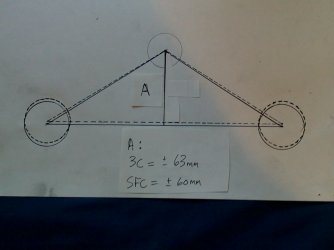
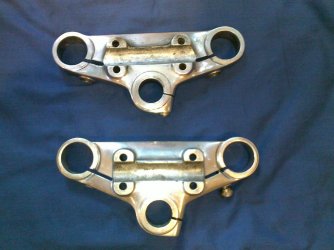
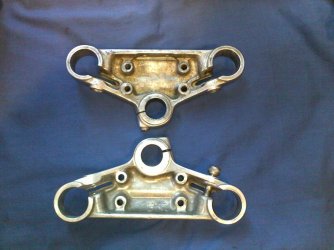
Below are some pics of the Ceriani top yokes for the SFC/parallel and the non-parallel units.
Also a very basic diagram showing how the offsets differ. The dotted lines represent the SFC yoke.
The top yoke in the pics is the SFC one, polished alloy now, but originally bright orange when I received it from the factory.
Also a very basic diagram showing how the offsets differ. The dotted lines represent the SFC yoke.
The top yoke in the pics is the SFC one, polished alloy now, but originally bright orange when I received it from the factory.
Attachments

breganzane said:The non-parallel triple clamps are not a bodge to fix a fuckup, they are a - perhaps dubious - intentional engineering solution. Bimota used the same method in the 80's. Presumably it is not only that the offsets are different, but the fork bores are non-parallel to the spindle bore as well (in production, a bigger complication than it sounds!).
Given the idea never really caught on, it's probably one of those solutions-in-search-of-a-problem that some companies specialised in.
Not really Steve!
You have surely ridden a 900SS bevel Ducrappy, and probably almost toppled over at your first attempt at a U-turn (like just about everybody else)... a result of the extremely limited steering lock resulting from the minimal yoke offset that Ducati chose, to arrive at their calculated trail figures (not much space between fuel tank sides and stanchion at full lock).
The Ceriani solution gets around this situation by offering decent steering lock without compromising trail and without the need to change anything in the tank/handlebar area.

No big deal with todays' fugly shaped tanks and "ape fucking football" ergonomics, but would have been a real shame to have to put a bloody big dent into the early triple tank just to get around corners.
piet
breganzane
Hero member
- Location
- NSW Australia
sfcpiet said:You have surely ridden a 900SS bevel Ducrappy,
piet
Very happy to say the only bevel ducrapi I have ever ridden was a VeeTwo Alchemy - aside from the heavy gutless engine it was nice.
My understanding of the concept was that the trail remains more consistent at large suspension displacements - chiefly to retain stability under hard braking. The u-turn thing is a nice benefit, though it's hard to imagine an Italian considering practicality in such a way.
Cheers
SteveB
I think i read somewhere that having the forks at a steeper angle than the steering head results in more trail than parallel ones, this presumably results in more stable geometry.
Someone told me that changing from the angled triple clamps to the parallel type improves the handling - presumably by reducing the trail the steering becomes 'quicker'.
Well i can't comment on the truth or otherwise of that, not having tried it. It sounds plausible although 'improvement' is a bit subjective.
circumstantially,
bazzee
bazzee said:I think i read somewhere that having the forks at a steeper angle than the steering head results in more trail than parallel ones, this presumably results in more stable geometry.
Someone told me that changing from the angled triple clamps to the parallel type improves the handling - presumably by reducing the trail the steering becomes 'quicker'.
Well i can't comment on the truth or otherwise of that, not having tried it. It sounds plausible although 'improvement' is a bit subjective.
That is in fact what actually happens, increased trail enhances straight line stability, does however compromise agility to a degree. Swapping from the "crooked" yokes to the parallel type does indeed quicken the steering, trail is greatly reduced, but so is high-speed stability.
Older bikes are hugely compromised in the steering department. The conservative head angles and long wheelbases were considered necessary with the weedy frame concepts to keep the plot on line, if it weaved, trail was further increased with yokes having less off-set. This brought about clearance issues with the contempory styling. Fork stanchions or clip-ons often ended up clouting the fuel tank sides, so steering lock needed to be reduced, resulting in a steady flow of customers to the paint shops after they had toppled over at walking pace... not nice trying to overcome the steering stop.
Modern bikes get around this by having a rather steep steering angle, good for quick steering, while using yokes with little or no offset, getting the maximum amount of trail from the set up. With tanks now set well back or moulded for clearance, bikes fitted with clip-ons even retain an almost useful amount of steering lock.
piet