Tubeless tires?

TeddyG

Hero member
Location
Portland Oregon
Greetings,

Since tubeless tires have the advantage of being temporarily plugged for a ride back, I’m considering going that route. But my understanding is that these old rims aren’t shaped for a steady bead lock without the inner tube. So has anyone done this with old rims or used some other newer brand? I’ve read about using rim tape, but some say it doesn’t work or remain air tight.
Thanks
 
I did it many years ago with a set of Astralite wheels I was going to put on my CBX......... I just never felt comfortable knowing the bead wasn't seated as it should be, so I ended up putting the tubes back in.

My opinion is that a set of tire irons and a couple of hours on the side of the road is still a lot cheaper than a hospital visit.

You do you though...... mind you I get people telling me how dangerous carbon fibre wheels are........ just over 20k miles on my BST's with nary an issue.

PS Are you running spoked wheels or mags? Not a chance you should try it with spokes.
 
Pretty sure Astralites are tubeless rims. I ran mine tubeless for over 25 years. With Astralites I'd be more concerned about the rivets holding the 2 sides together.

Didn't Martymoose go tubeless on spoke rims??
 
My RGS was converted to tubeless, 20 years ago. The front did get a puncture one time in the mountains as it was getting dark. By the time I found a place to pull over, the front was completely flat and it stayed on the rim.

Fifteen minutes later the puncture is fixed and I am back on the road. With tubes, there is no way I could have fixed it on the side of the road in the dirt and dark.

When my 3CL needs new tires, it will also be made tubeless.

And for those who say making the wheels tubeless is dangerous as the tire won't stay seated on the rim, please explain how a tube with no air in it is going to keep the tire on the rim?

And many people have made spoked wheels tubeless with no issues. It is more work but can be done.
 
Last edited:
Pretty sure Astralites are tubeless rims. I ran mine tubeless for over 25 years. With Astralites I'd be more concerned about the rivets holding the 2 sides together.

Didn't Martymoose go tubeless on spoke rims??
The early Astralites did require tubes. To counter leaking at the riveted joint we used to put a significant bead of RTV around the wheel.

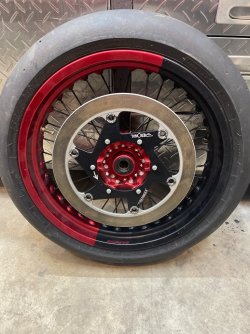
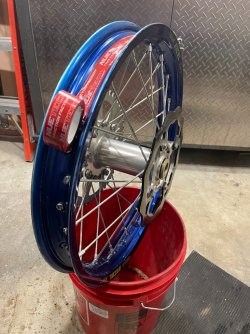
This is a tubeless spoked Alpina wheel for my supermoto.

I have heard of people running Nuetech Tubliss System on the road (18" wheels). I run it on my enduro but very seldom get past 60mph.
 

Attachments

  • IMG_9594.jpeg
    IMG_9594.jpeg
    183.6 KB · Views: 17
  • IMG_8224.jpeg
    IMG_8224.jpeg
    199.7 KB · Views: 17
I have run tubeless on my 78 Jota (thick-web wheels) for nearly 20 years with absolutely no issues. I believe 1200ts hit the nail on the head with his comment,
" And for those who say running wheels tubeless is dangerous because the tire won't stay seated on the rim, please explain how a tube with no air in it will keep the tire on the rim?"
 
Last edited:
I have run tubeless on my 78 Jota (thick-web wheels) for nearly 20 years with absolutely no issues. I believe Bruce hit the nail on the head with his comment,
" And for those who say running wheels tubeless is dangerous because the tire won't stay seated on the rim, please explain how a tube with no air in it will keep the tire on the rim?"
Tubeless rims feature a safety bead lock to keep the tire bead from slipping off the rim if pressure drops.

Everyone is free to do their own risk assessment and proceed accordingly. :)
 
Old story repeated here before. We were on a club Sunday ride, maybe 3 or 4 hours from home, when one of us ran over a 100mm x 10mm steel bolt rear tyre cast wheel. As a Hail Mary, I dug out my foam in a can, and it worked ok for the first 15ks. It was bloody hot with no shade, so the owner limped the next 40ks into the next town as the tyre by now was completely flat, with me following; it was pretty horribly wobbling all over the road. My take: the tyre stayed on, and if it passed that extreme test, there was no danger of running tubeless and a blowout. That's a cast rim; people have been running tubeless on spoked rims for ages as well. The technique involves various methods, including silicone to seal the inner side of spokes; some dont use this step, but the next step is mandatory: extremely thorough cleaning on the inner rim and the use of a high-tech 3M waterproof tape. One downside is the seal can be lost if spoke adjustment is done. There are lots of threads describing techniques on the Adventure Rider website.
 
Tubeless rims feature a safety bead lock to keep the tire bead from slipping off the rim if pressure drops.

Everyone is free to do their own risk assessment and proceed accordingly.

Please explain how if a bike was made tubeless and it gets a puncture it is somehow more dangerous than if it still had tubes? I am not understanding how a tube with no air in it is more safe than tubeless with no air in it? What exactly is this tube that is has no air doing to keep the tire on the rim?

If you are going to state the tubeless rims are different and are safer as they will keep the tire on the rim, then I guess we should all sell our bikes with tubes as they a dangerous and the tire will come off the rim on the first puncture. Whether you do or don't have a tube makes absolutely no difference. And as I stated previously, I did get a puncture on a rim converted to tubeless, the tire did not come off the rim. I rode for about 1 mile with it completely flat and it stayed on the rim.
 
Cast Laverda rims have a different shape/contour to almost every other rim ever made.

The actual seat for the tyre bead is too large in diametre, which is what makes tyre removal and fitting a nightmare with these rims. This seat does not have the safety bead incorporated on rims made for tubeless tyres. The tyre is nevertheless held so tightly that it rarely dislocates when flat. But, it isn't actually designed to perform thus.

Proper tubeless rims will allow hassle-free tyre fitting with the beads seating with a nice "plop" as pressure rises. These tyres will not slip off their seat when deflated.

Keith Nairn once went to the trouble of measuring the Laverda rims, found they had enough "meat" in them and modified them to the profile of proper tubeless, worked like a charm! THAT I would trust.

Converting a spoked rim to tubeless may work OK with modern, wider rims. Our narrow Borrani rims need every little tiny bit of space in the rim well to be able to get the tyre over the rim in the first place! Spoked rims used to be slathered in silcone over the spoke nipples to make them air-tight, this takes away vital space for tyre fitting. Tape seems to be used these days, but I reckon our narrow rims are far too dimpled and uneven to have a tape seal reliably.

As Ian has stated, everybody is free to make their own decisions...

piet
 
Please explain how if a bike was made tubeless and it gets a puncture it is somehow more dangerous than if it still had tubes? I am not understanding how a tube with no air in it is more safe than tubeless with no air in it? What exactly is this tube that is has no air doing to keep the tire on the rim?

If you are going to state the tubeless rims are different and are safer as they will keep the tire on the rim, then I guess we should all sell our bikes with tubes as they a dangerous and the tire will come off the rim on the first puncture. Whether you do or don't have a tube makes absolutely no difference. And as I stated previously, I did get a puncture on a rim converted to tubeless, the tire did not come off the rim. I rode for about 1 mile with it completely flat and it stayed on the rim.
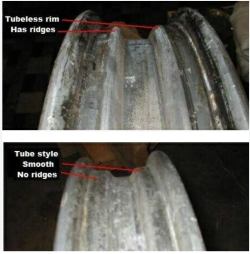
*photo with illustration is from a KLR forum.
 

Attachments

  • Screenshot 2026-09-18 084709.png
    Screenshot 2026-09-18 084709.png
    374.6 KB · Views: 44
If it is the Laverda cast wheels we are talking about , then never ever run them without tubes ( If that is your intention ) ........

Tubeless tyres yes , but always with a tube ........... The risks otherwise are just too great on a rim not designed for it ........ And would you get a tubeless valve core to fit into the Laverda cast rim anyway ? ....... Maybe you could , but I`m not sure I`d want to try ............

As Piet infers , a tyre ( tubeless or not ) WILL stay on the Laverda cast rim when there is no air in the tube , but this is purely by chance ....... Not an ideal state of affairs , but it will almost certainly stay there ........... I`ve ridden nearly thirty miles with a deflated rear tyre which stayed in place on the Laverda rim with no problems at all ..... ( apart from keeping to 40 mph or so , obviously .... ) .........

The tyre was near the end of it`s days so needed replacing soon anyway ........ the tube had a bloody great hole in it from the 1/8 th drill piece it had picked up !! ...........
 
Last edited:
... I am not understanding how a tube with no air in it is more safe than tubeless with no air in it? What exactly is this tube that is has no air doing to keep the tire on the rim?

If you are going to state the tubeless rims are different and are safer as they will keep the tire on the rim, then I guess we should all sell our bikes with tubes as they a dangerous and the tire will come off the rim on the first puncture. Whether you do or don't have a tube makes absolutely no difference. And as I stated previously, I did get a puncture on a rim converted to tubeless, the tire did not come off the rim. I rode for about 1 mile with it completely flat and it stayed on the rim.
My understanding is that usually tubed tyres release the pressure on puncture more slowly and therefore more possibilities to safely slow down.
Tubeless solution is more likely to release the pressure quickly if it gets a puncture, think this happening at full speed without the tubeless type rim.
Some times a tyre may stick well on the rim over time, but I would not bet that being the case in every puncture.
I guess possibly there is also some further optimization on the tyre and rim walls.

-Jouni
 
I run tubeless on everything. Broke a spoke on the rear of the 3C in Darwin on the trip around 0z, never even lost 1 psi.

Fair bit of work involved in converting borranis, 3M sealing tape works a treat.
 
Last edited:
I’ve ridden on the road and track for well over 40 years, with and without tubes, and only ever had issues with tubed tyres deflating on one or other of my OR600s.
I’m far more worried about the antics of other road and track users than with a tyre coming off a rim.
 
My understanding is that usually tubed tyres release the pressure on puncture more slowly and therefore more possibilities to safely slow down.
Tubeless solution is more likely to release the pressure quickly if it gets a puncture, think this happening at full speed without the tubeless type rim.
Some times a tyre may stick well on the rim over time, but I would not bet that being the case in every puncture.
I guess possibly there is also some further optimization on the tyre and rim walls.

-Jouni
I believe the opposite is true. A nail in a tubed tyre will waggle around and tear a larger hole in the tube quickly. In the tubeless situation the nail will sit in the hole and wiggle around but not make the hole in the tyre larger.
 
I had a sudden front deflation at 100 kph. As it was happening, I noticed the steering became odd, moved the bars to see what effect that had and immediately decided I needed to stop the bike. I knew applying the front brake would not end well, so I shut off and eased off the road just as violent weaving started happening. By pure luck, I didn't crash; the tyre was dead flat, but it was still attached to the rim. That's a front with a tube fitted, I never have heard of anyone having a tyre ever detach during a blowout. Tubeless or not. Fixed a few flats off-road over the years, and the biggest issue is actualy braking the bead to get the tube out.Sidestands and MX boots and its not easy to do.
 
Cast Laverda rims have a different shape/contour to almost every other rim ever made.

The actual seat for the tyre bead is too large in diametre, which is what makes tyre removal and fitting a nightmare with these rims. This seat does not have the safety bead incorporated on rims made for tubeless tyres. The tyre is nevertheless held so tightly that it rarely dislocates when flat. But, it isn't actually designed to perform thus.

Proper tubeless rims will allow hassle-free tyre fitting with the beads seating with a nice "plop" as pressure rises. These tyres will not slip off their seat when deflated.

Keith Nairn once went to the trouble of measuring the Laverda rims, found they had enough "meat" in them and modified them to the profile of proper tubeless, worked like a charm! THAT I would trust.

Converting a spoked rim to tubeless may work OK with modern, wider rims. Our narrow Borrani rims need every little tiny bit of space in the rim well to be able to get the tyre over the rim in the first place! Spoked rims used to be slathered in silcone over the spoke nipples to make them air-tight, this takes away vital space for tyre fitting. Tape seems to be used these days, but I reckon our narrow rims are far too dimpled and uneven to have a tape seal reliably.

As Ian has stated, everybody is free to make their own decisions...

piet
Keith did mine for me on my Jota..so far , so good 😊
 
I own 2 1978 triples. I know I'm showing masochistic tendencies, but what Laverda owners of the 21st century aren't: there are easier ways to get your highway thrills.
One bike has thin-web cast wheels with tubes; the other has thick-web wheels tubeless. I have easy access to mountain roads and "on a dark desert highway"; see how I placed 'Eagles' lyrics there, aha! Both bikes have seen their upper limits on those desert highways, and if either one of the bikes "experiences a sudden loss of cabin pressure' at those speeds, I'm very sure an Oxygen mask or a bead lock is not going to be my savior. You take your chances and enjoy the ride.

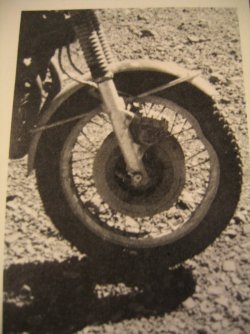
The attached photo, somewhere in Bolivia in 1980: I was very happy that I had tubes in the Borrani rim; it took me many miles. Barum (Czechoslovakia) $12 US front tire; it was 1000% better on the dirt roads than the Metzeler it replaced
 

Attachments

  • IMG_4009.JPG
    IMG_4009.JPG
    163.9 KB · Views: 20
Back
Top