Tucking noise primary drive

David Fetter

New member
Location
Germany
Hello together.

My laverda 1000/1 has developed a Problem.

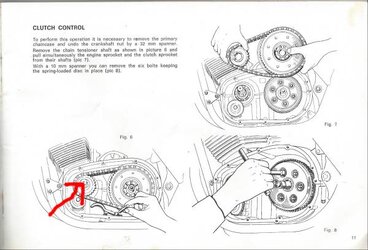
Lastly i atemp to adjust the primary chain tension.
And as i thigten it up, the primary drive begann developing a ticking noise, increassing with higher tension, long before the "whining" kiks in.

Wenn i losen the chain, the ticking noise decreases and finaly disapear.

The ticking seams do be evvery 3 engine revolutions

I had thougts of somewhat in the direktion needle bearings of the Drum or the dampers..


Had anyone a similiar problem before or any sugestions?

Btw, please excuse my poor english.
I only relay on my german school english with poor grades
 
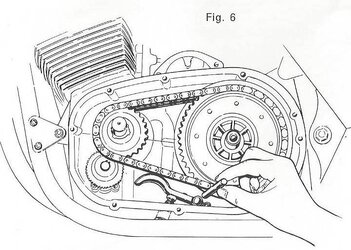
I would get the cover off and take a look inside.
make absolutely sure that the crankshaft sprocket is on tight.
Might as well do the clutch cush drive rubbers while you're in there.

Ich würde den Deckel abnehmen und einen Blick hineinwerfen.

Vergewissern Sie sich, dass das Kurbelwellenritzel fest sitzt.

Wenn Sie schon dabei sind, können Sie auch gleich die Gummis des Kupplungspedals überprüfen.

Primary Chain Adjustment.jpgPrimary Drive 1.jpgTriple Manual page 11 close up.jpg
 
Hello together.

My laverda 1000/1 has developed a Problem.

Lastly i atemp to adjust the primary chain tension.
And as i thigten it up, the primary drive begann developing a ticking noise, increassing with higher tension, long before the "whining" kiks in.

Wenn i losen the chain, the ticking noise decreases and finaly disapear.

The ticking seams do be evvery 3 engine revolutions

I had thougts of somewhat in the direktion needle bearings of the Drum or the dampers..


Had anyone a similiar problem before or any sugestions?

Btw, please excuse my poor english.
I only relay on my german school english with poor grades
Hi David and welcome to the Forum

(And never apologise for your English! It is WAY WAY better than the German of most everyone here ... :) (Hi Lothar, Stefan, Piet and all the members on the other side of the Rhine.)

Yes, a worn needle bearing can make a ticking noise. It's not super serious, but as they are cheap and easy to replace, start there.

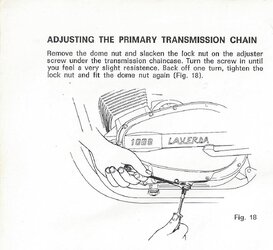
And follow Hamish ("The Sock") advice. And be careful about the "Tighten it until it whines" advice. As Hamish has posted, "a very slight resistance and then back off 1 turn" is all that Moto Laverda said ...
 
..while you are at it, replace the triplex chain with a modern duplex...its from a merc van i seem to recall..someone will be along to confirm suppliers. Yes, clutch rubbers...might not be simple if rivets are to be drilled. Important to do that main drive sprocket up tight. Before my ownership, my Jota had worn through the splines over halfway..now sorted with new end of crank, but not cheap!
 
When I had the issue with worn splines of the end of the crank years ago, I called Bodo Bergmann. He is very good in welding and welded the splines with a special electrode and then he grinded it in shape again. Real repair work and it is fine until today 😄👍
 
My splines were slightly worn and the sprocket could move slightly on the shaft. Locktite 620 Bearing and Sleeve Retainer has held it for decades. But it was only a very slight movement. YMMV
 
First of all, all to you great thanks, what a quick response.

A Lose "jesus nut" can be sortet out, as well as a worn chain, because the chain got renewed by the famous OCT aprocimatly 300 km ago, so, the needle bearing will get my atention, i go to get a look, i think its the outer bearing, in the Cover?
Or could it be also the bearing betwen clutch and gearschaft ?

Aspecialy thanks for the explanation of the right tensioning procedure, so the one in the wide spread manual seems wrong.

By the way, Do anybody know where to get the original Workshop manual?
 
First of all, all to you great thanks, what a quick response.

A Lose "jesus nut" can be sortet out, as well as a worn chain, because the chain got renewed by the famous OCT aprocimatly 300 km ago, so, the needle bearing will get my atention, i go to get a look, i think its the outer bearing, in the Cover?
Or could it be also the bearing betwen clutch and gearschaft ?

Aspecialy thanks for the explanation of the right tensioning procedure, so the one in the wide spread manual seems wrong.

By the way, Do anybody know where to get the original Workshop manual?
3000 not 300.....
 
A specialy thanks for the explanation of the right tensioning procedure, so the one in the wide spread manual seems wrong.
David, just to emphasise the point :). This note was written by Jean-Louis Olive, one of the most knowledgeable Laverda people in the world (I'm sure you read French!):

" Le tendeur n'est en aucun cas un "tendeur"!

Il n'est là que pour limiter le débattement de la flèche, en aucun cas pour mettre de la tension sur la chaîne.

S'il y a de la tension sur la chaîne, le réglage est loupé et çà tire sur les roulements, la chaîne elle-même, les douilles à aiguilles du carter et çà bouffe le caoutchouc du tendeur.

Les machines triple d'usine par exemple n'avaient pas de tendeur, juste deux patins fixes limitant le débattement de la flèche sans jamais toucher la chaîne elle-même au repos.

Lors du réglage, aucune tension ne doit être exercée sur la chaîne.

On visse doucement la vis de réglage et, dès qu'une résistance se fait sentir, on desserre d'environ un tour, jusqu'à ce que le tendeur soit complètement libre".
 
David, just to emphasise the point :). This note was written by Jean-Louis Olive, one of the most knowledgeable Laverda people in the world (I'm sure you read French!):

" Le tendeur n'est en aucun cas un "tendeur"!

Il n'est là que pour limiter le débattement de la flèche, en aucun cas pour mettre de la tension sur la chaîne.

S'il y a de la tension sur la chaîne, le réglage est loupé et çà tire sur les roulements, la chaîne elle-même, les douilles à aiguilles du carter et çà bouffe le caoutchouc du tendeur.

Les machines triple d'usine par exemple n'avaient pas de tendeur, juste deux patins fixes limitant le débattement de la flèche sans jamais toucher la chaîne elle-même au repos.

Lors du réglage, aucune tension ne doit être exercée sur la chaîne.

On visse doucement la vis de réglage et, dès qu'une résistance se fait sentir, on desserre d'environ un tour, jusqu'à ce que le tendeur soit complètement libre".
No, sorry, i cant read french...
Luckyli, Google can....

This are some verry clean words, explains, why a tensioning procedure isnt mentioned in the Workshop manual at al, only in the wide spread repair handbook...
Now i know better, thanks to All of you
 
Back
Top