Turn indicator light on dashboard - RGS1000

lt8x7

New member
I have just bought an RGS1000 (my first Laverda).
The turn indicator light on the dashboard is on (solid) when the key is on (engine on or off). When the indicators are turned on it flashes as expected.
Is this normal?
If not, what would be the cause?
 
Hi,
my RGS is diferent, the light only goes with the indicator. No flashing no light.
Maybe the relay isn‘ t connected in the right way or the cables from the left hand switches- but then the connerctor might be modified
 
Congrats on the purchase and welcome! No that's not normal.

First place I would look is the condition of the 9-way connector going to the LH switch block. It is absolutely common for these to melt, since they run one phase of unregulated alternator power up through a second pole in the light switch. The plug is usually mostly damaged around the two wires in question, however the heat involved can damage other nearby wires or cause high resistance joints. Many disable this loop and run all three phases direct to the regulator (may require upgraded regulator, they switched out one phase to prevent overcharging the battery when little electrical load was present).

Other obvious thing with those symptoms would be a bad earth. Make sure you have a good earth going up into the fairing harness, disassemble, clean and refit any earth points and check they are good. It's a decent harness that works well when all in good condition, but like anything can be improved. Inserting a dedicated earth wire from the main earth point to that point near the coils is not a bad thing at all. Also check the earth into the LH switch block, from memory there is an actual earth wire in the switchgear harness itself, but no corresponding wire in the chassis harness instead relying on grounding the switchblock through the handlebars/steering head bearings. I'm pretty sure I've added a wire back to the earth point near the coils to properly earth that. Apologies if I have misremembered that bit, it's decades since I have done those sort of little things on my bikes.

If you're getting onto Marty as a mechanic in Sydney, he will know all this stuff and be able to rectify/enhance as required.
 
  • Like
Reactions: Jo
Great advice above, like any 40 year old machine the wiring and connections all need some tlc and it’s often a corroded connection that causes problems. And there are a couple of recommended easy alterations to increase reliability. But firstly I’d say your flasher relay is wrong for your lamps and/or system.
Hopefully 😉
 
Great advice above, like any 40 year old machine the wiring and connections all need some tlc and it’s often a corroded connection that causes problems. And there are a couple of recommended easy alterations to increase reliability. But firstly I’d say your flasher relay is wrong for your lamps and/or system.
Hopefully 😉
Sounds like a strange flasher unit issue to me as well. As if it were permenantly in a sort of stand-by mode.

I once had a flasher unit that would pause momentarily before the indicator would light up, apparently the control filament needed some heat before it started working, drove me nuts. Now use Moto Gadget electronic flashers, expensive but brilliant!

piet
 
I like the idea of the Moto Gadget flasher, I've been surprised by how often they fail. If the stock system is a 3-terminal, how do you signal the dash indicator to blink? Don't you need that third leg from the flasher?
 
I like the idea of the Moto Gadget flasher, I've been surprised by how often they fail. If the stock system is a 3-terminal, how do you signal the dash indicator to blink? Don't you need that third leg from the flasher?
If a 3rd. terminal is provided on the flasher, the wiring is set up for this. Earlier Laverda indicator systems didn't have a dash light terminal at the flasher relay. Not sure about the RGS just now, haven't got a manual/wiring diagram to hand.

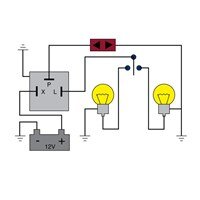
The flasher wiring incorporating an old-school single warning light doesn't make sense to anybody not aquainted with vehicle electrics. But, it is actually quite simple. Sounds and looks wierd, but it works, and has been doing so since indicators were first introduced! Rear flashers are wired as you'd suspect with +12V and ground. Front flasher "grounds" are not grounded, but are each connected to one of the terminals of the warning light.

piet
 
For a common dash warning you do need a third wire (or some extra components). Flasher manufacturers have it as an option and you’ve got to check the description or wiring diagram.
I have LED lamps, so I use a Narva 68251 which plugs straight into the existing RGS wiring (3 wires). Many other units require an earth connection to be added Eg Tridon LED03:
FF788639-D285-403E-8774-4D55876BA74D.jpeg
It8x7: please note that an incorrect/faulty/wrongly wired flasher is only “likely”, it could also be bad connections as above 😁
 
As far as my memory goes, SFC and RGS wiring are similar in this regards. The flasher work the same with 2 or 3 connectors. I had one with 3 when I got the bike, the relais died soon after and I replaced it with a 2 wire one. Still the flasher work the same and the indicator light only goes on when the flashers go on. As far as I remember, the indicator lights in the dashboard are just in-line with the indicators on the fairing. Maybe that's why - someone tried to copy an american lighting system where the indicators stay on while you ride and only turn of and on when you use the indicator switch?!?

The third cable is only needed if you have a single light for both sides of the indicators/turn signals afaik, unless you do not want to solder diodes in...
 
As far as my memory goes, SFC and RGS wiring are similar in this regards
I don't think they are Lothar. The SFC1000 had separate left hand and right hand repeaters on the dash whereas the RGS uses a single repeater in the instrument panel, which is driven off the 3rd indicator relay terminal.
 
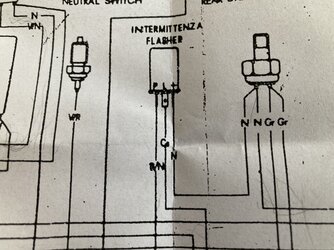
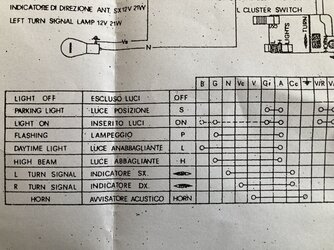
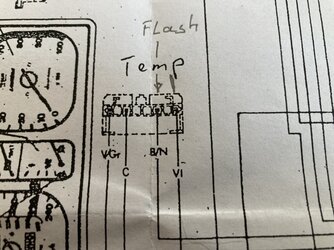
here you go
Flasher has N (Black) from the fuse +
C (Blue) to the right hand switch
B/N White/Black to the control lamp
N (Black) goes to the left flash lights and V (Green) to the right where the bulbs are connected to -
 

Attachments

  • CE1277A9-7D04-47E7-A0FA-1BB379741CD9.jpeg
    CE1277A9-7D04-47E7-A0FA-1BB379741CD9.jpeg
    146.6 KB · Views: 11
  • E137AF69-EF30-4527-8F8F-C4AD15C52C5C.jpeg
    E137AF69-EF30-4527-8F8F-C4AD15C52C5C.jpeg
    181.4 KB · Views: 11
  • DECCE1DE-D405-46DE-A637-04D8F6741CD7.jpeg
    DECCE1DE-D405-46DE-A637-04D8F6741CD7.jpeg
    142.9 KB · Views: 11
here you go
Flasher has N (Black) from the fuse +
C (Blue) to the right hand switch
B/N White/Black to the control lamp
N (Black) goes to the left flash lights and V (Green) to the right where the bulbs are connected to -
left hand switch ! sorry
 
And there we are, looks like for the RGS you need the third leg to trip the dash indicator. NAPA used to sell "electronic" flashers that, once upon a time, were very stout and seemed to work forever. No longer the case, as I've recently discovered ... likely now made in China instead of Bridgeport, Connecticut.
 
Back
Top