Good way to blow a fork seal..
In that case, you must blow fork seals every time you go over a bump.
We’ll I would be interested as to why you think that there is some issue with the way the bike is tied down
Has four points of contact, tick
Unless the tying mechanism is not to your liking I see no issue
I however would have ties down around the axles, less stress on the suspension…
I agree with Alzero that tie downs need to be attached as high as possible to provide maximum stability. It's simple geometry. Tent guy ropes go to the top of the pole, not half way up. Tying to the axles Cosi? I assume you're having a laugh.

I used to do a lot of bike transporting for members of the club I was with (my membership has now lapsed, but I still get called for an occasional bike pick-up).
For what it's worth, here's my method: I'm not saying it's the only way or the best way to do things, but in 50 years of shifting bikes on a purpose-built bike trailer I've never had a tie-down detach, a bike come loose, or even shift so much as a millimeter. Others will have their own preferred methods.
I park the bike with the front wheel against a stop. Could be the front of a box trailer, front of a ute tray, a purpose-built bike trailer or one of those wheel-lock gadgets.
I use proper bike tie-downs with a soft loop that goes over the handlebars, or fork leg above the triple clamp, or maybe a crash bar or some other solid anchor point towards the front. The bottom ends of the tie downs should be as far out from the side of the bike as the transport conveyance will allow. Take them out to the edge of the trailer or ute if possible. 45° is good. You don't want to get much closer than an angle of about 30° from vertical. Pull them down tight enough to compress the front suspension a little way. You don't have to wrench it down so the forks are bottomed out n. Around 30% - 50% fork compression is heaps. You just want to pre-load the straps so they don't flop around if they loosen or stretch a bit during transit. The straps should also be angled to pull the bike forward into the front wheel stop. You want to prevent the bike rolling backwards and forwards. I always tie the front of the wheel to its stop as well.
As for blowing fork seals, it's a myth. I've never had that happen, nor have I heard of it happening to anyone using a similar method. Forks are designed to compress. That's what they do in service. The seals are capable of holding against quite high pressure. They won't pop out because they're held in by circlips. Seals almost never fail from over-pressure. I'm not saying a fork seal won't leak when the suspension is pulled down with tie-down straps, but if it does, you can be 100% sure the seal was buggered beforehand and needed replacing anyway.
I also use another set of tie-downs at the rear end of the bike, the soft loop bike type if possible. They should be attached as high as possible to a strong point such as upper frame tubes, luggage rack or pannier rack, or maybe upper shock mounts. Sometimes space is limited for a webbing strap to loop through a small gap, so a loop of thin strong (kevlar or spectra) rope can be handy. The rear tie downs should also pulled down to compress the rear suspension enough to keep them under tension.
The loose ends of the tie down straps should be taped and/or tied so they don't flap around.
Finally, if the bike is on a flat tray like a box trailer or ute that doesn't have tracks to lock the bike's wheels into, I'll tie the wheels at the bottom to each side of the tray to stop them slipping sideways (I carry a shit-load of tie-downs and lengths of rope). As you could imagine, if the driver of the vehicle hurtles around a corner, the bike's wheels could slide sideways out from under the upper attachment points. It would be like kicking the bottom of a tent pole out. The tent will collapse. Similarly, the bike could collapse against the side of the trailer or ute if the tyres slide sideways. I've seen a bike arrive at its destination in exactly that condition (not one of my transport jobs).
You might consider my methods overkill, but I'd rather use a belt and braces approach and be confident that the bike will never shift, than be sorry if it does.
The photo below is a good example. It shows the front (soft loop) tie downs attached around the forks above the lower triple clamp and the rear tie downs to the upper shock mounts. The front wheel is tied to the bar across the front of the trailer to prevent any fore-aft movement. It differs from the description above only in that the rear tie downs aren't soft loop bike type because the plastic-coated hook type just happened to fit nicely on the upper shock mounts.
The trailer has had some alterations since then too. I put a mesh floor in it, welded on some more tie-down points, and gave it a new set of tyres.
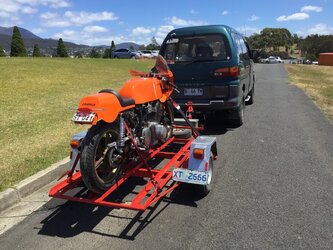


 all repaired now


