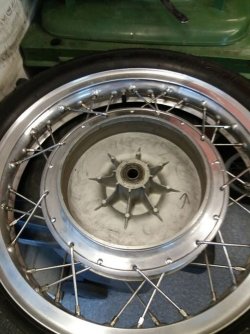
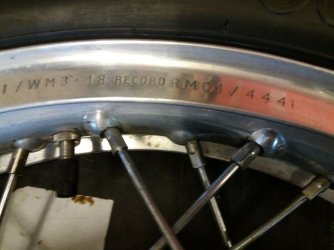
unknown wheel

Gerald

Hero member
This wheel came with a '72 750SF. Fits and works with the original brake and speedo plates.
Speedo side has four tapped bosses. Can someone identify the hub, or wheel?

Gerald
 

Attachments

  • 20200627_140855_resized_1.jpg
    20200627_140855_resized_1.jpg
    151.1 KB · Views: 210
  • 20200627_140836_resized_1.jpg
    20200627_140836_resized_1.jpg
    172.7 KB · Views: 212
  • 20200627_140907_resized_1.jpg
    20200627_140907_resized_1.jpg
    71.7 KB · Views: 207
Standard front Laverda wheel, someone has removed the tin plate that is normally attached to those bosses.  The plate guides cooling air around the entire hub before being expelled at the outer circumferance.

piet
 
Then again this wheel has a tin plate , and it appears to be pressed in?
No visible screws...

Gerald
 

Attachments

  • 20200629_115119_resized.jpg
    20200629_115119_resized.jpg
    142.6 KB · Views: 178
Sorry, the rear wheel cush drive ring is bolted to the bosses.

I've never removed the plate, dunno how it is fixed.

piet
 
So is a front drum hub basically the same as a drum rear hub ... just bolt on the cush drive? IIRC the spoke pattern is different - not sure why that would be, as both have to endure torsional forces.
 
Spoke pattern and rims as they have to be drilled differently.
I think the driven wheel takes more abuse than the front.
 
Piranha Brother 2 said:
So is a front drum hub basically the same as a drum rear hub ... just bolt on the cush drive? IIRC the spoke pattern is different - not sure why that would be, as both have to endure torsional forces.

Basically, the hubs are identical.  Dedicated rears usually do not have the speedo drive boss machined.

Quentin, through your bicycle experience, you will recognise that load bearing capabilities increase as the spokes are angled more tangentially to the hub.  The rear spoke pattern is a bugger and can only be accomodated half-decently on original Borrani rims as the dimples are deeper than on most other rims.  I think Laverda was the only manufacturer that used this pattern on such large hubs.

I've used a drum rear spoked in the more conventional manner on my triple without issues, always had a lot more problems with the front spokes.

piet
 
sfcpiet said:
... load bearing capabilities increase as the spokes are angled more tangentially to the hub. 

I presume you're talking about torque loads that are generated by accelerating and braking. Radial (and lateral) load capability increases as spokes are angled more radially. Assuming the hub flange is strong enough for any spoke orientation, the spoke angle is a compromise between radial, lateral and torque loads.

 
I don't agree with you Grant, bikes all brake to reduce speed far quicker than they accelerate. The difference is that they are accelerating or putting out power most of the time and braking for short periods. Last time I laced my rear wheel I had my inner spokes all set for pulling the rim (instead of pushing it if you get my meaning) and the outers going the other way for side loads, so far no broken spokes. I figure that spokes are most effective in extension and the hardest working spokes in the most direct line. The opposite would be the case for the front wheel, braking forces most direct.
 
Back
Top