
You are using an out of date browser. It may not display this or other websites correctly.
You should upgrade or use an alternative browser.
You should upgrade or use an alternative browser.
valve clearance rgs 1000
- Thread starter coolRGS
- Start date


Dellortoman
Hero member
- Location
- Tasmania, Australia
I've not done this myself, but I don't see any reason why you couldn't do it. Perhaps someone more knowledgeable will a different opinion.
You'll need to tighten the camshaft bearing bolts to the specified torque. The 6 outer bearing bolts are the short M8 studs fixed into the cylinder head, but the 6 inner bolts are longer M9 head/cylinder studs that go through the head and cylinder block to the crankcase. To check valve clearances with the head off you'll need to use M9 bolts through the cylinder head to take the place of those long studs. Be careful not to damage the underside of the aluminium cylinder head when you torque them up, otherwise the cylinder head gasket might not seal properly. Use wide, thick washers to spread the load out over a large area, maybe with some soft (like annealed copper) padding between the washers and cylinder head. I'd suggest not bolting the head to a steel plate or other surface unless you're sure it's perfectly flat.
To save the hassle of sourcing M9 bolts and suitable wide washers, there's a simpler way to do it. Leave the valve clearance job until the cylinder head is bolted down onto the engine.
You'll need to tighten the camshaft bearing bolts to the specified torque. The 6 outer bearing bolts are the short M8 studs fixed into the cylinder head, but the 6 inner bolts are longer M9 head/cylinder studs that go through the head and cylinder block to the crankcase. To check valve clearances with the head off you'll need to use M9 bolts through the cylinder head to take the place of those long studs. Be careful not to damage the underside of the aluminium cylinder head when you torque them up, otherwise the cylinder head gasket might not seal properly. Use wide, thick washers to spread the load out over a large area, maybe with some soft (like annealed copper) padding between the washers and cylinder head. I'd suggest not bolting the head to a steel plate or other surface unless you're sure it's perfectly flat.
To save the hassle of sourcing M9 bolts and suitable wide washers, there's a simpler way to do it. Leave the valve clearance job until the cylinder head is bolted down onto the engine.

motoddrob
Hero member
- Location
- S/W Australia
I'd do it in situ

Andy
Hero member
- Location
- Auckland, roughly
Yes, I understand you should really have timing camchain fitted and tensioned.
Last edited:

mauricejota7604
Hero member
- Location
- Victoria Australia
Easy to do on the bench just make a mount plate with 6 bolts to clamp down the inside of the cam blocks,
Clamp down your cam blocks do one cam at a time to avoid tangling your cams
Much easier to do it on the bench first.
Clamp down your cam blocks do one cam at a time to avoid tangling your cams
Much easier to do it on the bench first.

Easy peasy doing it on the bench, matter of couurse when rebuilding heads.
Stud torque isn't vital, ensuring the cam bearings seat properly (they often don't) is! Extra torque on the fixing bolts/studs won't cure this. Once a cam bearing is seated, more torque will not move it any further. A set of M8 through-bolts are fine as stand-ins for the M9 studs.
(Missing) chain tension needs to be considered, depending on age/mileage of the cam bearings, there's a lot of slop in there.
Good to opt on the high side of clearance tolerance, if any unforeseen gaps disappear when torqued down on the barrel and the chain is properly tensioned, clearances will most likely remain in the ball park.
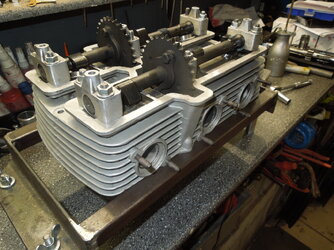
It's nice to have a jig, firmly bolted to the work top. This one allows me to fit and tension a chain over the cam sprockets (rollers on the underside hidden from view).
piet
Stud torque isn't vital, ensuring the cam bearings seat properly (they often don't) is! Extra torque on the fixing bolts/studs won't cure this. Once a cam bearing is seated, more torque will not move it any further. A set of M8 through-bolts are fine as stand-ins for the M9 studs.
(Missing) chain tension needs to be considered, depending on age/mileage of the cam bearings, there's a lot of slop in there.
Good to opt on the high side of clearance tolerance, if any unforeseen gaps disappear when torqued down on the barrel and the chain is properly tensioned, clearances will most likely remain in the ball park.
It's nice to have a jig, firmly bolted to the work top. This one allows me to fit and tension a chain over the cam sprockets (rollers on the underside hidden from view).
piet

The Sock
Hero member
- Location
- London, England
I'd still suggest that you re-check clearances once it's back in place and turned over a few times.I will do it on the bench,I don't like to hassle with the cam chain on off on
risk the clip falling in! I agree with the head bolted down properly on a extremely flat surface
it will make it a lot easier. it should also prove the camshaft cam holder fitment
motoddrob
Hero member
- Location
- S/W Australia
That's a great setup Piet, if I was doing it every day I'd certainly do it that way, but as I've only have the triple head off the triple 3 times after 180000 kays I don't think I'd bother going to the trouble of making a bench mount set-up. Be really important to have it dead flat as well.
Also lucky the Motodd give unrestricted access to the top of the head. Just need to make sure I stuff rags in all the voids.
Also lucky the Motodd give unrestricted access to the top of the head. Just need to make sure I stuff rags in all the voids.

chrisk
Hero member
- Location
- Brisbane, Australia
That’s pretty cool Piet. I presume that’s how they did it in the factory too.
Has to save a lot of fucking around on the bike.
Has to save a lot of fucking around on the bike.

piranha-bro2
Hero member
- Location
- Melbourne
Out of interest, any chance of a pic of the underside cam chain setup?
chrisk
Hero member
- Location
- Brisbane, Australia
Turn ya phone overOut of interest, any chance of a pic of the underside cam chain setup?
Here ya go, Quentin.Out of interest, any chance of a pic of the underside cam chain setup?
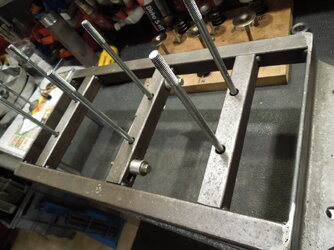
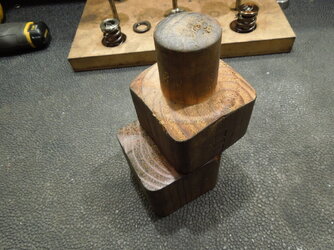
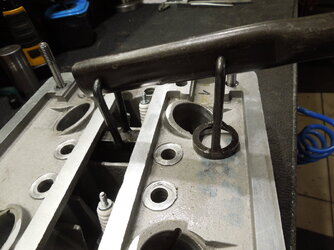
Just a couple of rollers that a short bit of chain can run on. I use that mainly to be able to check valve/valve clearance during overlap. The jig stands on pillars so valves can be removed and inserted. The 2-part wooden block is used to hold the valves in place while springs are removed or installed. Factory spring compressor, obviously not in use, just placed on the head to illustrate the working principle.
The whole thing doesn't necessarily need to be particularly rigid, nor dead flat. The head and cam bearings only need to be tight enough to ensure the bearings are fully seated.
piet

GregT
Hero member
- Location
- Christchurch NZ
Tidy setup. But only made necessary by the factory using the headstuds to hold down one side of the cam bearings. Love the spring compressor.
I routinely do Jap valve clearances on the bench when it's a new build. Because it's easy.
I routinely do Jap valve clearances on the bench when it's a new build. Because it's easy.
piranha-bro2
Hero member
- Location
- Melbourne
Thanks for posting Piet. Very clever - like that Oz ad from the 60s (Electricity!) 'Makes life easier'! Might have been Hecla or summit like that.
Not really.Tidy setup. But only made necessary by the factory using the headstuds to hold down one side of the cam bearings. Love the spring compressor.
I routinely do Jap valve clearances on the bench when it's a new build. Because it's easy.
When cutting seats, I just fit the cam with one stud per bearing and measure between valve stem and base circle to determine seat depth/height. This can all be done without any aids, just need to know the correct dimensions. Upon checking when assembled, my shim calculations are usually within 0.1mm of what I actually end up with (I use a manual Mira cutting tool).
The jig is handy for quick and tidy valve spring removal/installation and for checking valve to valve clearances. With the head solidly held down, the spring compressor works extremely well and collets no longer go flying through the workshop... never to be seen again.
piet