Valve guide oil seals,,, Your help is required.

Hello Gentlefolk.

    Many years have passed since I committed to the FULL and thorough engine rebuild on my 1977 Slater Mirage. I am pulling this motor apart again because it has started to smoke slightly. Rings are new and gapped . cylinder head is RGS with new valves the original has a sizable crack across two valves ......

  Here is my question..... The original head has NO inlet valve stem oil seals ..... But,,, when I built the motor using the later head I didn't think and never noticed any valve stem seals.... Does an RGS head have oil seals ?

    I thought I had everything covered but I am made of the same material as you lot !

                            Nice to know yall

                                      Tim
 
I'm pretty sure the inlet Laverda valve guides should have valve stem seals, starting in about 1974. The earlier engines did not use them on the exhaust..that should include your 1977, not sure about the RGS head.

You can fit some valve stem seals for a BMW on the Laverda inlet guides..Elring part #825.042..they are a little taller (10mm overall length) than the Laverda seals (9.6mm overall length)..check and be sure they don't bump the valve spring retainer at full lift on the cam, they shouldn't being only .4mm longer, but you never know.

 
I am totally WRONG .... The mk1 head is fitted with seals on the inlet valves.  Just goes to prove what a dick I can be !!( I have this c/head sat right in front of me as I type this drivel)

    Any photos of gas flowing one these earlier heads would be most useful,
 
I would replace the exhaust guides with either inlet guides or guides from Keith that are made to accept oil seals.Sure I had a picture of a Mirage valve guide somewhere, nope its disappeared.

                                                                                                              Dave 
 
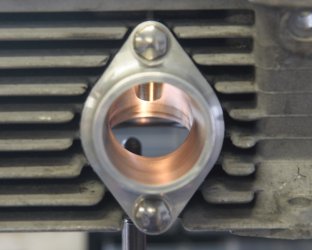
Here you go Tim, 36 tapering down to 32 behind the inlet guide. I bore the ports in the milling machine ensuring they are all the same volume.
Should keep you busy for a while.

  Keith
 

Attachments

  • Flowed and polished inlet port.JPG
    Flowed and polished inlet port.JPG
    187.2 KB · Views: 100
When you're done porting your head, dont forget to sort out the carburation and the inlet stubs to suit.
DSCF0954_zps9e847e66.jpg

 
My 1974 SFC smokes when the throttle is closed on decel, generally a classic sign of an exhaust valve guide leaking (no smoke at any other times, and compression is quite good and even). I was going to look at the exhaust seals at some point, but if Rusty is right, there may not be any, at which point I would think all early 70s Laverda's would have similar issues?
 
They do, not helped by the daft countersunk oil well in the top of the guide and rather generous clearances. When overhauling a head I always fit stem seals to the exhaust valve guides.


   Keith
 
Spub,

Smoke on the overrun is quite common, even though the exhaust guides are NOT worn!

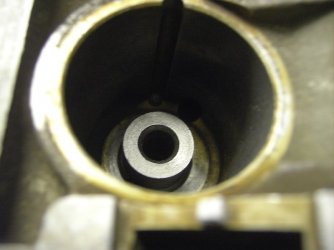
The culprit is the excessive countersunk taper at the top of the guide to supply the valve with oil.  I reduce this taper by about 80% and the smoking all but disappears.  The pic shows the re-worked guide (can be done in situ), the stock taper has an OD of about 9-10mm.  It is now under 8mm.

I have fitted seals to exhaust guides with mixed results.  Most engines show no issues at all, one engine in particular has seized 2 different valves on 2 different occasions.  I have since removed the seals and everthing is tops!  Won't be repeating that in the near future, at least not till I find the real cause for the siezures.

piet
 

Attachments

  • Neu_reduced oil taper ex.guides.jpg
    Neu_reduced oil taper ex.guides.jpg
    56.8 KB · Views: 38
same as Kieth
I fit valve guide seals to inlet and exhaust when I change valve guides, not had an issue yet and have dozens of engines running around set up like that
use custom made Bronze alloy Valve guides and stainless coated valves
works well, so far, no more smoking

I wouldn't fit valve guide seals to a cast iron guide though


sfcpiet said:
Spub,

Smoke on the overrun is quite common, even though the exhaust guides are NOT worn!

The culprit is the excessive countersunk taper at the top of the guide to supply the valve with oil.  I reduce this taper by about 80% and the smoking all but disappears.  The pic shows the re-worked guide (can be done in situ), the stock taper has an OD of about 9-10mm.  It is now under 8mm.

I have fitted seals to exhaust guides with mixed results.  Most engines show no issues at all, one engine in particular has seized 2 different valves on 2 different occasions.  I have since removed the seals and everthing is tops!  Won't be repeating that in the near future, at least not till I find the real cause for the siezures.

piet

piet..I think the exhaust guides are steel? Could be wrong. They don't seem to wear out.  The taper in the stock exhaust guides is very generous..how did you reduce it "in situ"? I think that should be done.
 
Rusty Spokes said:
piet..I think the exhaust guides are steel? Could be wrong. They don't seem to wear out.  The taper in the stock exhaust guides is very generous..how did you reduce it "in situ"? I think that should be done.

both inlet and exhaust standard guides are fine grained cast iron
I used to make my own from chill filtered spun cast iron but changed to a specific bronze alloy

 
Red beat me to it...cast iron.  Yes they do wear, eventually.  Had a head here last year with almost 1.5(!!) mm valve stem/guide clearance.  Guy said he regularly took it to 9 grand, just needed a little oil. ::)  I was amazed it ran at all!

Can be machined on a Serdi or any other similar head servicing machine.  Just need a tool head that fits inside the follower bore.

piet
 
sfcpiet said:
Had a head here last year with almost 1.5(!!) mm valve stem/guide clearance.  Guy said he regularly took it to 9 grand, just needed a little oil. ::)  I was amazed it ran at all!

Years ago I had an old triumph Bonneville that had valves rattling around in their guides like that. There was nearly half a millimeter clearance between pistons and bores too. The bike was running OK when I took the head off, but was quite rattly and was blowing a puff of smoke when the throttle was cracked on. I was expecting a bit of wear, but was astonished to se so much. I gave it a rebore, new pistons, rings, valves, guides, seats. When assembling the reconditioned engine I was anticipating a much quieter running engine and a significant improvement in performance. But once on the road agan, it had no more grunt, and was just as smokey, rattly and oil-leaky as it had been before! It was about that time that I gave up on pommy bikes and bought a Kawasaki Z1.

Cheers,
Cam
 
Back
Top