Valve spring compressor

Dellortoman

Hero member
G'day folks. Does anyone have a valve spring retainer off a triple engine in front of them? I need to know the diameter.
I'm making up a valve spring compressor for a mate so he can replace his valve stem seals without taking the head off the engine. If I know the diameter I can get started on making the bit that presses down on the valve spring. I don't really want to pull my own bike apart just to measure the spring retainer.
I tried the search function but couldn't find any help there.
 
Thanks Red. Yep, it's Russell's bike. I presume you're supplying the seals. No such thing as privacy in the Laverda community! :)

Yes, Vince. It'll be the rope trick. I've used it several times before (but not on a Laverda) and it works really well. I think it's a bit simpler and more idiot-proof than using compressed air. The only thing to be mindful of is that there's a (small) chance that the rope could loop itself inside the cylinder in such a way that it gets a knot in it as you pull it out. The rope needs to be thin enough that a knot will fit through the spark plug hole. Para cord is ideal. It would be a real pisser if you can't get it out. Unless you have the equipment and ability to do keyhole surgery, it would be a head-off job to get the knot out of the cylinder.

I'm not working on the bike BTW. Russ is perfectly capable of doing it himself. I'm just inventing a gizmo to hold the valve springs down while he fishes the collets out with a magnet. I'm imagining something like a lever that hooks under the other camshaft and presses down on the valve spring. I have to confess that I'm motivated by a measure of self interest. I might need it myself some day, assuming I live long enough.
 
Here's the factory tool, Cam.

Very easy and efficient in use, at least when the head's on the bench. ;) Hooks into the gap between the cam boxes. This is actually the tool for the 500, the hole has been added to enable me to use it on some other engine. The tool for the triple is just the same except for a larger ring that presses down on the spring retainer.

piet

DSCN0579.JPGDSCN0580.JPG
 
Great. Thanks Piet.
That's very much what I had in mind, but I was thinking of using a dummy shaft in the opposite cam bearings as a fulcrum. I even found a piece of steel water pipe amongst my scrap steel pile that I could skim down to the right diameter to fit the cam bearings. I hadn't thought of hooking the tool between the cam boxes, which seems to be a better idea. Still need to work out how to make it fit while the engine is in the bike. I expect the frame might get in the way when doing the centre cylinder, so may need to tweak the shape of the handle or something.
 
Good luck with your methods Cam.
I prefer this method to change valve stem seals and more.

I changed a broken valve spring at Cadwell Park in 2009 using a USB type cable and a notched piece of conduit. I still use this soft type of cable because I find it much easier to feed in and examine afterward.

On some bikes, I just lever off parts of the frame, the longer the fulcrum, the more stable the leverage becomes which helps when you need a free hand.

The dry collets often drop into place on their own with reassembly if balanced right. I'm sure you know all this anyway.
Rob

Edit, my memory deceives me, actually fixed the bike at home .

I found the pictures and with single spring setup looks like I was using palm pressure only.
 

Attachments

  • Screenshot_20251103_234453_Chrome.jpg
    Screenshot_20251103_234453_Chrome.jpg
    76.5 KB · Views: 78
  • Screenshot_20251103_234416_Chrome.jpg
    Screenshot_20251103_234416_Chrome.jpg
    120.9 KB · Views: 78
Last edited:
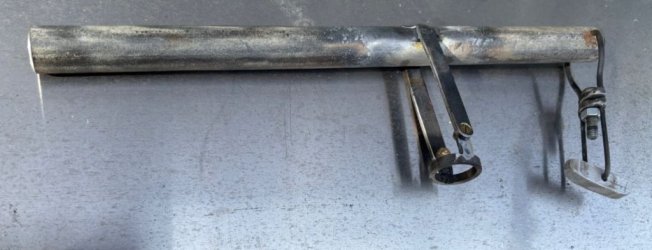
I made a valve spring compressor tool. It's loosely based on the one Piet posted pictures of, in that hooks under the joint flange between the front and rear sections of the cam box. But Piet's tool looks like it can only work when it is positioned at 90° to the camshafts, with the handle facing directly forwards or backwards, so it would only work on an engine that's out of the bike. Otherwise the frame would interfere with its use on the middle cylinder.

I need a tool that'll work with the engine still in the bike. To that end, I've made it so it can be angled at about 45° so it can reach the middle cylinder, and leave the handle in an accessible position where a grubby mechanic's hand can push down on it. That necessitated a couple of modifications.

The tommy bar that hooks under the flanges in the head has a swivel. Actually it has two swivels. One "seesaw" to even the load between the two valve box flanges. Piet's tool can potentially put all the load on one flange, which is probably perfectly OK, but I preferred to err on the side of safety and make life a bit easier for the bike's cylinder head. If there was a weakness in the flange, it would be embarrassing to snap a bit of it off.

The other swivel (via the nut and bolt) has a vertical axis allowing the tool to be angled across the bike either left or right. It also allows some vertical adjustment if necessary to get the angle of dangle of the business end correct.

I also made the ring that actually pushes down on the valve spring retainer hinged at the bottom rather than up at the handle. It just seemed to make more sense to me.

The toggle and the spring compressor legs appear to be a bit further apart than on Piet's tool. But that's to be expected because they have to span across the engine at an angle.

I haven't tried it yet, but expect to give it a trial run on Russell's bike this weekend.

It looks a bit rough made out of galvanised water pipe and bits of scrap steel. I almost grabbed a can of spray paint to tart it up, then I figured it was a waste of time and paint. Who cares what it looks like? Besides, it might need modifying.

The main reservation I have is that the little brass screws in the hinge for ring that pushes on the valve spring retainer may not be strong enough. They're only M3 so they could shear off if the valve spring pressure is too high. But I didn't have anything better on hand. I made them countersunk to keep the thing narrow so the legs will fit down inside the valve bucket tube. If I'm anywhere near the nut and bolt shop before the weekend I'll grab some steel ones, and maybe go up a size to M4.

valve spring compressor 1.JPGvalve spring compressor 2.JPG
 
It'll be perfectly adequate Cam. Maybe a bit over-engineered... I do admire your swivelling joint!(y)

The loads on the head casting aren't high enough to cause anything to break off. If something does break off, it was bound to fall off anyway in the very near future!

I've been able to use the factory tool on installed engines, but it can be a bit cramped. A shorter (telescopic?) handle could be handy. It can also be used at an angle, the joints are all very loose and allow lots of sideways "adjustment".

piet
 
Not sure as I have never used such a tool, but for those who do not have Cam's or Piet's skills, it might be possible to adopt/alter an existing tool from the net to suite. The folowing is just an example, I do not have any experience whatsover with this particular tool nor in general with removing valve springs or valves, I just think it could be an easier approach for man to just buy a tool and adopt it:


this is not to de-value Cam's approach, please, I just know that I would not have the skills to make me such a tool, therefore I would simply buy one and get it working for my application.
 
The home-made valve spring compressor worked a treat. Seen in use here on the right cylinder using the rope trick to hold the valve against its seat. You can see the thin rope hanging out of the spark plug hole. Valve collets came out easily with a magnet, springs removed, stem seals replaced and everything reassembled. The collets were put back with fine needle nose pliers. It was an easy 2-person job. One person to compress the valve spring while the other guy removed the collets. Although it could be done single handed if necessary.

The trickiest bit was removing the old seals. They'd gone very hard and were reluctant to let go of the valve guides. In the end they came out either with a modified pair of forceps, or by slipping a wire noose over them and yanking on it. A bit like using a piece of string to pull a tooth.

If I were to make the tool again, I'd make the ring that presses down on the valve spring slightly larger in diameter, with a lip around the outside edge that fits over the spring retainer to keep it centred. It did tend to slip sideways a couple of times. Not that it was a big deal, but if it located over the spring retainer rather than just sitting on top, it would be a little easier to use.

All the paper towel was to plug up potential holes that a valve collet could inadvertently fall down.

Hopefully this will put an end to the smoking habit of Russel's 3CL. We had a look inside the cylinders with a borescope, and the left cylinder head, valves and piston crown were quite black and oily compared to the other two cylinders. So we concluded that cylinder was the source of the exhaust smoke. But all of the stem seals had gone as hard as rock and were well past their use-by date. Makes me wonder if I should do mine too, although I haven't noticed any plumes of smoke following behind me.

valve spring compressor 3.JPG
 
Top job, Cam. Love the clever thinking behind it. Bloody good effort for a first up prototype. I’ll have to look at something for the SF with motor in situ! Could be a tad too tricky manouvering the collets.
 
Interestingly, the valve spring retainers were 30.5mm diameter. I'm not sure where Red's figure of 25mm came from. Maybe the valve spring arrangement changed at some stage in the triple's history. I think Russell's 3CL is 1976 and it has single valve springs. For some reason I was expecting double springs, but I don't know why I had that idea in my head. I didn't actually measure the spring OD but looking at the photo they appear marginally wider than the retainer, so I'd guess about 31mm.

The actual diameter of the spring retainer didn't matter in the end as far as making the spring compressor was concerned. I made the ring that presses down on the spring retainer 20mm ID x 30mm OD x 5mm thick. I wanted the hole in the middle large enough to manipulate the collets through, and the ring thick enough so it wouldn't be too fiddly to weld.
 
Interestingly, the valve spring retainers were 30.5mm diameter. I'm not sure where Red's figure of 25mm came from. Maybe the valve spring arrangement changed at some stage in the triple's history. I think Russell's 3CL is 1976 and it has single valve springs. For some reason I was expecting double springs, but I don't know why I had that idea in my head. I didn't actually measure the spring OD but looking at the photo they appear marginally wider than the retainer, so I'd guess about 31mm.

The actual diameter of the spring retainer didn't matter in the end as far as making the spring compressor was concerned. I made the ring that presses down on the spring retainer 20mm ID x 30mm OD x 5mm thick. I wanted the hole in the middle large enough to manipulate the collets through, and the ring thick enough so it wouldn't be too fiddly to weld.
Possibly had the 500 in mind...

Single and double springs use different retainers but OD remains the same. The OD of the double springs is only marginally larger than that of the single springs but necessitated followers with a slightly larger ID to avoid binding.

piet
 
Yes, the idea is to position the piston around BDC, feed a length of small soft rope down the plug hole, then turn the crank to push the bundle of rope hard up against the cylinder head to stop the valve dropping down. I suppose there’s a jeopardy of sorts if the rope coils in such a way as to tie itself in a knot that could pull tight and jam against the inside of the plug hole as you withdraw it. But I reckon the chance of that happening is remote. It’s easily countered anyway by choosing a rope less than half the diameter of the plug hole, so if a knot forms it’ll still pull out through the hole. Something like 5mm para cord is ideal. You’ll need a couple of metres of it.
 
Back
Top